
Should You Start With Spot Trading Before Crypto Futures?
New crypto day traders should start with spot trading before futures. Spot markets let you buy and sell actual crypto at the current price without leverage, liquidation, margin calls, or funding-rate costs eating into your position. Futures can be useful later, but they layer in extra complexity: collateral requirements, a liquidation price that can force-close your trade before the market even reverses, and periodic funding payments that charge you for holding a position too long.
I’m not saying spot trading is risk-free. Crypto is volatile, and prices can fall sharply. But spot is usually the cleaner learning environment for building execution discipline, risk control, and real market structure awareness before you touch leverage. Coinbase defines spot trading as buying and selling crypto at current market prices while taking ownership of the asset. The CFTC warns that leveraged futures accounts amplify risk because traders post only a fraction of the contract’s full value as margin — meaning a small adverse move creates a much larger loss than the price itself suggests.
That is the gap this article explains.
Key Takeaways
- Spot trading means you own the crypto you buy. Futures trading means you hold a contract tied to that asset’s price — not the asset itself.
- Spot trading removes the most dangerous variables for beginners: no forced liquidation, no funding-rate costs, no margin calls.
- Futures amplify losses through leverage. A 5% adverse move on 5x leverage costs 25% of your capital.
- Building consistent habits on spot first gives you measurable discipline before you add leverage risk.
- No trading method — spot, futures, bots, or copy trading — eliminates the risk of losing capital.
Spot Trading vs Crypto Futures: What You Legally Own
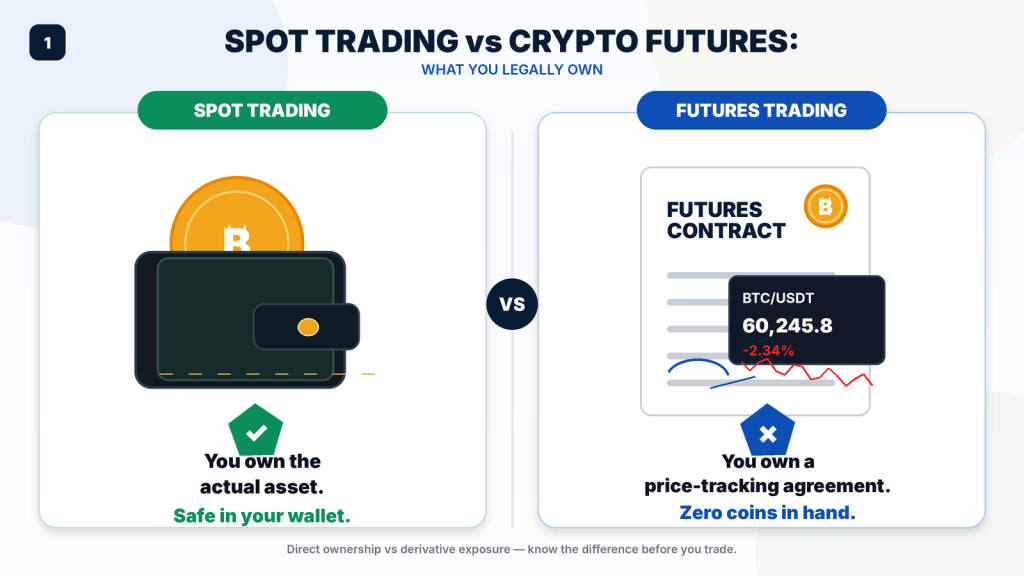
These two markets are not the same thing at different speeds. They are structurally different, and that structural difference changes your entire risk exposure.
How spot trading works
When you place a spot trade on BTC/USDT, you’re buying Bitcoin at the current market price. As Gemini’s Cryptopedia notes, once a spot trade executes, ownership of the asset transfers instantly — no contracts, no borrowing, no future obligation. If the price drops 20% while you hold it, you lose 20% of the value you put in. No more, no less — no borrowed capital involved, no background engine checking whether your margin is still sufficient.
| Step | What Happens |
|---|---|
| 1 | You deposit USDT into your spot wallet |
| 2 | You select BTC/USDT and choose your order type: market, limit, or stop |
| 3 | The exchange matches your order at the best available price |
| 4 | You receive BTC in your spot balance |
| 5 | You can hold, sell, or transfer your BTC at any point |
That process is direct. No leverage multiplier calculating your loss in the background, no liquidation engine on standby, no funding payment due at the end of the session.
How perpetual futures trading works
Crypto futures are a different mechanism entirely. You never own the underlying asset. Instead, you open a contract that tracks Bitcoin’s price. The most common type is the perpetual futures contract — it has no expiry date, which means you can hold it indefinitely, but it carries a funding rate that is paid or received at regular intervals based on the balance between long and short positions. Britannica Money describes perpetual futures as derivatives that track the price of an underlying asset, allow high leverage, and carry no expiration date. That combination — constant leverage exposure with no forced closing date — is precisely what makes them flexible for advanced traders and destructive for undisciplined ones.
Same BTC move. Two completely different outcomes.
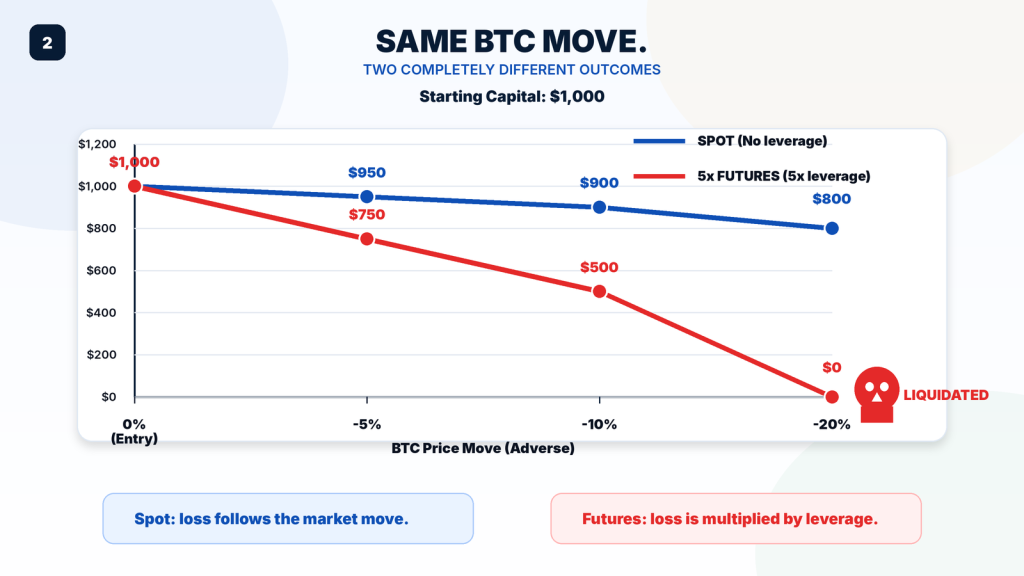
Here is what a 5% adverse price move looks like in a spot account versus a 5x leveraged futures position, starting with $1,000.
| Scenario | Starting Capital | Position Size | BTC Move | Loss | Account After |
|---|---|---|---|---|---|
| Spot (no leverage) | $1,000 | $1,000 in BTC | -5% | -$50 | $950 |
| 5x Futures | $1,000 | $5,000 contract | -5% | -$250 | $750 |
| 5x Futures | $1,000 | $5,000 contract | -10% | -$500 | $500 |
| 5x Futures | $1,000 | $5,000 contract | -20% | -$1,000 | $0 — liquidated |
A 20% drop on spot is painful but survivable. The same move on a 5x leveraged futures position wipes the account before the price has any chance to recover. In a market where BTC regularly moves 5–15% inside a single session, that is not a rare outcome. It is a predictable one for traders who enter without understanding what leverage is actually doing to their exposure.
The Risk Gap — The Benefit of Futures Trading
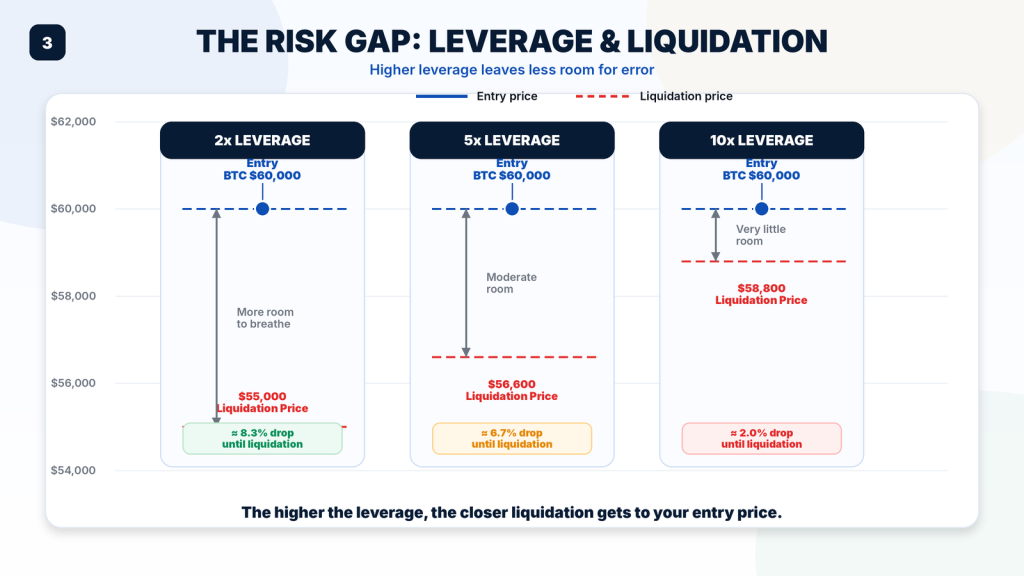
To trade futures with any consistency, you need to understand four concepts that most beginners either skip entirely or learn from a misleading screenshot. Skipping them is not a neutral mistake — it is a costly one.
Leverage
lets you control a larger position with less capital. With 5x leverage, your $1,000 controls a $5,000 contract. Both profits and losses are calculated on the $5,000, not the $1,000 you deposited. The CFTC warns that leverage amplifies risk precisely because only a fraction of the full contract value is posted as margin — the full economic exposure falls on you without requiring you to fund it upfront.
Margin
is the collateral required to open and maintain a leveraged position. There are two thresholds: initial margin, which is what you need to open the trade, and maintenance margin, which is the minimum balance the exchange requires to keep it open. If your account equity falls below the maintenance margin threshold, the exchange does not send a warning first. It moves directly to liquidation.
Liquidation price
is the specific price level at which the exchange force-closes your position to prevent losses exceeding what your margin covers. The more leverage you use, the closer your liquidation price sits to your entry. Many beginners discover their liquidation price after they hit it, not before entering the trade.
Funding rate
Is a periodic payment exchanged between long and short traders in perpetual futures markets. Binance Academy explains that when long positions outnumber short positions, longs pay shorts to compensate for the imbalance. When shorts dominate, the payment reverses. For a day trader holding a position for an hour, this rarely matters. For someone holding a leveraged position across multiple funding intervals — every 8 hours on most exchanges — the cost quietly accumulates.
Here is how spot and futures compare across the factors that actually affect your daily trading decisions.
| Category | Spot Trading | Futures Trading |
|---|---|---|
| Asset ownership | You own the crypto | You hold a price contract |
| Default leverage | None | Commonly available |
| Forced liquidation | Not applicable to basic spot | Triggered when the margin falls below the threshold |
| Funding rate | Not applicable | Charged periodically on perpetuals |
| Loss speed | Tied to actual price movement | Amplified by the leverage ratio |
| What it teaches | Execution, structure, and discipline | Margin, liquidation management, leverage control |
| Biggest danger | Holding a losing position too long | Forced liquidation before price recovers |
| Better for | Beginners building a foundation | Experienced traders with established risk systems |
This is not an argument that futures are unusable. It is an argument that futures require something most beginners have not yet built: consistent discipline under pressure. A trader who cannot close bad trades on spot will not find leverage to be the solution. They will find it to be the same problem at ten times the speed.
Think of it as a risk ladder that you climb in sequence, not skip:
- Level 1 — Spot trading: Learn how prices move and how to execute orders cleanly.
- Level 2 — Spot with strict stop-loss rules: Learn consistent risk per trade.
- Level 3 — Spot during high-volatility sessions: Learn how to manage your emotions when the price moves fast.
- Level 4 — Low-leverage futures: Test margin, liquidation mechanics, and funding-rate impact with controlled exposure.
- Level 5 — Higher-leverage futures: Advanced risk management. Not a starting point.
Each level requires what the one below it teaches. Climbing from Level 1 to Level 5 without doing the work in between is how most beginners destroy their first account.
A Practical Framework for Spot Day Trading
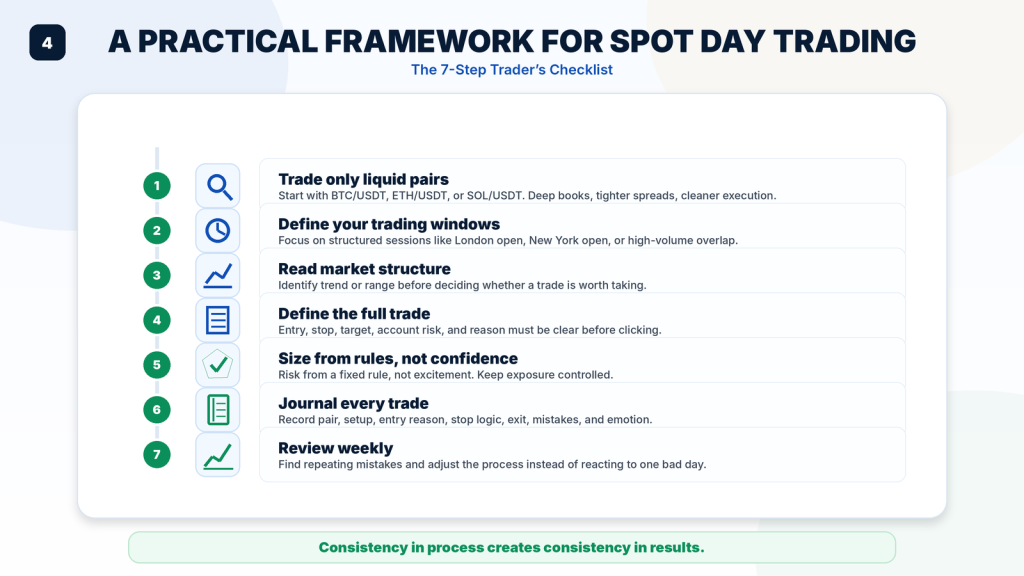
Knowing the theory matters. But applying it through a consistent daily process is what separates traders who improve from traders who repeat the same mistakes for months. Here is a seven-step framework built around BTC/USDT spot trading.
Step 1 — Trade only liquid pairs.
BTC/USDT, ETH/USDT, and SOL/USDT are solid starting points. They have deep order books, tighter spreads, and more predictable behaviour compared to low-cap coins. A thin coin can move 10% on low volume, making accurate stop placement harder and execution messier. Master liquid markets first.
Step 2 — Define your trading windows.
Checking the BTC chart every 30 minutes throughout the day is not a strategy — it is a recipe for reactive entries. Pick one or two structured windows: the London open, the New York open, or the high-volume overlap between them. BTC behaves differently across sessions, and studying one session consistently teaches you more than reacting to all of them sporadically.
Step 3 — Read the market structure before placing an order.
You need to know what the market is doing before you decide whether to trade at all. Higher highs and higher lows signal an uptrend. Lower highs and lower lows signal a downtrend. Price bouncing between two defined levels signals a range. Trading with the structure is the most basic filter between disciplined trading and guessing.
Step 4 — Define the full trade before clicking.
Every entry needs five things confirmed in advance: where you enter, where the setup is proven wrong (your stop), where you plan to exit with profit, how much of your account is at stake, and the specific reason this trade exists right now. If any of those five are unclear before you click, the trade is not ready.
Step 5 — Size from rules, not confidence.
Trade size should be determined by how much you are willing to lose on this specific setup — not by how certain you feel about the direction. High confidence without position-sizing rules is what creates overexposure. Keeping risk between 1% and 2% of account per trade is a widely used starting framework for building discipline without wiping an account on a bad week.
Step 6 — Journal every single trade.
Record the pair, the setup type, your entry reason, where you placed the stop and why, how you exited, any mistakes made during the trade, and your emotional state before clicking. This feels unnecessary until you review three months of data and notice the same avoidable mistake appearing 20 times in a row.
Step 7 — Review weekly, not daily.
The goal of the review is to identify patterns in your mistakes, not to count daily profit and loss. One bad day is noise. The same mistake appearing on seven different days across two weeks is a pattern worth adjusting for. Weekly review is where most of your real improvement happens.
Common Mistakes When Starting With Spot — and What to Do Instead
Most spot trading mistakes trace back to one of two sources: importing bad habits borrowed from futures trading culture, or assuming that the absence of leverage means the absence of consequence. Neither is accurate.
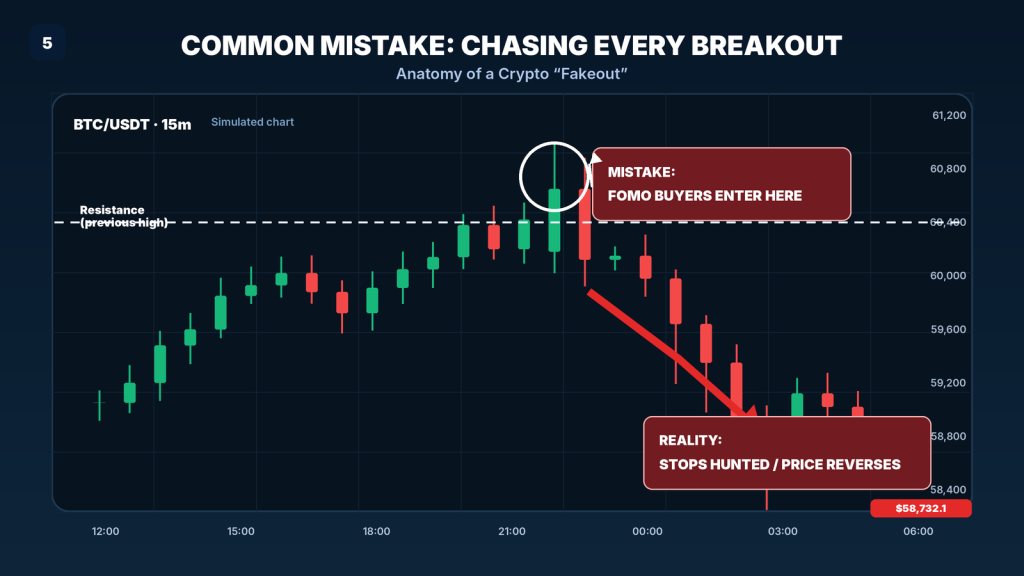
Chasing every breakout.
BTC/USDT breakouts are among the most aggressively faked setups in crypto. Price breaks a key level, early buyers rush in, price reverses to take out the stops, then continues — or goes nowhere. These are liquidity grabs, not confirmations. Before entering a breakout, ask whether the rice is breaking cleanly into open space or pushing into a high-density stop zone. Breakouts into stop clusters are significantly more likely to reverse before running.
Turning a day trade into a long-term hold.
A day trade has a time horizon and a plan. If you enter a BTC/USDT setup expecting a reaction within the session and that reaction does not happen, the trade is over. Changing the reasoning from ‘session reaction trade’ to ‘I’ll hold it because it’ll go up eventually’ is no longer trading — it is hoping. Changing the reason mid-trade means there was no plan to begin with.
Overtrading out of boredom or FOMO.
The crypto market is open 24 hours a day. This does not mean you should be active for 24 hours. Two or three well-structured spot trades per session will consistently produce better results than 15 to 20 impulsive ones — because structured trades come with defined exits, and impulsive trades do not.
Underestimating exchange and stablecoin risk.
Spot trading removes leverage risk from a non-leveraged position, but it does not remove all risk. Your funds sit on an exchange subject to that platform’s security, withdrawal policies, and operational stability. If you hold USDT, you hold exposure to Tether’s peg. These are real risks to manage — not ignore because spot feels safer than futures.
Trading illiquid coins from the start.
A coin that moved 40% in 24 hours on low volume looks attractive on a chart. What the chart does not show is the spread on that coin, the difficulty of exiting at a reasonable price, and the manipulation risk from a thin order book. Learn price behavior on BTC/USDT first. The problems you encounter on BTC are the right problems to learn from.
Before entering any spot trade, run through this:
- Is this a liquid pair with a reasonable spread?
- Is BTC’s current behavior supporting or undermining this setup?
- Is the trade aligned with the higher timeframe structure?
- Do I know exactly where the price invalidates my setup?
- Is my stop placed before the idea fails — not just before the account does?
- How much of my account is at risk on this trade?
- Is there a news event or volatility window open right now?
- Am I entering because the setup is ready — or because I want to be in the market?
If any answer is uncertain, wait. The market opens again tomorrow.
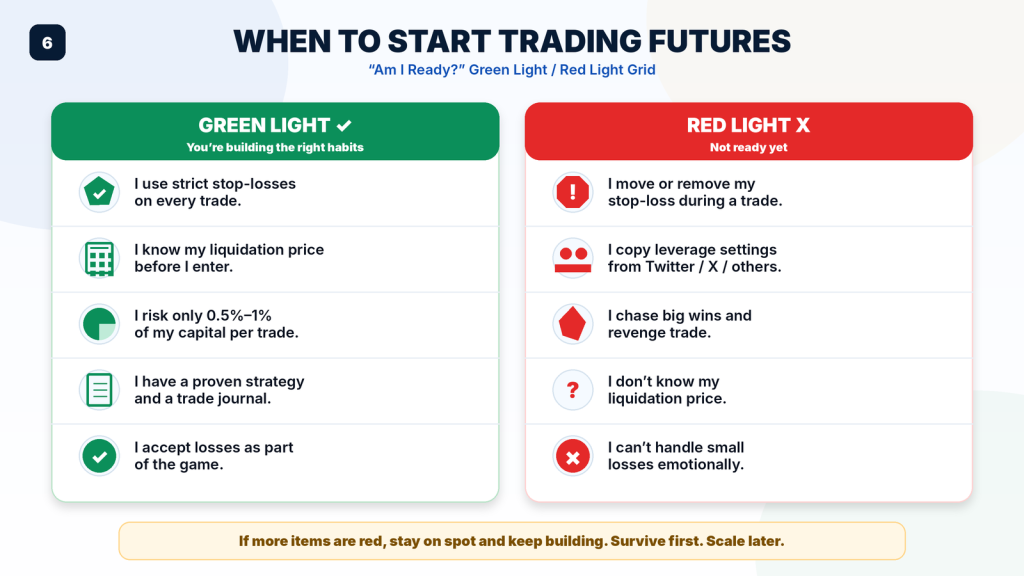
When To Start Trading Futures
No rule says you need to trade spot for a fixed number of months before touching futures. Readiness is about demonstrated skill and knowledge, not calendar time.
You may be ready to consider low-leverage futures if you can honestly confirm all of the following: you apply consistent position sizing without recalculating it each time. You can explain the liquidation price of any trade before you open it. You understand the difference between isolated margin and cross margin, and you choose deliberately between them. You check the funding rate before holding a position overnight. After a losing streak, you do not increase leverage to recover faster. You have a written daily loss limit, and you stop trading when you reach it.
If even two or three of those feel unclear, futures will not fix it. Leverage reveals undisciplined trading habits. It does not correct them.
The clearest signal trader is not yet ready: they ask what leverage to use before asking where the stop goes. They don’t know how funding rates work. They move stops after entry because the trade feels almost there. They revenge trade after losses. They copy leverage settings from an influencer. They risk most of the account on a single directional idea.
Different traders have different natural starting points, but the pattern is consistent across all of them.
| Trader Profile | Better Starting Point | Why |
|---|---|---|
| Complete beginner | Spot | Learn execution and exits without liquidation risk |
| Small-account trader | Spot | Avoid over-leveraging to compensate for limited capital |
| Emotional trader | Spot | Slower loss feedback helps develop discipline |
| Experienced day trader | Spot or low-leverage futures | Depends on whether risk systems are already functioning |
| Hedger | Futures may help | Requires a solid understanding of margin and contract mechanics |
| Bot user | Depends on the system | Must understand drawdown, execution, and risk controls before automating |
What Spot Knowledge Changes When You Use Bots or Copy Trading
A trader who has built real experience in spot execution arrives at automated trading differently. They already know what a clean entry looks like, what slippage feels like on a volatile BTC candle, and what it means when a stop is placed too close to entry. That baseline makes them harder to deceive by performance marketing and better equipped to evaluate whether a system is worth using.
Before using any crypto trading bot, these are the things worth verifying — regardless of what the provider claims or shows on a screenshot:
- What is the maximum drawdown, and how was it calculated?
- Are stop-loss rules built into the system, or are they left to manual override?
- Has the bot been tested under the specific execution conditions of your exchange, including spread behavior and slippage on volatile BTC moves?
- Is there a kill switch or circuit breaker for abnormal market conditions?
- Is the performance shown from a live funded account or a simulated backtest?
The same scrutiny applies to copy trading. Following a master trader’s account is not passive income with no exposure. The master trader can lose. Execution on your account may differ from theirs due to lot sizing ratios, slippage at fill, and order timing. Understanding how spot and futures positions differ helps you evaluate whether the system you’re copying takes structured positions or uses leverage in a way that doesn’t match your risk tolerance.
Automation may reduce some emotional decision-making errors, but it does not remove volatility, drawdown, or execution risk. A bot without proper risk controls will lose capital just as efficiently as a trader making impulsive decisions manually — and often faster, because it executes without hesitation.
| If you want to continue building a structured approach to trading, James Trading University publishes practical education on market structure, risk management, and trading system evaluation. Join the JTU Telegram community to stay connected. |
Final Thoughts: Spot Trading, A Training Ground for Futures Trading
Spot trading teaches you whether you can follow a plan without the pressure of liquidation. Futures trading then tests whether your risk management survives when leverage is added on top of that discipline.
If you can’t manage the emotional pull of a losing trade on spot, futures makes the same problem more expensive and faster to arrive at. The market doesn’t reward impatience with a better outcome. It charges more for the same lesson.
This isn’t an argument against futures. It’s an argument for the right sequence. Execution discipline on spot is the foundation that everything else gets built on — including bots, copy trading, and eventually, structured use of leverage. You build the foundation first. You earn the upper floors through consistent performance, not ambition.
| DisclaimerThis article is educational and does not constitute financial advice. Crypto spot trading involves price volatility and can result in significant loss of capital. Futures trading adds leverage, margin requirements, liquidation risk, and funding-rate costs that can accelerate those losses. No trading strategy, bot, signal service, or copy trading system guarantees profit. Only risk capital you can afford to lose. Past performance does not indicate future results. |
Frequently Asked Questions
Is spot trading safer than futures trading?
Spot trading is simpler and avoids forced liquidation in a basic non-leveraged position, but it is not risk-free. Crypto prices can fall sharply even on spot. The difference is that losses are tied directly to price movement without leverage amplifying them.
Should beginners start with spot trading before futures?
Yes. Spot trading teaches order execution, market structure, position sizing, and emotional discipline before you add the complexity of margin, liquidation price, and funding mechanics. Those skills are prerequisites, not optional extras.
Can you lose all your money in spot trading?
Yes — particularly if you concentrate too much capital in one volatile asset, hold losing trades without a stop, or trade low-liquidity coins with poor exit conditions. Spot removes forced liquidation from non-leveraged trading, but it does not remove market risk.
Why do traders use futures instead of spot?
Futures allow short-selling, leverage, hedging, and more capital-efficient positioning. For experienced traders with risk systems in place, these are useful tools. For beginners, the same features create faster and larger losses.
What is liquidation in crypto futures?
Liquidation is the forced closure of a leveraged futures position by the exchange when the trader’s margin balance falls below the maintenance margin threshold. The exchange closes the position to prevent losses from exceeding the collateral posted.
What is a funding rate in perpetual futures?
A funding rate is a periodic payment exchanged between long and short traders in a perpetual futures market. It keeps the perpetual contract price aligned with the spot price. When longs dominate the market, longs pay shorts. When shorts dominate, the payment reverses.
Is 10x leverage too much for a beginner?
For most beginners, yes. With 10x leverage, a 10% adverse price move wipes out the entire initial margin. In crypto, 10% intraday moves on BTC are not uncommon. The position closes before there is any opportunity to recover.
Can you day trade crypto using only spot?
Yes. You can actively day trade BTC/USDT, ETH/USDT, and other liquid pairs on spot without using futures. The absence of leverage means position sizing, stop placement, and exit discipline become the primary risk management tools.
What should I understand before trying crypto futures?
At minimum: how to calculate your liquidation price before entering a trade, the difference between isolated and cross margin, how funding rates affect hold costs, how to size a position from risk rules rather than confidence, and how to place a stop before the liquidation price — not at the same level.
Are crypto trading bots safer on spot or futures?
Spot bots that don’t use leverage avoid forced liquidation, but they can still lose capital through poor strategy logic, slippage, or volatility. Futures bots add margin exposure and liquidation risk on top of those same variables. Understanding the underlying market is a prerequisite for evaluating either type of system.