
A BTC scalping bot is only profitable when its average trade is larger than every real cost stacked against it — maker/taker fees, spread, slippage, funding on perpetuals, partial fills, and latency. A bot can win 7 out of 10 trades and still bleed your account dry if each target is too small to survive that cost stack. Automation doesn’t create an edge. It just executes whatever edge (or lack of one) the strategy already has, faster than you could by hand.
BTC Scalping Bot, Definition.
A BTC scalping bot is software that opens and closes Bitcoin trades quickly, usually chasing small price moves dozens or hundreds of times a day. Two distinctions matter before you go further:
Spot vs. futures. A spot bot buys and sells actual BTC — no funding rates, no liquidation risk, but also no leverage. A perpetual futures bot can use leverage, which means it can also lose faster, and it has to account for funding payments every few hours.
Manual vs. automated. Automation buys you speed and consistency — it won’t hesitate or panic mid-trade. What it doesn’t buy you is a strategy. A fast bot running a bad system just loses money faster than a slow human would.😂
Most people searching for a BTC scalping bot fall into one of a few camps:
- Beginners wondering if a bot can really trade for them,
- Backtesters confused about why a strategy that looked great on paper isn’t translating live,
- Buyers trying to figure out which bot is actually safe to connect to an exchange, and
- Risk-aware traders asking if one bad day can wipe out weeks of gains.
I’m addressing all of it because the answer to “Are BTC scalping bots profitable?” depends entirely on which of these questions you actually need answered.
Are Bitcoin scalping bots effective in generating profit?
They can be — but only if there’s a measurable edge left over once every cost is subtracted.
“Win rate is not the metric that matters”.
A bot can win 60% of its trades and still lose money if the losers are bigger than the winners, or if fees and slippage eat the profit target on every single trade, win or lose. I’d rather see a bot with a 40% win rate and a clean cost-aware edge than a 70% win rate bot that’s quietly losing to its own fee structure.
The formula I use to sanity-check any strategy before I trust it:
Net edge per trade = expected gross move − fees − spread − slippage − funding − latency/error cost
If that number isn’t reliably positive across hundreds of trades and multiple market regimes, the bot isn’t profitable — it’s just busy. This isn’t theoretical.
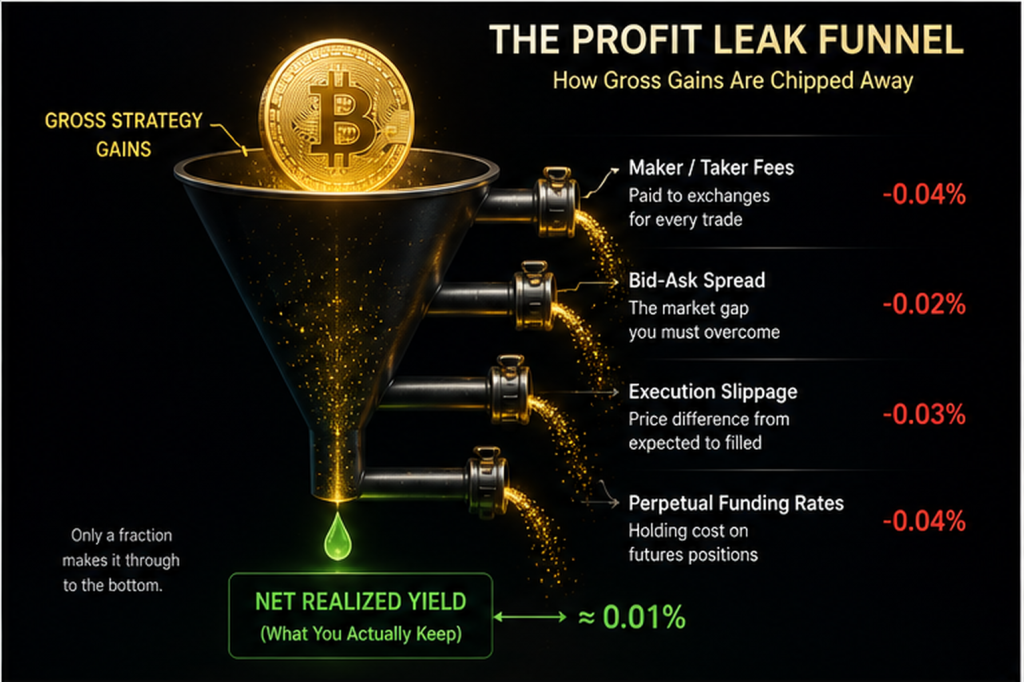
A 2026 BTC-USDT walk-forward study found that several models produced positive gross results, but the same trades failed once a 10-basis-point transaction cost was applied. The researchers’ conclusion lines up with everything I’ve seen in live execution: turning a forecast into a trade is the hard part, not the prediction itself.
The Real Cost Stack: Fees, Spread, Slippage, and Funding
This is where most “profitable” backtests quietly fall apart.
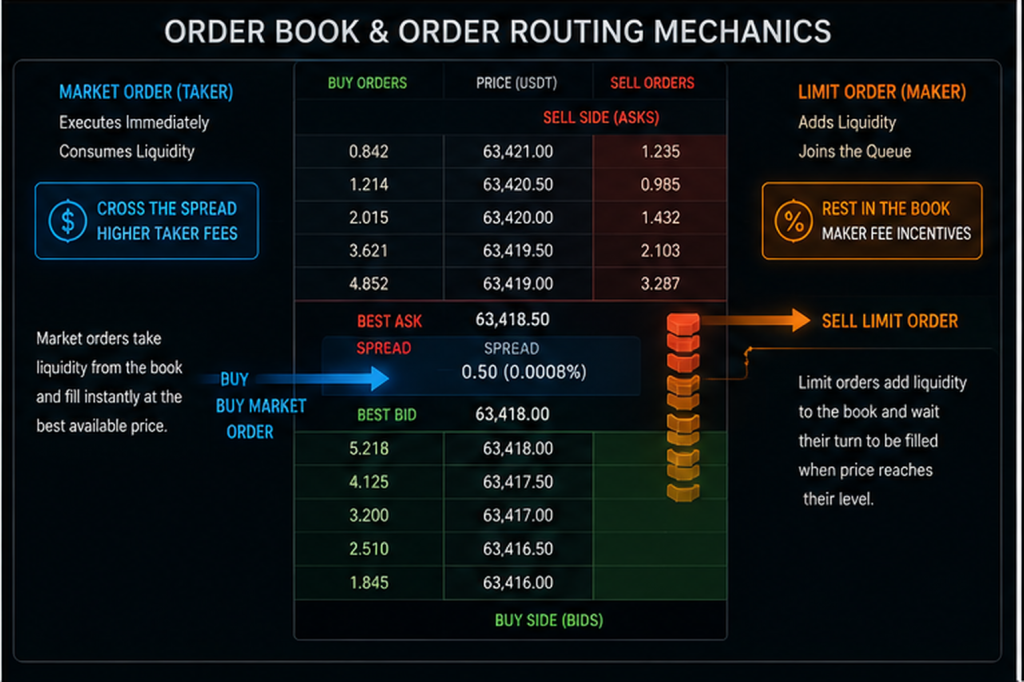
- Maker fees apply when your order adds liquidity to the book (a resting limit order). Taker fees apply when your order removes liquidity and fills immediately (a market order). A partially filled order can pay both — one portion as maker, the rest as taker.
- Spread is the gap between the best bid and the best ask. Your trade has to clear this before it’s even at a break-even.
- Slippage is the difference between the price you expected and the price you actually got filled at.
- Funding rates apply only to perpetual futures — hold a position through a funding interval, and you’re paying (or occasionally collecting) a hidden cost on top of everything else.
Here’s what that looks like as a breakeven example:
| Cost Item | Example |
|---|---|
| Entry fee | 0.04% |
| Exit fee | 0.04% |
| Spread | 0.02% |
| Slippage | 0.03% |
| Total hurdle | 0.13% |
If the bot is targeting a 0.10% move per trade, it loses money on every single trade, even when it calls direction correctly. This is the gap that separates a backtest that looks great from a live account that quietly drains.
⚙️Learn the System, but Don’t Miss the Moves
I built James Trading University (JTU) because I kept seeing the same pattern: traders finding a bot, skipping the due diligence in the sections above, and connecting real capital before they understood what they were exposed to. The market doesn’t wait for you to learn the hard way — every week you spend figuring this out from scratch is a week of setups you’re not positioned for.
That’s the idea behind JTU (education) and James Trading Strategies (execution): learn how the cost stack, drawdown rules, and execution mechanics actually work, and get access to systems that are already built and forward-tested, so you’re not choosing between learning and participating. You don’t have to pick one.
I don’t ask anyone to take my word for bot performance — I’d rather you see it.
👉 View Live Results in My Telegram Channel
If you’ve seen enough and want in:
👉 I’ve made my decision — How can I get the BTC bot?
Why Does a BTC Scalping Bot Fail After a Great Backtest?
A strategy that looks profitable on historical candles can still fail live, and it’s rarely the strategy logic that’s the problem.
Backtests run on clean candle data. That data doesn’t show queue position, partial fills, rejected orders, or the order book shifting under you mid-trade.
Paper trading isn’t live execution. A paper account often assumes fills happen exactly where you wanted them. Real liquidity doesn’t make that promise.
Overfitting is easy to miss. A bot tuned tightly to the last six months of BTC’s behavior can fall apart the moment volatility regime shifts.
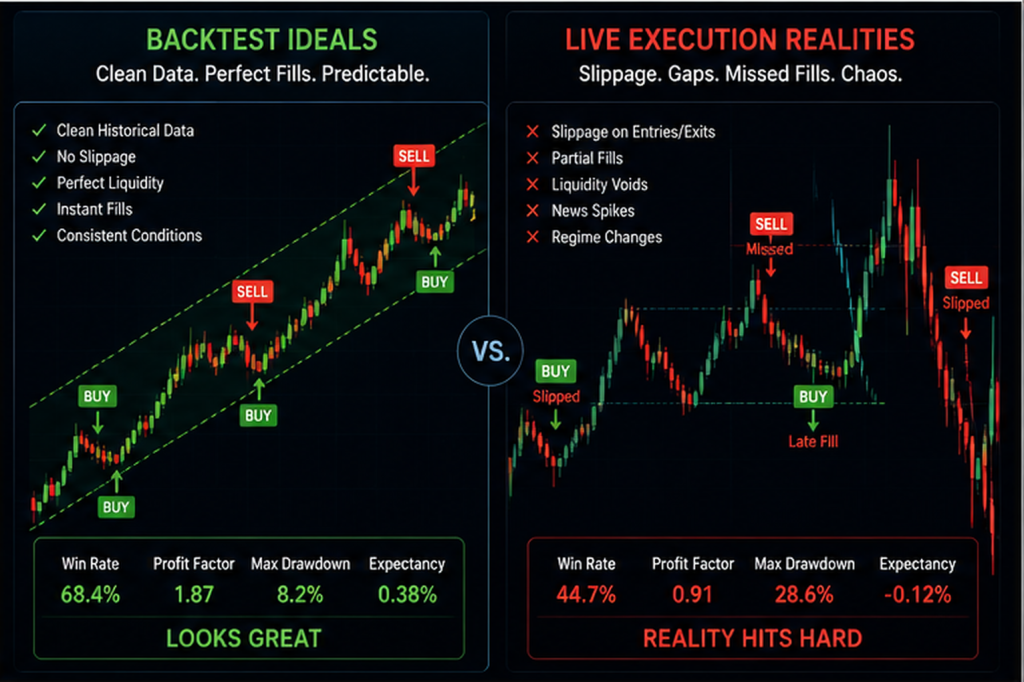
Forward testing is non-negotiable. This is the difference between a bot that’s been tuned to history and one that’s proven it can survive real-time spreads, slippage, and execution delays. If a bot or provider can’t show you forward-tested results, that’s the gap you’re being asked to trust blindly.
Market Orders vs. Limit Orders
Market orders fill fast — useful when speed matters — but they pay taker fees and are exposed to worse pricing during volatility.
Limit orders can earn maker fees and give you price control, but they risk missed trades, partial fills, and queue complexity in fast markets.
A serious BTC scalping bot tracks fill rate, average slippage, and missed-trade rate alongside net PnL after fees — not just whether the signal was “right.”
Data and Execution Metrics That Actually Matter
At minimum, a bot needs price, volume, the exchange’s fee schedule, spread data, and full trade logs. A bot built for real scalping needs more: order book depth, tick data, a live WebSocket feed, and visibility into liquidity changes.
Either way, track these execution metrics, not just win rate:
- Average entry and exit slippage
- Maker/taker ratio
- Partial fill percentage
- Rejected orders
- Latency
- Average hold time
- Drawdown by session
Latency-sensitive strategies live or die on real-time order book visibility and clean, exchange-direct data — not delayed or aggregated feeds.
Risk Management Rules Every BTC Scalping Bot Needs
- Max daily loss — the bot stops trading once it hits a defined daily limit.
- Max drawdown — a hard cap on peak-to-trough account decline.
- Kill switch — shuts the bot down the moment conditions turn unsafe.
- Volatility filter — pauses trading during extreme spreads, major news, or exchange instability.
- Position sizing discipline — never size up after a loss unless that specific logic has been tested on its own.
- Leverage caution — on futures, high leverage turns ordinary BTC volatility into liquidation risk.
Is It Safe? API Keys and the Scam Checklist
Can a bot withdraw your funds? It depends entirely on the permissions you grant. Coinbase’s API for automated trading is built to deny withdrawal or transfer requests and never exposes login credentials.
But trade-only keys still carry risk. Binance has warned that even keys without withdrawal access can be abused — for example, through forced trading on illiquid pairs — if they’re compromised. Their guidance: use IP whitelisting, restrict permissions to the minimum needed, rotate keys regularly, and never store them insecurely.
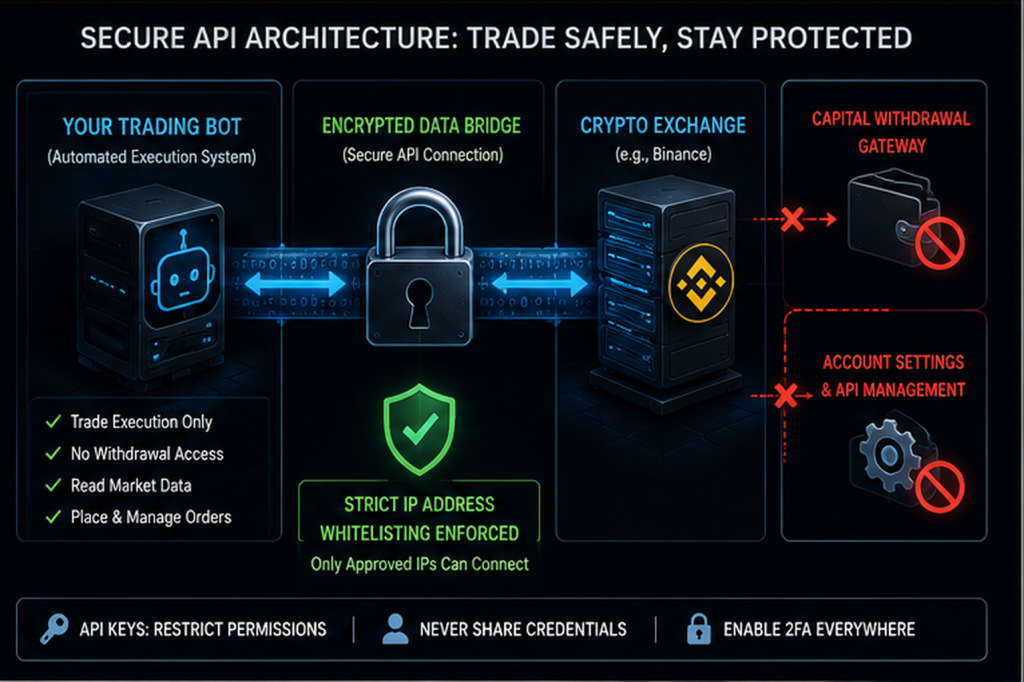
Before connecting anything to an exchange:
- Never enable withdrawal permissions for a trading bot
- Use trade-only permissions wherever possible
- Set IP whitelisting
- Enable 2FA on both the exchange and the bot platform
- Use sub-accounts when available
- Rotate API keys
- Avoid unverified GitHub bots requesting key access
- Start with a small capital
- Delete API keys you’re not actively using
Build, Buy, or Use a Guided System?
| Option | Best For | Main Risk |
|---|---|---|
| Python bot (build it yourself) | Technical traders | Coding errors, weak execution logic |
| GitHub bot | Experimenters | Unverified code, API key exposure |
| Commercial bot | Non-coders | Overhyped claims, hidden cost stack |
| JTS guided system | Traders who want education and automation | Still requires understanding the risk — no system removes that |
I’m not going to pretend JTS is hype-free marketing. It’s structured around education, discipline, and risk control first — automation is the delivery mechanism, not the pitch.
The 10-Point Checklist Before You Risk Real Capital
- Does it show results after fees and slippage, not just gross?
- Has it been forward-tested, not just backtested?
- Does it record live fills?
- Does it handle spread widening?
- Does it have a max drawdown limit?
- Does it have a kill switch?
- Does it avoid requesting withdrawal permissions?
- Does it support testing with small capital first?
- Does it explain when not to trade?
- Does it avoid guaranteed-profit claims?
If a bot or provider can’t check most of these boxes, that’s your answer.
Final Verdict: Who Should — and Shouldn’t — Use a BTC Scalping Bot
Good fit: traders who understand fees, slippage, drawdown, API risk, and volatility, and who treat the bot as a tool inside a risk plan rather than a replacement for one.
Bad fit: anyone expecting passive income, guaranteed returns, or a “set and forget” account.
The JTS BTC bot, for context, runs as a mid-risk, buy-and-sell system, forward-tested over two months, and usable on any broker as well as Binance. Stop-loss parameters aren’t fixed — they adjust to current market conditions rather than running on a static number, which is exactly the kind of risk-managed, structured approach I outlined throughout this piece. I’m presenting it here as one option for traders who already understand the risks above, not as a profit promise.
FAQ
Are BTC scalping bots profitable?
They can be, but only if the strategy stays positive after fees, spread, slippage, latency, funding, and partial fills are all accounted for. Automation alone doesn’t create profit.
Why do BTC bots work in backtesting but fail live?
Backtests typically underestimate slippage, spread changes, order book liquidity, latency, and shifting market regimes.
What win rate does a BTC scalping bot need?
There’s no fixed number. A lower-win-rate bot can be profitable if winners outsize losers after costs; a high-win-rate bot can still lose if costs are too high.
Market orders or limit orders for scalping?
Market orders fill faster but cost more in fees and slippage. Limit orders offer better pricing but risk missed or partial fills.
Is it safe to connect a bot to Binance or Coinbase?
Only with restricted permissions — trade-only keys, IP whitelisting, 2FA, sub-accounts, and never withdrawal access.
Can a BTC scalping bot blow an account?
Yes. Poor risk settings, high leverage, spread spikes, API failures, and bad execution can all cause major losses.
What’s the biggest mistake bot users make?
Judging a bot by backtest profit or win rate instead of live net performance after fees, slippage, spread, latency, and drawdown.
Before You Use Any BTC Scalping Bot
Check the fee assumptions. Check the slippage model. Check whether there’s actual forward-tested, live performance behind the claims — not just a backtest. That’s the entire difference between a bot that survives contact with the real market and one that doesn’t.
If you want to see what forward-tested, risk-managed execution actually looks like before you commit anything:
👉 View Live Results in My Telegram Channel
👉 I’ve made my decision — How can I get the BTC bot
Trading BTC with bots involves risk. Fees, spread, slippage, latency, API failure, volatility, funding rates, leverage, and liquidation can all affect results. Never risk money you can’t afford to lose, and don’t rely on backtests alone.