
What Is Two-Way Trading in Forex and CFD Markets?
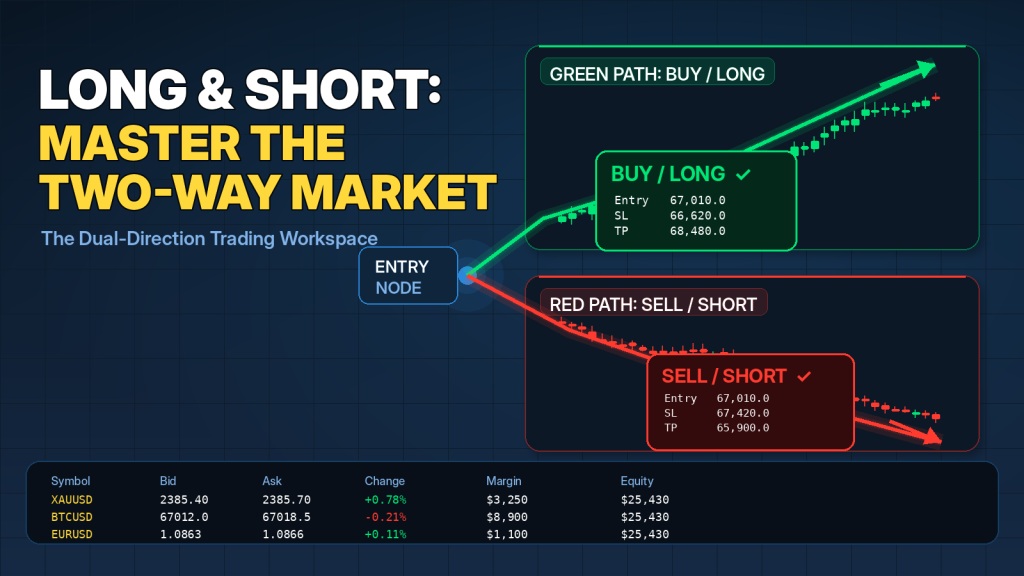
Two-way trading means exactly what it sounds like: the ability to take either a long position or a short position — and in some cases, hold opposing positions on the same instrument to reduce market exposure. It is not a strategy by itself. It is a structural feature of the market that gives you directional flexibility, meaning you are not forced to wait for one specific setup to participate.
Here is the distinction most traders miss: two-way trading and hedging are not the same thing. Two-way trading describes the broader ability to trade in either direction depending on conditions.
Hedging is one specific technique within that ability, where you open an opposing position to avoid/ stop exposure from an existing trade. You can trade both directions without hedging, and not every two-way position is a hedge.
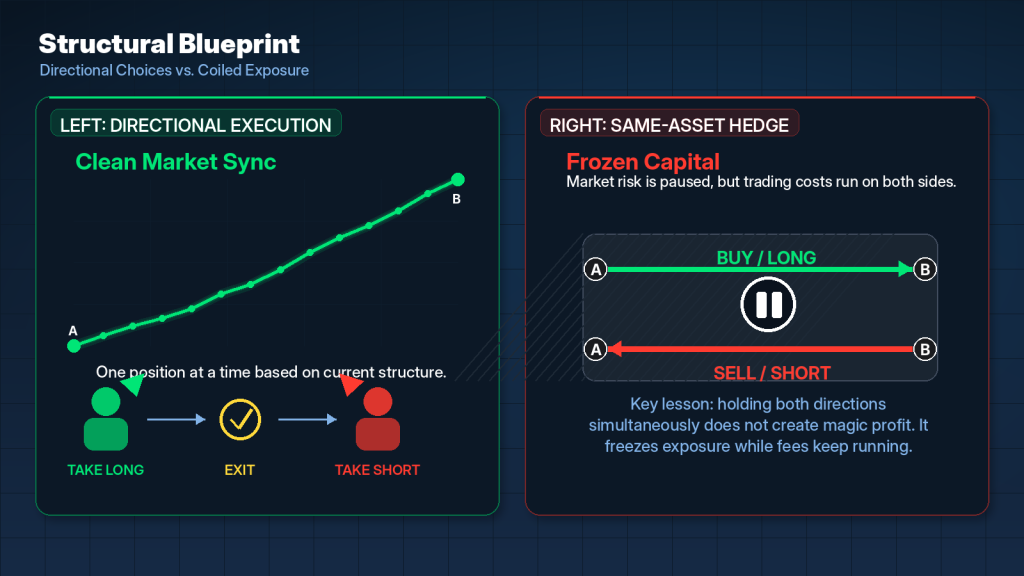
Many traders search this topic after a volatile news spike or trend reversal traps them in a losing trade. The appeal of opening the other direction to fix it is understandable. But a fully hedged position — equal long and short on the same instrument — does not generate profit. It pauses directional exposure while costs continue to build on both sides. The value of a hedge is in what it prevents, not in what it earns.
Key Takeaways
- Two-way trading is the ability to go long or short depending on market conditions — not a method for profiting from both sides simultaneously.
- Hedging is one specific application of two-way trading, not the same concept.
- A perfect hedge reduces directional exposure but locks in costs and floating drawdown.
- An imperfect hedge offsets part of the risk while keeping some market participation.
- Netting accounts automatically combine opposite trades into a single net position — holding both directions separately may not be possible in your account.
- Spread, swap or funding rate, slippage, margin, and broker account rules all determine whether a hedge is worth the cost.
How Two-Way Trading Works in Practice
The way active day traders use two-way trading falls into two practical modes: directional flexibility and same-instrument hedging.
Directional two-way trading is the cleaner version. You switch between long and short setups based on what the market is telling you. When the price is in a confirmed uptrend, you take longs. When structure shifts bearish, you short. There is no overlap between positions. The two-way capability here simply means you are not limited to one direction — you follow what the market offers.
Same-instrument hedging is where the complexity begins. This is when you hold both a buy and a sell on the same asset at the same time — for example, an active long and a new short on XAUUSD opened ahead of a high-impact news release. The goal is to pause directional exposure for a defined window while uncertainty plays out. The trade-off is that both positions now carry costs on both sides: spread at entry, swap or funding rate while open, and slippage at exit. The hedge does not earn directional progress during that time. It only controls exposure, and it does so at a price.
Cross-instrument hedging takes it further. You hedge using a related but separate instrument, such as shorting GBPUSD while holding a long on EURUSD during a dollar-strength move. This introduces basis risk: the two instruments do not move in the same proportion, so the hedge may under-offset, over-offset, or create a net position you did not intend.
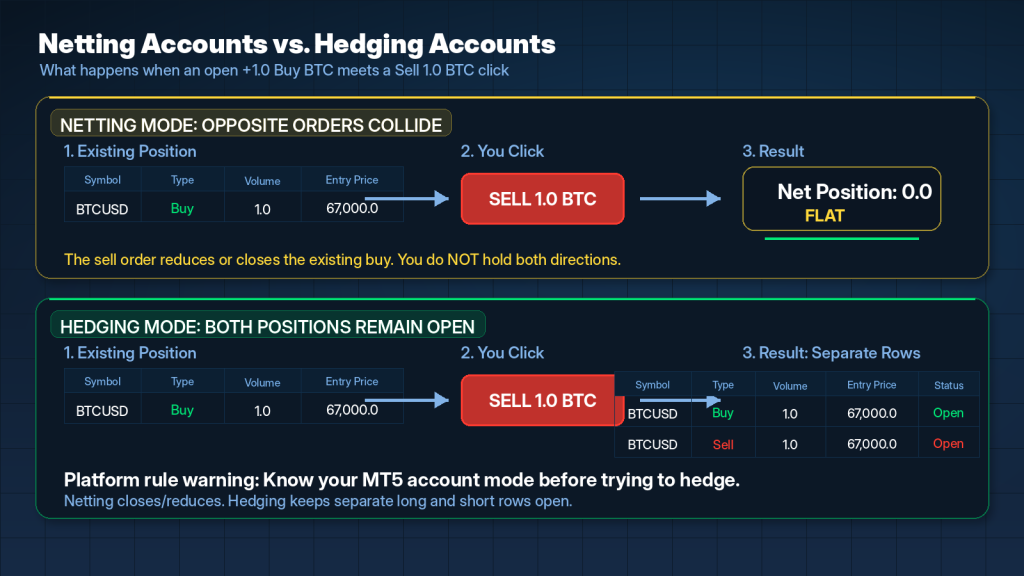
On MetaTrader 5, your account type determines which of these you can execute. In netting mode, opening a sell against an existing buy will reduce or close the buy — the platform does not allow separate positions on the same symbol. In hedging mode, each trade stays independent regardless of direction. This is selected at account opening and cannot be changed on the same account afterwards.
| Type | What It Means | Main Benefit | Main Risk |
|---|---|---|---|
| Directional two-way | Alternating between long and short based on structure | Flexibility in bullish and bearish markets | Overtrading, emotional position switching |
| Same-instrument (perfect) hedge | Equal long and short on the same asset | Pauses directional exposure | Costs accumulate; floating drawdown stays locked |
| Imperfect hedge | Short offsets only part of the long exposure | Keeps partial upside or downside participation | Hedge may under- or over-offset |
| Cross-instrument hedge | Hedge via a correlated but different asset | Preserves the original position | Basis risk — instruments don’t move in exact proportion |
| Netting | Opposite trades merge into one net position | Simpler exposure view | Cannot hold both directions separately |
Forex vs Crypto Two-Way Trading: Key Differences for Day Traders
Two-way trading works differently across forex and crypto, not because the concept changes but because the cost structure, regulation, and execution environment are different enough to produce very different outcomes from the same approach.
| Factor | Forex (e.g. EURUSD, XAUUSD) | Crypto (e.g. BTC Perpetuals) |
|---|---|---|
| Hedging availability | Allowed outside the US; blocked under NFA Rule 2-43b for US retail traders | Available on major exchanges; no equivalent restriction for crypto derivatives |
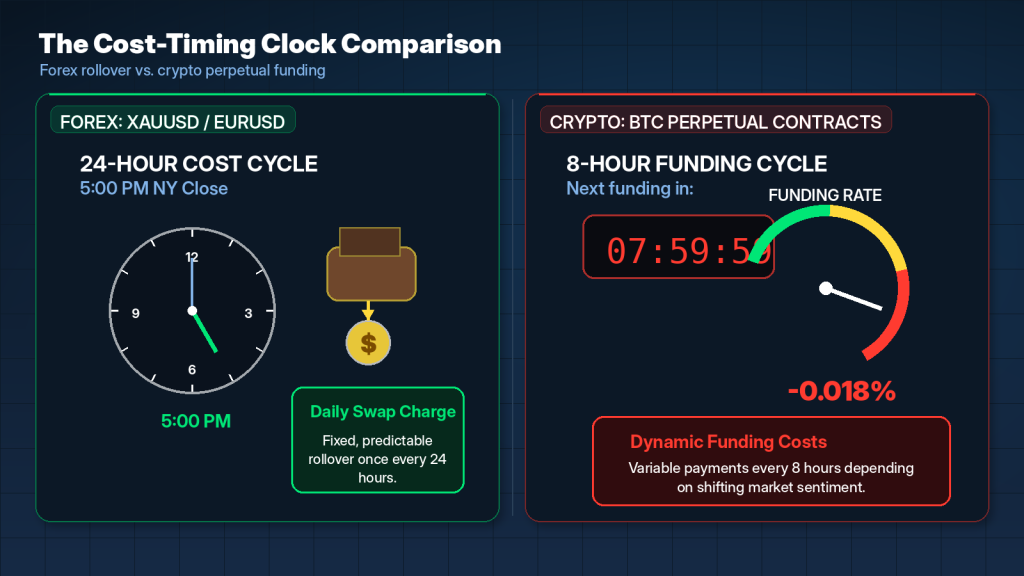
| Position holding cost | Swap/rollover charged once daily after 5 PM NY close | Funding rate on perpetuals every 8 hours |
| Spread structure | Fixed or variable; widens sharply during news and rollover | Percentage fee per trade; spikes during high volatility |
| Market hours | 24 hours, Monday to Friday | 24 hours, 7 days, including weekends |
| Leverage range | Up to 1:500 outside the US; capped at 1:50 for major pairs in the US | Up to 100x on many exchanges |
| Slippage risk | Lower during liquid sessions; significant during news events | Higher overall, amplified by leverage and thin liquidity windows |
| Basis risk on cross-hedge | Lower — forex correlations are well-documented | Higher — crypto correlations shift rapidly during altcoin volatility |
The most practical difference for active traders is cost timing. In forex, swap rates are published by your broker and charged once per day — you know the holding cost before you open. In crypto perpetual contracts, the funding rate adjusts every 8 hours based on the imbalance between longs and shorts. When sentiment is heavily bullish, longs pay shorts. If you hold a short hedge in that environment, you collect funding. But if sentiment shifts, you pay. A rate that was neutral can turn against you before the hedge has served its purpose.
The regulatory difference matters for anyone trading forex through a US-regulated broker. NFA Compliance Rule 2-43b, implemented in 2009, prohibits US forex dealer members from allowing clients to hold offsetting positions on the same currency pair. If you try to hedge a forex trade on a US-regulated account, the opposing order closes or reduces your original position rather than creating a separate hedge. Babypips explains this clearly: the rule effectively bans same-account hedging for US retail forex traders. Crypto derivatives currently operate under different oversight, so opposing positions are generally available on major exchanges without the same restrictions.
Crypto futures allow you to hold long and short positions on price-tracking contracts without owning the underlying asset. The flexibility is genuine. So is the complexity: leverage up to 100x means a hedge carries liquidation risk on the short side if the market moves sharply before you can adjust. dYdX’s crypto hedging guide makes this clear — hedging in crypto reduces directional risk but increases operational complexity and requires active monitoring, not a set-and-forget approach.
For traders outside the US operating a non-US broker account, the flexibility to hedge across both markets exists. What changes are the cost mechanism and the speed at which those costs can shift? Forex swap rates are stable and predictable day to day. Crypto funding rates can move significantly within a single 8-hour window depending on market sentiment and open interest distribution.
For Gold traded as a CFD through a non-US broker on a hedging-enabled MT5 account, same-instrument hedging is available. The catch is that Gold spreads widen most sharply around major events like NFP and CPI — the exact moments when a hedge feels most necessary are also when the cost of opening a second position is highest.
What You Need to Check Before Going Both Ways
Before opening any position in the opposite direction, three things need to be confirmed: your account structure, the true cost of the trade, and your exit condition. Missing any one of these converts a risk management decision into an uncontrolled expense.
Account and Broker Structure
Verify whether your account uses hedging or netting. On a netting account, a sell placed against an open buy reduces or closes the buy automatically — you are not creating a hedge; you are partially closing a position. Confirm whether FIFO rules apply to your account based on your jurisdiction and broker. If you run an Expert Advisor, check that the EA was built for your account’s position accounting mode — a mismatch between an EA designed for hedging and a netting account can cause the EA to close trades it was not programmed to close.
Calculate the Full Cost Before You Open
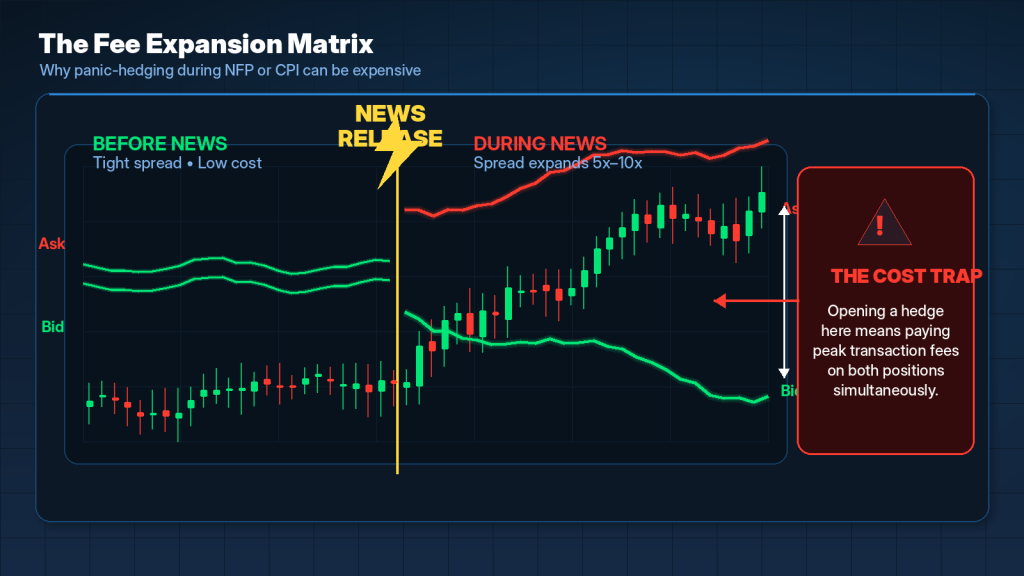
Every two-way position doubles the cost structure. A hedge that costs more to maintain than the exposure it protects is not risk management — it is expensive indecision with open positions attached.
| Cost Type | When It Hits | Common Mistake |
|---|---|---|
| Spread | Both entries and potentially both exits | Underestimating cost on a wide-spread market like Gold during a news release |
| Swap (Forex) | Daily after 5 PM NY close | Holding a hedge overnight without calculating the daily carry |
| Funding rate (Crypto) | Every 8 hours on perpetual contracts | Not tracking when the rate shifts direction against the position |
| Slippage | Both entries during volatility | Expecting clean fills on both sides during a high-impact release |
| Margin | Throughout the full hedge period | Assuming reduced directional exposure means reduced margin usage |
Define the Exit Condition Before You Open
This is what separates a planned hedge from a floating loss trap. Write down the specific trigger that will close one side or both: a price level, the passing of a news event, an equity threshold, or a time limit. If you cannot state that condition clearly before opening the second position, the hedge is not ready.
Common Mistakes Traders Make With Two-Way Trading
Mistake 1 — Treating Hedging as Risk Removal
A hedge changes the type of risk, not the amount. Directional risk drops, but cost risk, timing risk, and execution risk all increase. Traders who open both sides and assume the account is now safe often discover that the hedge eroded more equity through costs than a clean stop-loss would have.
Mistake 2 — No Exit Rule
Opening both sides without defining when one closes turns a hedge into a holding pattern. The position floats, costs accumulate, and the decision gets delayed because holding both sides feels neutral. It is not neutral — it is expensive, and the longer it runs without a defined trigger, the narrower the range of outcomes that make it worthwhile.
Mistake 3 — Ignoring Spread Expansion During News
Forex and Gold spreads can widen by 3x to 10x during high-impact releases. If you open a hedge ahead of CPI or a Fed statement, both entries may fill at expanded prices. That wipes out a significant portion of the protection the hedge was meant to provide before the price has even moved meaningfully.
Mistake 4 — Confusing a Bot’s Directional Capability With Risk Management
A trading system that can open positions in both directions has a two-way capability, but that is not the same as a two-way risk framework. What makes an automated system safe in this context is the logic behind when positions are opened, how they are sized, what triggers a close, and whether the account mode matches the strategy’s assumptions. Without those controls verified, a bot that can trade both ways can accumulate losses on both sides simultaneously.
Mistake 5 — Using a Hedge to Avoid Taking a Loss
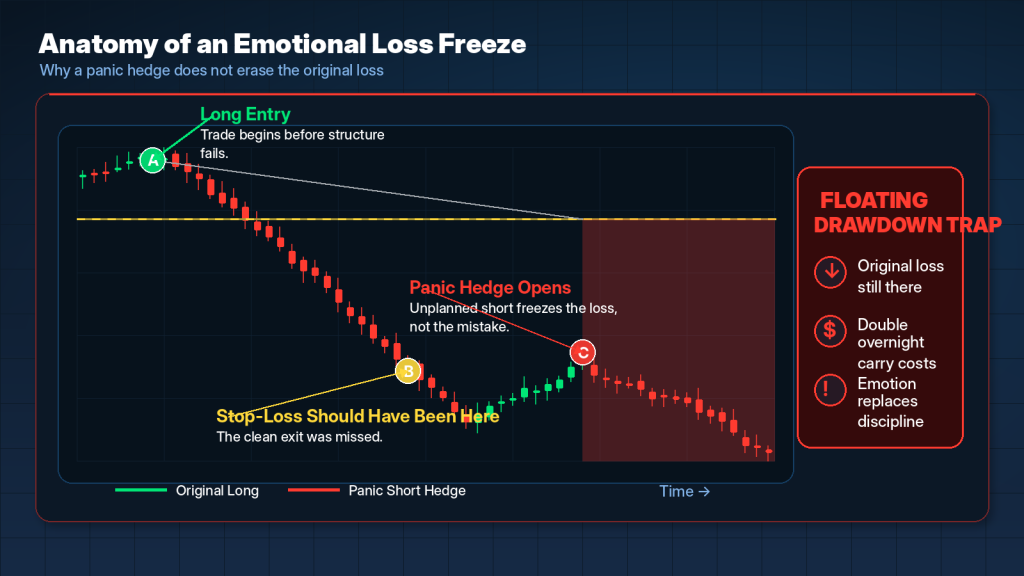
This is the most common emotional use of hedging. A trade goes against you. Instead of closing it and accepting a defined loss, you open the opposite direction, hoping the second position will offset the first. It does not fix the original trade. It pauses the loss while both positions run up costs. If the only reason for the hedge is to avoid realizing a loss, the cleaner solution is almost always to close the original position and reset from a clear starting point.
Two-Way Trading Checklist — Before You Open Both Sides
Work through every step before placing a second position on any instrument. If any step cannot be completed, the hedge is not ready to open.
- Define the purpose clearly. Is this hedge reducing real exposure on a planned trade, or is it a reaction to a loss you do not want to close? Write the reason in plain language before placing the order. A defined purpose sounds like: “I am holding my XAUUSD long through a high-impact release and opening a short to reduce directional exposure for two hours.” A delayed stop-loss sounds like: “The buy is losing, and I need to do something.” Know which one you are dealing with.
- Confirm your account and broker rules. Check whether your MT5 account runs hedging or netting mode. Confirm FIFO restrictions for your broker and jurisdiction. If you use an Expert Advisor, verify it was built for your account’s position accounting method before running it on any live account.
- Calculate the total cost. Add spread on both entries, estimated swap or funding rate for the expected hold duration, likely slippage range, and margin impact. If the total cost approaches or exceeds the risk you are protecting against, the trade is not economically sound. Do this calculation before opening, not while the position is already running.
- Choose the hedge type deliberately. Decide between a perfect hedge, an imperfect hedge, a cross-instrument hedge, or no hedge at all. That choice should come from your account rules, cost calculation, and market conditions — not from which option feels safest in the moment.
- Set the release trigger first. Define the exact condition that closes one or both sides before you open the second position. Time-based: close the short after the release. Price-based: close the hedge if XAUUSD clears a specific level. Event-based: exit both sides once volatility drops. If that condition cannot be stated before the position is open, the hedge is not ready.
- Set a circuit breaker. Define the maximum drawdown, maximum cost, and maximum time you will allow the hedge to remain active. A hedge that outlasts its protective purpose becomes a position management problem. No two-way position should stay open past the conditions that justified opening it.
What This Means for You
Two-way trading is a tool that grows more useful as your understanding of market conditions deepens. If you’re still building an understanding of market structure, a stop-loss and a clean exit will almost always outperform the complexity of managing two open positions with costs running on both sides.
Once you’re out of the woods, you can identify conditions clearly enough to trade directionally in both bullish and bearish environments. Two-way trading gives you the flexibility to stay active when markets shift rather than waiting on the sidelines.
You are not trying to profit from both sides at once. You are equipped to take the direction the market is offering — and to manage exposure deliberately when conditions become uncertain.
The question to ask before every two-way position is the same:
- What risk am I reducing,
- What cost am I accepting, and
- What rule tells me when to exit?
A hedge that cannot answer all three has no business being open.
Frequently Asked Questions
What is two-way trading in Forex?
Two-way trading in Forex is the ability to open either a long or a short position depending on market direction.
Is two-way trading the same as hedging?
No. Two-way trading describes the broader ability to trade in either direction. Hedging is one specific use of that ability, where you open an opposing position to reduce exposure from an existing trade. You can use two-way trading without hedging, and every hedge uses two-way mechanics.
Can you hold a long and a short position at the same time?
On many platforms, yes — but it depends on your account type and broker. On MetaTrader 5, hedging accounts allow separate long and short positions on the same symbol. Netting accounts combine them automatically. US retail forex traders are restricted by NFA Rule 2-43b, which prohibits offsetting positions and enforces FIFO closure.
Does hedging guarantee profit in trading?
No. KuCoin’s trading education states it clearly: hedging reduces risk but does not eliminate it. A perfect hedge reduces directional exposure but does not generate profit. Spread, swap, funding rate, and slippage continue accumulating on both sides.
What is the difference between hedging and netting?
Hedging keeps long and short trades as independent positions with their own entries, exits, and stop-loss levels. Netting automatically combines opposite trades into a single net position.
Why do some brokers block hedging?
In the United States, NFA Compliance Rule 2-43b requires forex dealer members to close offsetting positions on a first-in, first-out basis, which effectively prohibits same-account hedging.
Is two-way trading good for Gold trading?
Gold can be traded long and short through CFDs or spot contracts, and directional flexibility is useful given how quickly Gold can reverse around news events. However, Gold spreads widen the most during major releases — the same moments when hedging feels most necessary are also when the cost of opening a second position is highest.
Can trading bots use two-way trading safely?
A bot’s ability to open long and short trades does not make it automatically risk-managed. Whether it is safe depends on the position sizing rules, drawdown limits, equity protection, and account mode compatibility.
Risk Disclaimer
Trading forex, gold, and crypto carries a significant risk of loss and is not suitable for all participants. Past performance is not indicative of future results. Only allocate capital you can afford to lose. Two-way trading, hedging, and automated trading strategies do not guarantee profit and may result in losses exceeding your initial deposit. Always understand the full cost of any strategy before going live.




This Post Has One Comment
Great content! Keep up the good work!