
Yes, automated trading can produce sustainable results. The word “can” simply implies that when an automated system runs by the 3 principles explained in this post, a trading bot will run the same code for years without complaint and with profits.
So How Does Automated Trading Actually Hold Up Over Time?
| Direct Answer: By using software to open, manage, and close positions based on rules set in advance. Whether it produces long-term gains comes down to three things: can the strategy adapt, does it manage risk properly, and is it running in a market suited to what it was built to do? |
Key Takeaways
- Automated trading can support long-term gains, but only when the strategy still has an edge, and someone is watching it.
- A system built to adapt to changing conditions holds up better than one tuned for a single market environment.
- Position limits, stop losses, and drawdown rules decide whether a bad stretch stays a bad stretch or turns into a blown account.
- The market and the trading platform behind the bot matter almost as much as the strategy logic itself
- A clean backtest is a hypothesis, not proof — live spreads, slippage, and real fills tell the real story.
Basics of Automated Trading
Automated trading uses software to open, manage, and close positions based on rules you set in advance. Traders apply it in the stock market, in forex trading, and in crypto. Its strength is that it follows the plan without hesitation. Its weakness is the same trait pointed the other way: it will keep following bad or outdated rules for as long as nobody steps in to fix them.
What Automated Trading Does (and Doesn’t Do)
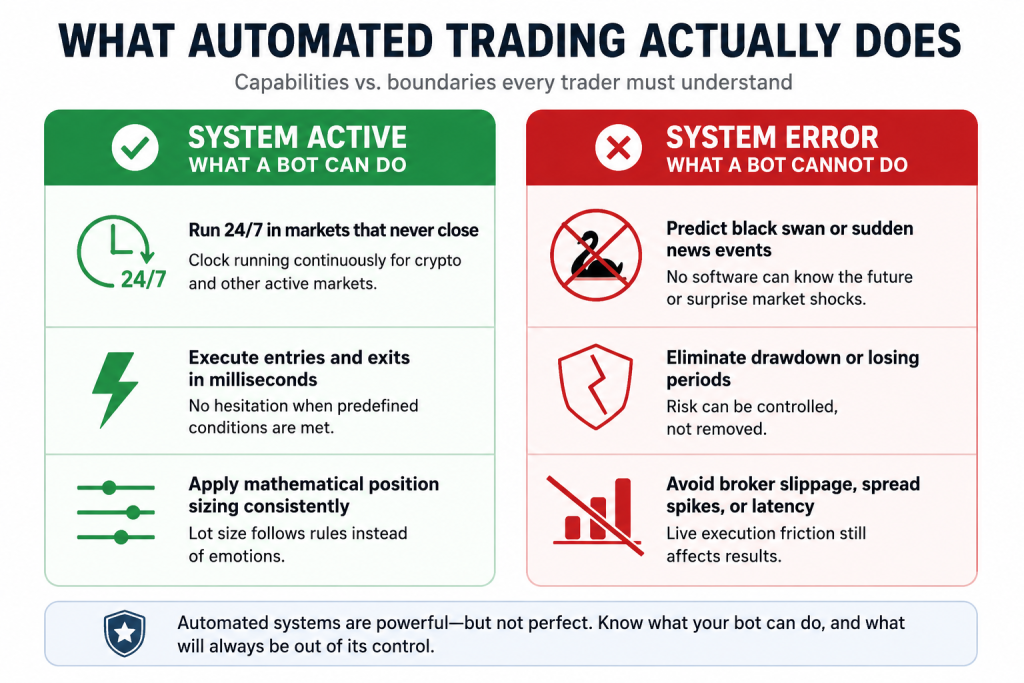
What a bot can do:
- Follow rules without hesitation or second-guessing between sessions
- Execute entries and exits faster than any human reaction time can match
- Monitor multiple instruments simultaneously without losing focus
- Apply position sizing rules consistently to every single trade
- Run 24/7 in markets that never close — like crypto
What a bot cannot do:
- Think beyond the programmed rules.🔑
- Predict market moves that fall outside what its rules were designed to handle
- Remove the possibility of drawdown or losing periods entirely
- Adapt to a market regime its logic does not account for
- Avoid all slippage, spread spikes, or execution delays from the broker side
- Guarantee daily income, fixed returns, or a positive result on any specific trade
The CFTC makes this explicit in its customer advisory: AI technology cannot predict the future or sudden market changes. Anyone promoting an automated system that claims otherwise is either mistaken or deliberately misleading you.
What Makes Automated Trading Useful?
A well-built system can watch several markets at once, size a position correctly, place the order fast, and respect a stop loss without a second thought. That removes a specific category of human error: revenge trading after a loss, moving a stop because the trade “feels” close, or doubling size to make back what just got lost.
Automation also gives a business owner something manual trading struggles to offer: repeatability. Feed the same market conditions into the same system, and you get the same response every time. That makes performance far easier to test, measure, and review than a discretionary approach that shifts with the trader’s mood on any given day.
Below are 3 conditions necessary for sustainable profits in Automated Trading.
3 Conditions for Long-Term Automated Trading Results
At James Trading Strategies, we design bots which hold up over the long run by these 3 conditions: adaptability, risk management, and a market that actually fits the system. Miss one of the three and early gains have a way of turning into a slow bleed later.
The Strategy Has to Adapt to Market Conditions
Markets move because people move them. Fear, greed, and the pull toward safety drive volatility and liquidity up and down in ways that don’t stay constant. A system built only for calm, trending conditions will struggle the moment the market turns unstable, and a system built only for volatility will bleed small losses during quiet stretches.
Adaptation doesn’t need to be complicated. It can be as simple as reducing exposure when volatility spikes outside its normal range, pausing around major news releases, or switching parameters between trending and ranging conditions. What it can’t be is static.
The person/team running the bot still has to check, on a regular schedule, whether the original edge is still there or whether the market has quietly moved past it.
Risk Rules Have to Protect the Capital
Long-term results depend far more on surviving the bad months than on one standout week. Position size limits, stop losses, drawdown thresholds, and an equity-based shutdown rule are what keep a rough season from turning into permanent damage to the account.
Our guide to forex risk management for small accounts walks through why risk per trade and drawdown limits matter so much for traders working with limited capital. The same logic applies here. It doesn’t matter whether a human or a piece of software is pressing the button — the account still needs a ceiling on how much any single mistake or losing streak can cost.
The Market and the Platform Have to Fit the System
A strong strategy running in the wrong environment is still a bad deployment. The stock market, forex trading, and crypto each run on different hours, different cost structures, and different liquidity patterns. The trading platform behind the bot has to support reliable data, clean execution, and real monitoring, or none of the strategy logic matters.
At James Trading Strategies, we constantly produce, improve and watch over our trading systems for you. Audit our expertise below or contact us to experience real automated profits.
👉 Click Here to Audit Our Live Performance on Telegram, OR
👉 Click Here to Contact us for Our Gold, BTC, or Prop Firm Bots.
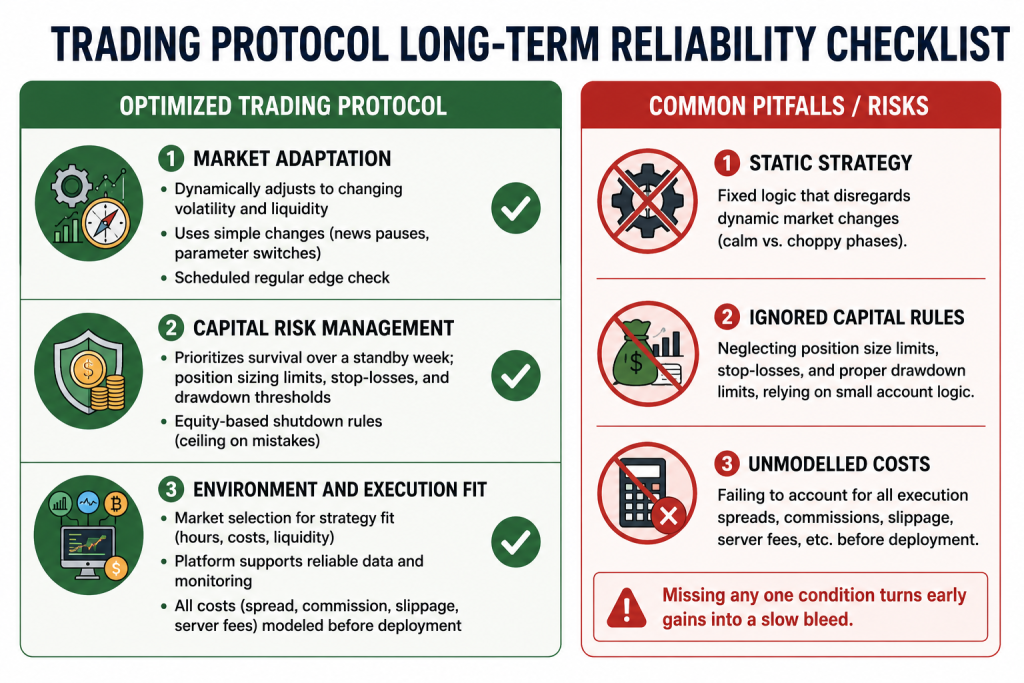
Costs are where a small edge quietly disappears. Spread, commission, slippage, funding rates, and server fees all need to be modelled before real capital goes in, not discovered after the fact. Our BTC scalping bot checklist breaks down how execution costs alone can turn a fast strategy’s paper profit into a live loss.
Automation Can Hide Risk. Here Is How You Keep It in Check
The real danger with automated trading isn’t the software itself. It’s the feeling that nobody needs to watch it anymore. A clean, polished backtest can talk an investor into adding more capital than the system has actually earned the right to manage, well before it has faced live spreads, a dropped connection, or a genuinely difficult market cycle.
Testing the same idea repeatedly against the same historical data can also produce results that look impressive but aren’t real. Research on the probability of backtest overfitting explains why the best-looking result out of dozens of trials often fails to hold up once new, unseen data comes in.
The fix is staged validation, done in order: historical testing, testing on data the strategy has never seen, a demo or small-capital forward test, and clear rules for when the system shuts itself down. FINRA’s guidance on algorithmic trading controls points to the same sequence, stressing risk assessment, software testing, system validation, and ongoing supervision as standard practice, not optional extras.
Be skeptical of any bot marketed as guaranteed income. The CFTC has warned that automated systems can’t predict sudden market shifts and has told investors to account for fees, spreads, and subscription costs before trusting the marketing. Its trading bot advisory is worth reading as a screening tool before committing to any provider.
How Should You Assess an Automated Trading Strategy?
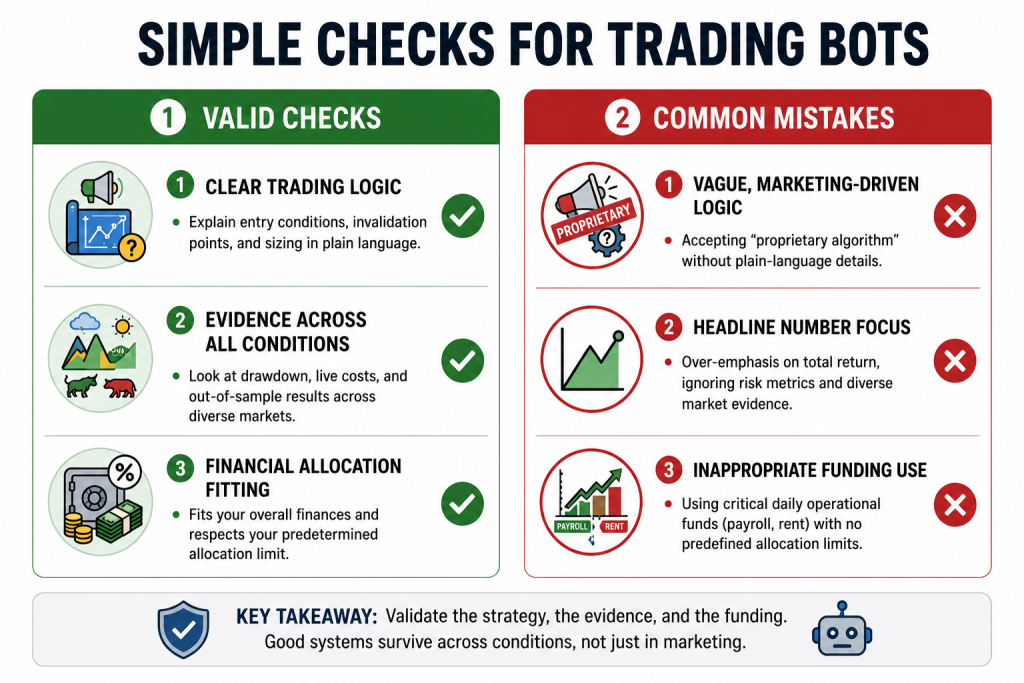
Start with the logic, not the marketing. You should be able to explain the entry condition, the invalidation point, the position sizing method, and the shutdown rule in plain language. “Proprietary algorithm” isn’t an answer when your own capital is the thing exposed.
Look at the evidence across different market conditions, not just the total return figure. Maximum drawdown, recovery time, real live-trading costs, and the gap between backtested results and forward-tested results all matter more than a single headline number. Ask whether the track record actually covers quiet markets, volatile ones, uptrends, and downtrends, or just the period that happened to work.
Decide how the system fits into your wider finances before funding it. Money set aside for payroll, rent, debt, or emergencies has no business sitting in a leveraged trading account. Business owners already carry operational risk day to day, so any market exposure on top of that needs a firm, predetermined allocation limit.
If a managed structure suits you better than running a bot directly, our beginner’s guide to copy trading, forex, and crypto is worth reading before choosing a provider. Due diligence stays the investor’s job either way.
Can Automated Trading Become a Reliable Income Stream?
It can become one income stream among several. It shouldn’t be treated like a salary. Returns don’t arrive on a steady schedule. Even a genuinely sound system can post losing months, and pulling money out during a drawdown weakens the exact capital base the system needs to recover.
The realistic goal is controlled participation in a market that has real potential, not a fixed paycheck with your name on it. Measure results over a meaningful stretch of time, keep business cash completely separate from trading capital, and review the system on a set schedule rather than only when something goes wrong. Human oversight doesn’t stop once the bot goes live. It’s part of the job for as long as the bot is running.
Frequently Asked Questions (FAQs)
1. Why do backtested trading bots often fail when deployed in live markets?
They fail in live trading due to backtest overfitting (tuning parameters until they fit historical noise rather than a genuine edge) and ignoring real-world execution friction. In live trading, execution costs, spread widening during high-volatility news events, and execution latency quietly eat away at paper profits.
2. Can a trading bot run completely on autopilot without human intervention?
No. While automated bots execute rules cleanly without emotional hesitation, markets constantly undergo regime shifts (transitioning between trending, ranging, and highly volatile environments). A static bot cannot recognize when market conditions have changed. This creates the need for supervision. Maybe in the future, yes.
3. What risk controls should be built into an automated trading system?
Key risk management safeguards include:
- Hardcoded Position Size Limits
- Automated Stop Loss & Exit Rules
- Drawdown Circuit Breakers (e.g., a 3% or 5% equity loss ceiling).
- Volatility Filters
4. Is buying a pre-built commercial bot or using copy trading safer than building your own?
Whether using copy trading or third-party algorithms, traders must conduct strict due diligence, perform forward tests with small capital, model live execution fees, and enforce independent account-level loss limits.
5. How does automated trading compare to manual trading?
Automated trading excels at speed, multi-market monitoring, consistency, and eliminating psychological mistakes like revenge trading or moving stops. However, manual traders excel at interpreting macro context, news events, and market nuance. The most sustainable trading setups combine both.
The Bottom Line
Automated trading can support long-term gains when the strategy has a real edge, adapts as conditions change, runs on trading platforms suited to it, and protects the capital behind it. It can add discipline to trading in the stock market or in forex trading that manual execution often struggles to match. It cannot remove uncertainty, and nothing about running it on autopilot changes that.
Treat automation as a supervised investment strategy, not a machine that prints money on its own. Test it slowly. Judge it by its costs and its drawdown, not by the best month on the equity curve. At James Trading Strategies, our goal is to make structured trading opportunities more accessible to everyday entrepreneurs, with education and risk control placed ahead of any return claim.
Want to see how these principles play out in real market conditions? Join the James Trading Strategies Telegram community for practical education on automation, risk, and execution.
Risk disclaimer: Trading involves the risk of loss, and past or simulated performance does not guarantee future results. This article is educational and is not personal financial or investment advice.