
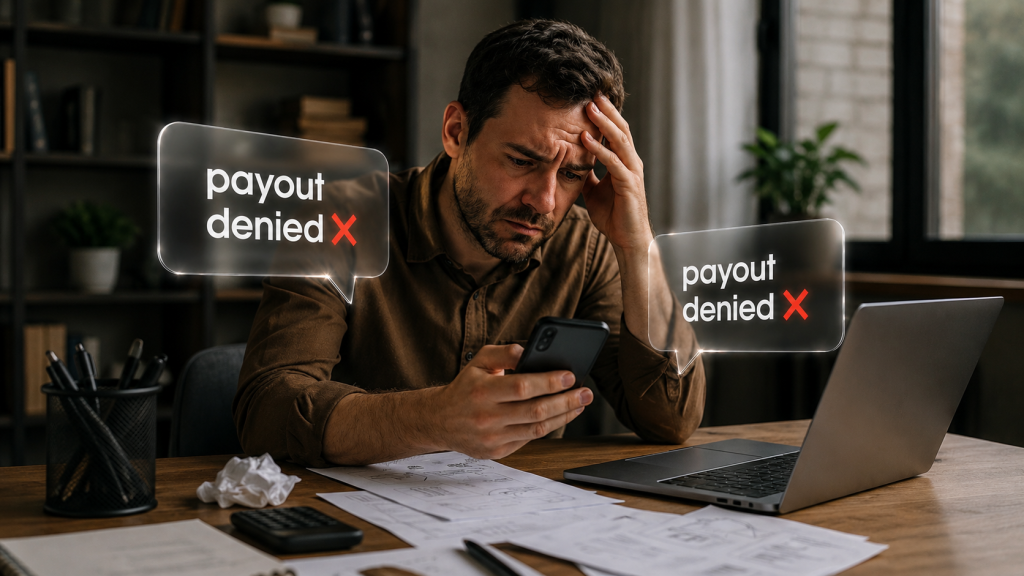
DEFINITION:
A prop firm payout denial is a formal decision not to approve a requested withdrawal or performance payment under the firm’s account rules and review process. A denial can involve eligibility, drawdown, consistency, prohibited trading methods, identity checks or payment verification, and it is different from a payout that is still pending or under review.
When a prop firm payout gets denied, the immediate instinct is to respond — write the complaint, post in the community, tag the firm publicly. That response usually doesn’t resolve the situation.
The first action is not a response.
- Save the denial email,
- Take a screenshot of the dashboard status, and do not touch the prop firm account until you understand exactly what happened.
KEY TAKEAWAYS
• The difference between a normal processing delay, a risk review and a formal prop firm payout denial
• How to identify the exact rule version, account type, timezone and trading period that applied
• A numbered account audit covering drawdown, consistency, trading days, restricted periods and prohibited strategies
• The documents and platform records required for a complete payout evidence pack
• A factual appeal structure that asks precise questions without making unsupported accusations
• When escalation may be appropriate and which routes are realistic for Nigerian and West African traders
Why Do Prop Firms Deny Payouts?
A payout denial is not, by itself, proof that a prop firm is fraudulent. The first task is to identify the written reason and preserve the evidence.
Now before you enter any prop firm challenge, the single most useful habit is to plan your target results before choosing the prop firm.
- Know your maximum drawdown before the first trade.
- Know the consistency rule before you reach the profit target.
- Know the KYC requirements before you request the payout.
This sequence narrows your prop firm choices to ones whose rules match your actual strategy — and removes the pressure of discovering a rule at the exact moment it blocks your withdrawal.
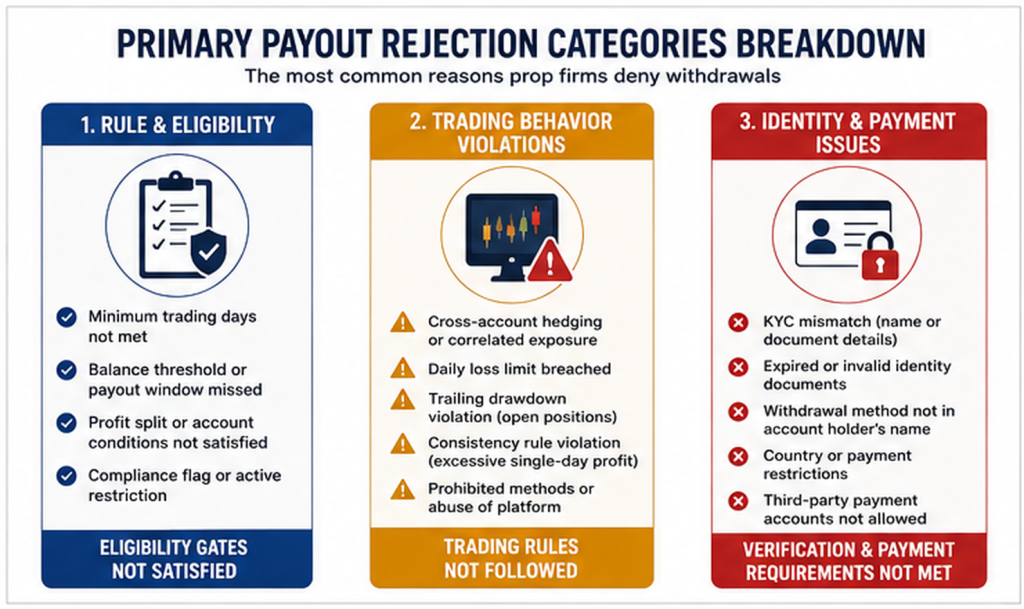
That said, denials happen even to prepared traders. The categories below cover most of what actually causes them.
Common rule and eligibility reasons
Most prop firm payout denials trace back to eligibility conditions that traders missed or misapplied. Minimum trading day requirements, payout window restrictions, profit split conditions that require a minimum account balance after withdrawal, and active compliance flags that pause processing until a review completes — these are the most frequently overlooked eligibility gates.
Trading-behavior reasons
The largest category of prop firm payout denials comes from trading-behavior violations. Cross-account hedging — opening opposing positions across multiple funded accounts to limit directional exposure on any single one — accounts for roughly 22% of disputes according to one published industry breakdown, making it the single most-cited cause. Firms call this group hedging and prohibit it explicitly across their terms.
Other documented triggers include daily loss limit breaches that remain on the record even when the current balance is healthy, trailing drawdown violations caused by open floating positions at the time of a review snapshot, and consistency rule breaches where a single session’s profit exceeded the stated percentage of total period gains.
In April 2025, a trader’s payout was denied over alleged VPN usage — the trader said they had only traded on mobile, and community analysis suggested the flagged connection was corporate ZScaler security software, not a VPN. The case illustrates the asymmetry: the burden of proof falls on you, and the internal investigation starts from the firm’s own data.
Identity and payment reasons
Some denials have nothing to do with trading. A KYC mismatch — name spelling differences between the account and the submitted identity document, an expired document, a payment method not in the account holder’s name, or a country-specific payout restriction — can block a withdrawal entirely. These are usually resolvable quickly, but only through the firm’s official verification channel with the correct documentation.
Is Your Payout Delayed, Under Review, or Formally Denied?
The practical response depends entirely on which situation you are in. Treating a KYC processing hold as a formal prop firm denial and escalating immediately is one of the most common mistakes that complicates what should be a straightforward document submission.
Check the exact wording and timestamp
Read the dashboard status carefully. ‘Processing,’ ‘under review,’ and ‘denied’ are different states requiring different actions. Note the exact timestamp of the original payout request, the stated processing window from the firm’s terms, and any request for additional documents — that request is a different status from a denial, and treating them the same way creates delays.
Ask for written clarification when the notice is vague
If the dashboard shows a delayed status with no explanation, submit one written support message through the official channel: ‘Can you confirm whether this payout request is still in processing, under compliance review, or formally denied? If under review, which policy section applies?’ Keep the message factual and the question specific. Vague questions produce vague responses.
Do not create new activity that changes the evidence
Do not place new trades, delete any messages, or alter the account in any way while the status is unclear. New account activity creates additional data that may be pulled into a review originally about something else.
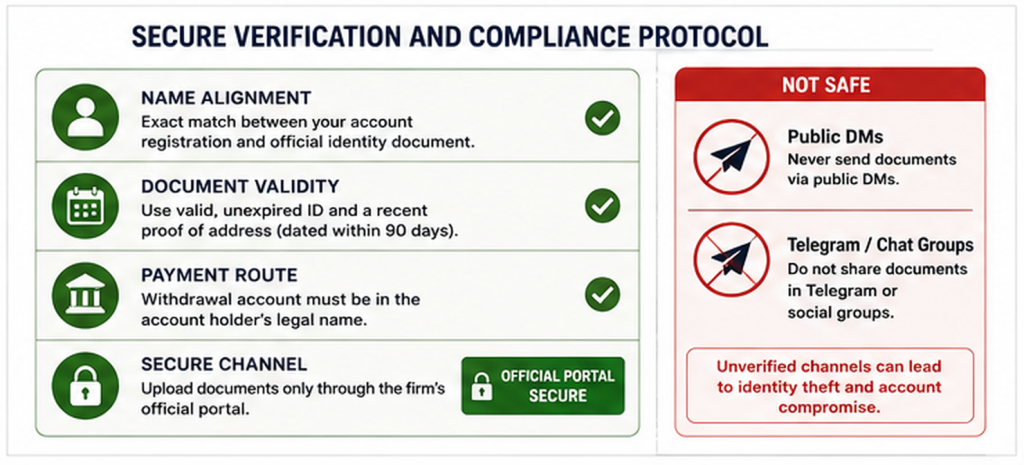
Do not publish KYC documents, account credentials, payment records or full trade-account identifiers in any public channel.
| Status | Typical signal | Immediate action | Do not do |
|---|---|---|---|
| Processing delay | Request pending inside or near the stated processing window | Save status and confirm the expected completion date in writing | Call it a denial before official confirmation arrives |
| KYC/payment hold | Additional documents or payment verification requested by the firm | Submit through the firm’s official portal and save proof of submission | Send identity files through Telegram, chat groups or social media |
| Risk/compliance review | Firm requests trade context or states activity is being reviewed | Preserve all logs and ask which specific rule is under review | Alter files, speculate publicly, or open duplicate tickets |
| Formal denial | Written refusal with a reason or rule reference from the firm | Begin the audit and evidence pack using the steps in this guide | Send an emotional response before reviewing the terms carefully |
Which Prop Firm Rules Applied to Your Account?
The governing rule set is not necessarily what the prop firm’s website shows today. Rules change. A trader who joined a prop firm funded programme in January and requests a payout in June may be operating under terms updated twice in that period. The rule version that applied during the trading period — not the current published version — is the document the dispute is based on.
Save the rule version from the trading period
Use archived terms from confirmation emails, dashboard screenshots taken at account opening, and purchase records. Do not rely on the firm’s current website. If the cited rule was introduced after your funded account was activated, that is a retroactive change — and it is a separate factual point in the appeal.
Match the rule to the correct account type and phase
A two-step evaluation prop firm program has different rules for the challenge phase and the funded phase. An instant funding account has different terms than a standard evaluation account. Add-on features — scaling plans, additional instruments, special payout cycles — may carry their own conditions not in the base terms. Confirm which document governs the specific account, phase, and payout period in question.
Confirm the calculation clock
Identify the firm’s timezone for daily loss resets, how weekends are treated in the trading day count, whether the drawdown calculation uses equity or balance, whether floating losses count toward the threshold, and whether the trailing level adjusts at end-of-day or intraday. These variables change the outcome of every calculation in the audit.
| Rule | Exact wording / source | Version or effective date | Account data needed | Your finding |
|---|---|---|---|---|
| Daily loss | Terms or dashboard rule display | Date/version confirmed from purchase email | Equity and balance records by daily reset period | Pass, fail, or unclear |
| Max/trailing drawdown | Terms or FAQ document | Date/version confirmed from source document | Peak equity, account low, closed and floating P&L | Pass, fail, or unclear |
| Consistency | Payout policy document | Date/version confirmed from source document | Daily or trade-level profit distribution table | Pass, fail, or unclear |
| Prohibited methods | Trading rules or programme addendum | Date/version confirmed from source document | Trade log, timestamps, device and EA records | Pass, fail, or unclear |
How Do You Audit a Prop Firm Payout Denial Step by Step?
Work through each step in order. Each step produces a saved file, a verified calculation, or a written question that feeds the appeal. The entire audit should be completed before any appeal is submitted.
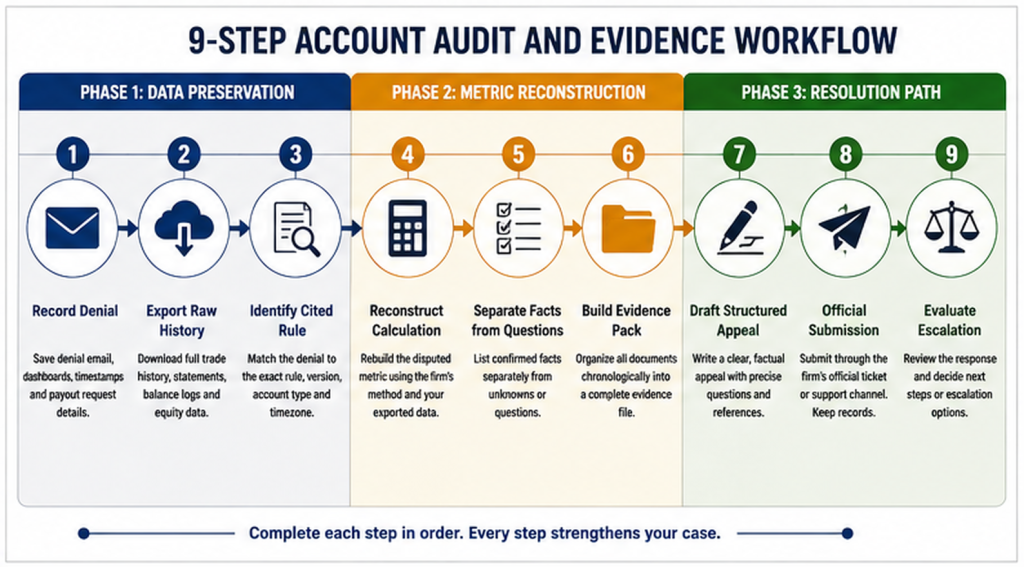
Step 1: Preserve the denial notice and current account state
Save the full email, dashboard message, all visible timestamps, the payout request details, the current account status, and any stated reason — before anything changes in the account display or email thread.
Step 2: Export the complete trade and account history
Download the full platform statement, order and deal history, balance operations log, and equity data if the platform provides it. Do not rely on screenshots of the current dashboard view. Export the raw data files and save them unchanged.
Step 3: Identify the exact rule and version cited
Match the denial wording to the relevant terms document, the account type, the program phase, the effective date, and the correct timezone. If the firm cited a vague reason without a specific rule reference, that gap is your first precise question in the appeal.
Step 4: Reconstruct the disputed metric or event
Calculate the daily loss, trailing drawdown, consistency distribution, trading day count, or alleged prohibited pattern using the firm’s stated method and the data you exported. Do not assume your platform’s display was calculating it the same way the firm’s compliance system was.
Step 5: Separate confirmed facts from open questions
Create two lists: what the exported data confirms clearly, and what remains unclear because data is missing, the rule wording is ambiguous, or the firm has not specified which trade or calculation triggered the decision. The appeal presents confirmed facts in one section and questions in another — not assumptions in either.
Step 6: Build a chronological evidence pack
Organise all documents from account purchase and rule acceptance through the full trading period, payout request, compliance review, and denial. This becomes the reference file for every communication from this point forward.
Step 7: Write a concise appeal with precise requests
State the denial, the rule you are addressing, your calculation, the attached evidence, and the exact clarification or remedy you are requesting. One claim per point. One question per open issue. A long narrative appeal is harder to act on than a short, structured one.
Step 8: Submit through the official channel and log every response
Record the submission date, ticket number, every attachment included, and every response received. Do not open duplicate tickets unless the firm’s terms explicitly describe that as the escalation path. Duplicate submissions can complicate the record.
Step 9: Decide whether escalation is justified
Only after the internal process has completed — or failed to respond within the stated appeal window — should escalation beyond the firm’s own channel be considered. The next section covers what escalation routes are realistic for different jurisdictions.
Keep original exports unchanged. Work from copies and preserve file metadata where possible. Originals may be required if the dispute is escalated beyond the internal review.
What Should a Prop Firm Payout Evidence Pack Contain?
The evidence pack is not for the public. It goes through the firm’s official channel only. Its purpose is to make the disputed issue easy to verify with a complete, accurate record that leaves no ambiguity about what you are claiming and what evidence you are relying on.
A one-page case summary
Include: account programme name, account identifier in masked form, payout request date, denial date, stated reason from the firm, requested outcome, and a numbered index of all attached files. This is the first document the reviewer reads.
A timeline of events
Rule acceptance date, relevant trades, payout request date, any verification requests from the firm, your responses, and the denial — listed in chronological order with dates and timestamps.
Rule excerpts with version evidence
Attach only the clauses that relate to the dispute, with the source URL, PDF filename, email thread, or screenshot showing the version and effective date. Do not attach the full terms document — attach only what is relevant to the specific disputed rule.
Platform records and calculations
The complete trade statement with order-level timestamps, equity or drawdown records that are directly relevant, and a calculation sheet showing your formula, the timezone you applied, the inputs from the exported data, and the result. If your calculation differs from the firm’s stated finding, that difference is the substance of the dispute.
| File | Purpose | Minimum contents | Privacy treatment |
|---|---|---|---|
| 01_Case_Summary.pdf | Explains the dispute in one page | Status, stated reason, requested review, attachment index | Mask account and identity numbers throughout |
| 02_Timeline.pdf | Shows chronology of events | Dates, events, rule acceptance, requests, denial | Exclude personal detail unrelated to the dispute |
| 03_Rules.pdf | Establishes the governing terms | Relevant clauses only, source document, version date | Keep original screenshots or PDFs unchanged |
| 04_Trade_History.csv/PDF | Supports calculations | Full order and deal history with timestamps and P&L | Share only through the firm’s official secure channel |
| 05_Calculations.xlsx/PDF | Reconstructs the disputed metric | Formula used, timezone applied, inputs, result | Work from copies; preserve the original exports |
| 06_Communications.pdf | Shows requests and replies | Full support thread and ticket reference numbers | Redact personal data unrelated to the dispute |
Never post the evidence pack publicly. KYC documents, account records and payment details belong only in the firm’s verified official channels or with a qualified adviser.
How Do Drawdown, Daily Loss, and Consistency Rules Affect Payouts?
These three calculation types cause more confusion — and more denials — than any other category in prop firm disputes. The reason is not that the rules are hidden. It is that each one has inputs that vary by firm, by account type, and sometimes by program add-on. The familiar definition of drawdown is not necessarily the definition used in your account’s specific rule.
Maximum drawdown
Maximum drawdown is the largest drop from an account peak to a later low. Prop firms define the peak differently — some use the balance only, others use equity. Some calculate it at end-of-day only; others track it intraday. A strategy that passes the end-of-day check can still breach an intraday equity-based drawdown rule during a single session.
Daily loss in a prop firm account
The daily loss rule sets the maximum equity drop allowed in one trading session. The reset timezone is the critical variable. A firm that resets at 17:00 New York time applies a different calculation window than one that resets at midnight UTC. Trades placed in the Asian or early London session can fall in a different ‘day’ depending on that reset time. The forex drawdown and account risk management guide covers how daily loss interacts with position sizing and equity protection in practice.
Trailing drawdown
A trailing drawdown threshold moves upward as account equity or balance grows. If your prop firm funded account starts at $50,000 with a $2,500 trailing drawdown, and you trade up to $53,000, the trailing level rises to $50,500. A $1,500 payout withdrawal that reduces the account to $51,500 then leaves only $1,000 of breathing room. Prop firm traders have lost funded accounts within days of their first payout because of this mechanic — a common pattern documented across trading communities. Some firms offer a drawdown reset for a fee; check whether your prop firm provides it before requesting a large withdrawal.
Consistency rules
A consistency rule limits how much of your total payout-period profit can come from a single trading session. A common threshold is 30% — if one session produced more than 30% of your total gains during the period, the payout request may not qualify even if the profit target was reached. Whether this rule applies to your specific program and what percentage threshold applies must come from the actual terms document, not the headline program description.
Floating losses and open positions
Some prop firm accounts calculate drawdown on equity, which includes unrealised P&L. An open losing trade can push the equity-based drawdown below the limit even if all closed trades are profitable. A position that later recovers does not undo a breach that occurred while it was open. This is how traders breach the drawdown rule without a single closed losing trade on the statement.
| Rule | Inputs to confirm | Common misunderstanding | Evidence required |
|---|---|---|---|
| Daily loss | Reset timezone, starting reference, commissions, floating P&L inclusion | Using local midnight instead of the firm’s stated timezone | Equity snapshots and full account statement by session |
| Maximum drawdown | Static or trailing, balance vs. equity, peak definition, intraday vs. EOD | Calculating only from closed trades, ignoring floating losses | Peak-to-low equity reconstruction from exported data |
| Consistency | Period covered, numerator, denominator, any exclusions | Applying a rule from another account type or earlier program version | Daily profit distribution table aligned with the terms |
| Min. trading days | What counts as a qualifying day, payout-period start and end boundaries | Counting calendar days instead of qualifying trading days | Trade dates and payout-period policy cross-referenced |
Use the firm’s written formula and stated timezone. A familiar drawdown definition is not a substitute for the actual calculation method in your account’s specific terms.
Which Prohibited Strategies or Execution Patterns Can Trigger a Review?
The categories below appear consistently across major prop firm terms documents. The goal is to help you understand what may have been alleged and what evidence answers it — not to show how to avoid detection.
Restricted news or market-close trading
Many prop firms prohibit open positions, new entries, or both during specified high-impact news events, rollover windows, weekends, or market-close periods. The window is usually defined in the trading rules document, not in the general programme terms. A trade that opened during a normal session but remained open into a restricted period may still trigger a review.
Copying, coordinated trading and account sharing
The standard prop firm rule is that the account must be traded by the account holder using their own strategy. Running a trade copier into a funded account from an external signal service, allowing a third party to manage the account, or coordinating entries across multiple accounts are all documented denial triggers. Understanding how copy trading platforms work in a standard retail context is different from what is permitted inside a funded evaluation — the firm’s specific terms govern the latter, not general industry practice.
Latency, arbitrage and platform-exploitation allegations
If the denial references latency arbitrage, price manipulation, or platform exploitation, request the specific trade IDs, timestamps, and the exact rule clause that defines the prohibited behavior. These allegations should come with trade-level evidence. A broad label without a specific trade reference is not a verifiable denial and should be the focus of the first question in your appeal.
Two-way trading and cross-account hedging
A normal two-way trading strategy that uses long and short positions on a single account is different from cross-account hedging across multiple funded accounts. The prop firm’s specific terms for your account type and programme determine which is permitted and which is prohibited. Do not assume that a valid retail trading approach is automatically compliant inside a funded account.
EAs, bots and trade-management tools
Prop firms have different rules on automation by account type and programme. Some permit EAs freely. Some restrict specific EA categories. Some require disclosure. Others prohibit automation on evaluation accounts but allow it on funded stages. Verify what the terms state for your specific programme — not the firm’s general information page or what you were told in a Telegram group.
| Review category | Rule to locate | Evidence to preserve | Precise question for appeal |
|---|---|---|---|
| News restriction | Event window and position timing rule in trading terms | Trade timestamps cross-referenced with economic calendar | Which specific trade and which specific event triggered the decision? |
| Copying/account sharing | Ownership and coordination clause in account terms | Device and access records, trade origin documentation | What matching behavior or access record was relied on in the review? |
| Prohibited execution | Definition of latency/arbitrage/exploitation in trading rules | Order entry and fill logs, quote timestamps | Which specific orders met the stated definition in the terms? |
| Automation | EA, bot or copier permission clause for this account type | Tool logs, EA settings, account mode documentation | Which tool or behavior was specifically prohibited for this account? |
This section explains rule categories to help you understand what was alleged and gather appropriate evidence. It does not provide methods for evading detection, bypassing controls, or exploiting platform behavior.
How Can KYC and Payment Checks Delay or Block a Payout?
A payout that appears to be a trading-rule denial may actually be a verification issue. These are resolved differently and usually faster — but only when the correct documents are submitted through the official channel.
Identity or address mismatch
Check spelling differences between your account registration name and the identity document submitted. Check document expiry, address format, and whether the residential address on file matches your current proof of address. Some prop firms require a recent utility bill or bank statement — a document from six months ago may not qualify.
Payment-method ownership and payout route
The payment method used to fund the account or receive the payout must typically be in the account holder’s name. A bank account, crypto wallet, or payment account in a different name can block the withdrawal. Confirm the payout route rules for your specific programme and region — these vary between firms and between account types.
Duplicate accounts or access anomalies
If the firm’s review identifies multiple accounts under the same identity, or an access pattern that resembles another account, they may request clarification. Provide legitimate documentation through the official verification portal rather than through social media, chat, or unverified email. Creating new accounts or changing access methods while the review is active is counterproductive.
How to submit verification safely
Use only the firm’s official secure portal. Confirm the domain is correct before uploading any documents. Save a copy of the submission confirmation. Never send identity documents, recovery codes, or payment credentials through Telegram group chats, WhatsApp messages, social media DMs, or unverified email addresses.
Never send identity documents, recovery codes, passwords or complete payment credentials through Telegram, social media or unverified email addresses — regardless of who makes the request.
How Do You Write a Calm, Evidence-Based Payout Appeal?
The appeal is a factual document. It describes a decision, identifies a rule, presents evidence, and asks a precise question. Firms like FundedNext, FTMO, and FundingPips — which are reputation-sensitive businesses that publicly market their payout track records — do respond to well-constructed factual appeals. The internal compliance process is where the large majority of legitimate prop firm disputes are resolved. An appeal that reads like a complaint thread is harder to act on than one that reads like an audit.
Structure the appeal in four clear sections
State the decision: the denial date, dashboard status, and the reason as stated by the firm. Identify the governing rule: the exact clause, the account type, and the effective date. Present your evidence: numbered attachments with one-line descriptions of what each proves. Ask your questions: one precise, specific question per unresolved issue.
Use a precise subject line and account reference
Example format: ‘Payout appeal — [masked account ID] — [payout request date] — [denial date].’ A clear subject line makes the ticket easier to route to the right team and harder to close without a substantive response.
End with a specific, reasonable requested outcome
Request confirmation, recalculation, or internal review — not an immediate payment demand. Ask for the specific trade ID, timestamp, calculation input, or clause the firm relied on when the denial notice is unclear. Do not include language that makes the firm’s legal team treat the message as a threat rather than a dispute requiring review.
Avoid words such as ‘scam,’ ‘fraud,’ ‘illegal,’ or ‘stolen’ unless a qualified authority has established those facts. A firm-neutral appeal describes the decision, the evidence, and the requested review — nothing more.
APPEAL TEMPLATE
| Field | Your entry |
|---|---|
| Subject line | Payout appeal — [masked account ID] — [request date] |
| Decision received | [Date] and exact dashboard/email status wording |
| Stated reason | Quote or accurate summary from the firm’s denial notice |
| Applicable rule | Clause reference, account type, and effective date of the rule |
| My evidence | Numbered list of attachments with one-line purpose for each |
| My calculation | Concise table or numbered points showing formula, inputs, and result |
| My questions | One precise question per each unresolved issue in the denial |
| Requested outcome | Confirmation, explanation, recalculation, or internal review |
When Should You Escalate a Denied Payout?
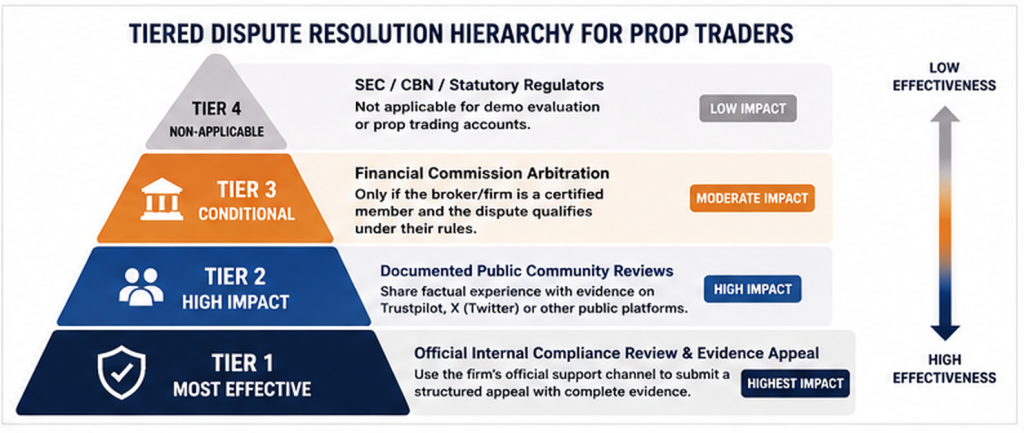
For traders in Nigeria and West Africa, the realistic escalation routes are significantly narrower than they may appear online. Understanding which routes are genuine before investing time and stress in the wrong one is a practical advantage.
Internal review process — most effective step
This is where the large majority of legitimate prop firm disputes resolve. Prop firms like FundedNext, FundingPips, and FTMO are reputation-sensitive businesses — their revenue depends on challenge fee sales, and public payout disputes damage that. A well-documented, factual appeal submitted through the official dispute channel gives the compliance team something concrete to act on. FundedNext’s stated 24-hour payout guarantee (with a $1,000 compensation penalty for missed windows) reflects how reputation-conscious leading prop firms have become. Start here.
Public community pressure — high practical impact
Trustpilot, X (Twitter), and large African trading communities can accelerate a firm’s response when evidence is well-documented and the claim is verifiable. This route carries risk: publishing sensitive account details or making claims you cannot prove creates legal exposure for you. Use only verified facts, redact any personal identifiers, and separate documented evidence from opinion. The evidence-based scam red flags guide provides a separate framework for distinguishing genuine grievances from bad-faith patterns of conduct.
The Financial Commission — conditional applicability
The Financial Commission is an independent external dispute resolution body. This route only applies if the specific prop firm or its partner broker is a certified Financial Commission member. Check the firm’s legal footer for a current certificate link. Most modern prop firms operating under corporate structures in Dubai, Malta, or the Cayman Islands are not Financial Commission members. If there is no certificate link in the legal footer, a complaint will result in a jurisdictional dismissal.
Nigerian SEC, CBN and international bodies — not applicable
Nigeria’s Securities and Exchange Commission and Central Bank of Nigeria do not regulate prop trading. Prop firm challenges are legally categorized as demo evaluation services, not live brokerage accounts. The CFTC, NFA, and CySEC face the same jurisdictional limitation — a profit split dispute from a simulation evaluation is a commercial contractual matter, not a regulated financial breach. Filing complaints with these bodies will not produce a recovery.
Qualified legal advice — when the amount justifies it
When the amount in dispute, the jurisdiction of the firm, or the complexity of the contractual issue justifies it, consult a qualified legal adviser before escalating publicly. Predicting specific legal outcomes for prop firm disputes is outside the scope of this guide, and what works in one jurisdiction may not apply in another.
Rules and escalation routes vary by jurisdiction and firm. This article is educational content, not legal advice, and a documented appeal does not guarantee a payout outcome.
Frequently Asked Questions About a Prop Firm Payout Denial
Can a prop firm deny a payout?
Yes, when the prop firm account terms permit denial for eligibility issues, rule breaches, prohibited trading methods, identity verification failures, or payment conditions.
What should I do first if my prop firm payout is denied?
Save the prop firm denial notice, dashboard status, account statement, and applicable terms before anything changes. Confirm whether the status is a processing delay, a compliance review, or a formal prop firm denial — these require different responses.
Does a denied payout mean the prop firm is a scam?
No. A prop firm payout denial can be disputed or poorly explained without proving fraudulent intent. Compare the decision with the governing terms and the account data, and avoid public accusations unless a qualified authority has established the facts.
What evidence should I include in a payout appeal?
Include a one-page summary, a chronological timeline, the exact rule version with source evidence, your complete trade statement, relevant screenshots, a calculation sheet, the communications thread, and the status of any KYC or payment verification.
Can a drawdown breach happen because of floating losses?
Yes, if the prop firm’s rule is based on equity or explicitly includes unrealised P&L. An open trade in a losing position can push the equity calculation below the drawdown limit even while all closed trades show a profit.
How long should I wait before escalating a payout dispute?
Use the processing and appeal periods written in the firm’s terms or support responses. Request written confirmation of the current status when a deadline passes.
Treat the Payout Dispute Like an Audit, Not an Argument
The five-part sequence works regardless of which prop firm is involved or what the denial reason states: preserve the evidence, classify the status accurately, identify the exact prop firm rule version, reconstruct the disputed metric using the firm’s own formula, and appeal with a factual record. That sequence does not guarantee reversal — but it gives you the strongest position possible at every stage of the process.
The traders who resolve these disputes most consistently are the ones who can show, in a single document, exactly which rule was cited, how their account data compares to it under the firm’s own calculation method, and what specific clarification or review they are requesting.
☐ Denial notice and dashboard status saved before any account activity
☐ Full trade and account statement exported in original form
☐ Rule version and effective date identified and matched to account type
☐ Disputed calculation reconstructed using the firm’s formula and timezone
☐ Evidence pack organised and ready for submission through official channels only

Keep all KYC documents, account statements, and payment records out of public Telegram groups and social channels, regardless of how trusted the community appears.
P.S. Do you need a prop firm bot?Contract us @James the Trader: James the Trader.
Trading forex, gold, and cryptocurrency involves significant risk of loss and is not suitable for all investors. The use of automated trading systems, copy trading, and Expert Advisors does not eliminate risk. Past performance is not indicative of future results. Market conditions, broker spreads, slippage, and system settings all affect outcomes. Only allocate capital you can afford to lose. James Trading University provides educational content only and does not constitute personalised financial or investment advice. Always consult a qualified financial adviser before making trading decisions. Information about payout reviews, appeals and disputes is general educational information and does not constitute legal advice.