A few weeks back, I followed a YouTuber who consistently showed himself flipping $1,000 into $4,000–$5,000 daily. The results looked clean, and the videos looked credible. So I registered for $1k to copy his trades, but not a single trade was ever executed. He simply took the funds and vanished😂.
In my case, it was a controlled test, a capital I could afford to lose entirely. But most people walking into these situations are not testing. They’re trusting.
This Guide gives you a repeatable process for spotting a copy trading scam before you risk your capital. You’ll learn how fake traders attract beginners, how they manipulate performance data, what red flags to check, and what to do if you’ve already lost money.
Key Takeaways
- The most common copy trading scam tactics used to attract beginners
- How to verify live performance history instead of trusting screenshots,
- The difference between realistic drawdown and hidden account blow-up risk,
- how fake traders manipulate statistics and profit charts,
- An expert checklist to use before committing capital, and why past performance, even when it’s real, does not guarantee future results.
Copy Trading Scam?
Copy trading scam is a misleading operation where a master trader or a promoter encourages you to mirror trades using manipulated results, unreal claims, or false credibility. These scams rely on curated performance screenshots, unrealistic return promises, and accounts that hide drawdowns and losing periods.
It’s important to know that a fake copy trader is not always someone who loses trades. The real warning sign is the absence of transparent, verifiable evidence showing how returns were generated under normal trading conditions.
This distinction matters because losing trades are a normal part of any strategy. Even professional fund managers experience drawdown. The International Organization of Securities Commissions (IOSCO) published a report in 2025 specifically warning that copy trading strategies often involve higher-risk, leveraged products like forex and crypto, and that retail investors may not fully understand the implications of automatically imitating trades without active monitoring.
If you’re new to copy trading as a concept and want to understand how the model actually works before learning to spot scams, read our Beginner’s Guide to Copy Trading, Forex and Crypto 2026 first.
How Fake Copy Traders Attract Beginners
Before you can check the numbers, you have to understand why these offers feel convincing in the first place. Scam traders use psychology and marketing, not trading skill, to attract followers. Recognizing their playbook is your first line of defence.
Unrealistic profit claims. Any trader or service claiming daily income, zero losses, or consistent fixed returns is either lying or running a strategy that will eventually collapse. Markets are uncertain by nature. Even the strongest hedge funds in the world have losing months. When someone posts “I make 10% every week, guaranteed,” that language alone is a red flag. No legitimate strategy produces perfectly smooth returns indefinitely.
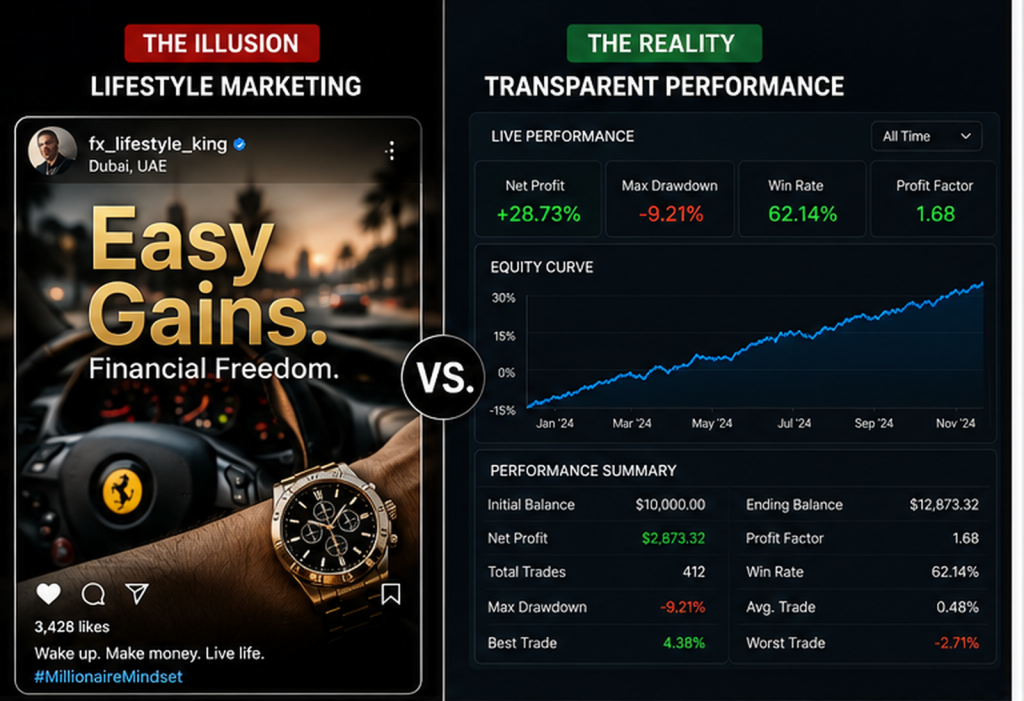
Lifestyle marketing instead of trading evidence. Rented cars, luxury watches, travel photos, “freedom” messaging. This content is designed to sell a feeling, not to demonstrate competence. A real trader shows you account analytics. A fake trader shows you a Lamborghini and a laptop on a beach. The more lifestyle content you see relative to actual trade data, the more skeptical you should be.
Pressure tactics and limited-time access. Scammers compress your decision window on purpose. “Only 5 spots left.” “VIP access closes tonight.” “Prices go up after this week.” These urgency plays exist to push you into depositing before you have time to verify anything. A legitimate trader has no reason to rush you. Their results should speak on any timeline.
Fake community proof. This is one of the most effective tactics. The FTC reported that in 2025 alone, Americans lost $1.1 billion to investment scams originating on social media, with scammers frequently creating WhatsApp groups full of fabricated testimonials and fake “successful investors.” Paid reviews, bot-filled Telegram groups, fabricated withdrawal screenshots, and recycled testimonials from unrelated accounts are all part of the toolkit. If you can’t independently verify the community claims, treat them as marketing, not evidence.
How Scammers Manipulate Copy Trading Results
Even when a scammer shows you data instead of lifestyle photos, that data can be engineered to look far better than reality. Here are the most common manipulation methods.
Hand-picked screenshots. A screenshot of a profitable trade tells you nothing about the 15 losing trades that came before it. Screenshots can be cropped, filtered by date, or pulled only from winning positions. They are the weakest form of performance evidence available, yet they remain the most commonly shared.
Demo accounts presented as live results. Demo trading removes real-world execution conditions like slippage, spread widening during news events, and broker requotes. A strategy that looks profitable on a demo account may perform very differently on a live one. If a trader cannot prove their results are from a live, funded account with real execution, the data is unreliable.
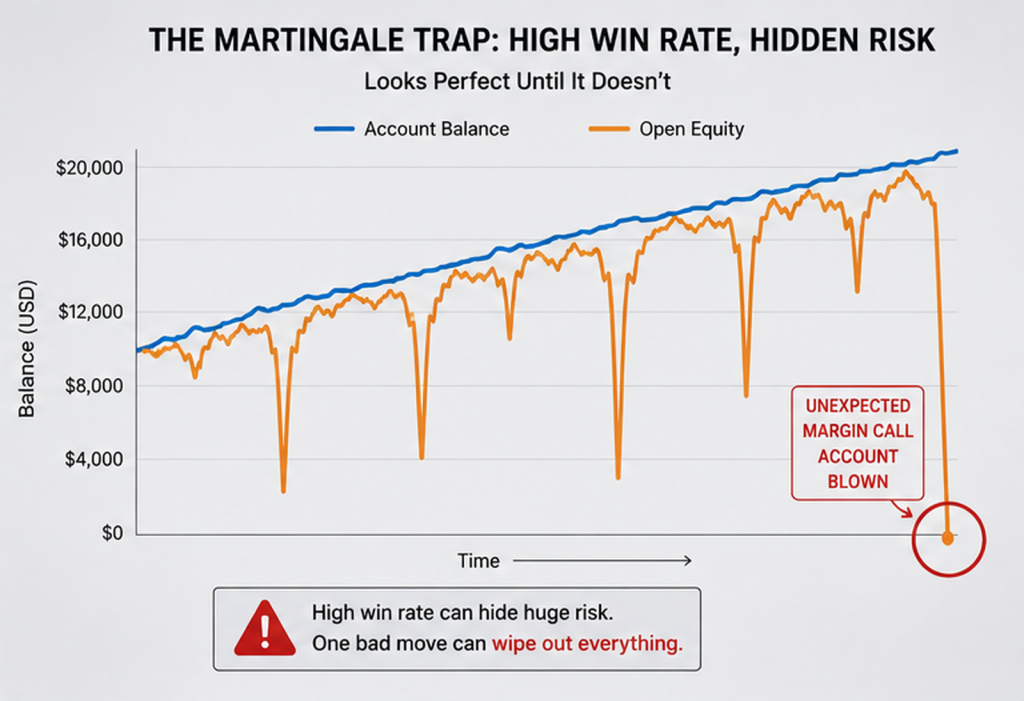
Short-term profit hiding long-term risk. Some strategies can look excellent for weeks or months by taking on outsized risk that hasn’t materialized yet. A trader may stack large positions betting the market won’t move against them. The balance grows steadily right up until one sharp move wipes out the account. This pattern is especially common in gold and crypto trading, where volatility spikes can be sudden and severe.
Martingale and grid systems disguised as skill. A martingale strategy doubles position size after every losing trade, attempting to recover all previous losses with a single win. This creates a smooth-looking equity curve with a high win rate because the system avoids closing losers. But the math works against you: a martingale system starting at 2% risk per trade can blow a standard account after just seven consecutive losses, an event that is statistically common in forex. Grid systems operate on similar logic, opening multiple positions at set intervals and waiting for reversals. If a trader shows you a 90%+ win rate with almost no visible drawdown, ask whether they’re using martingale, grid, or recovery-style position sizing. The answer changes everything about the risk you’re actually copying.
Account resets and deleted history. Some traders abandon blown accounts and start fresh, only showing you the new one. Others add large deposits after losses to mask the drawdown on their balance chart. If the trader has multiple abandoned Myfxbook pages, missing historical records, or a track record that only stretches back a few weeks, that’s a pattern worth questioning.
Copy Trading Scam Red Flags vs. Safer Verification Signals
This comparison is not a guarantee of safety. “Safer” means the trader provides enough evidence for deeper due diligence, not that copying them is risk-free. Use this as a quick filter before committing time or money.
| Area | Scam Red Flag | Stronger Verification Signal |
|---|---|---|
| Performance proof | Screenshots only, no clickable links | Verified live account on Myfxbook or FX Blue |
| Return claims | Extreme or fixed profit promises | Returns shown alongside drawdown data |
| Risk disclosure | No mention of losses or risk | Clear explanation of risk limits and losing periods |
| Account history | New, reset, or suspiciously short record | Longer visible track record across multiple market conditions |
| Marketing style | Urgency, lifestyle content, countdown timers | Transparent trading process and verifiable results |
| Trader identity | Anonymous, no verifiable credentials | Clear trader name, background, or company details |
| Trade data | Only selected winning trades are shown | Full trade history accessible to the public |
| Fee structure | Hidden charges, deposit pressure, or unclear costs | Clear fee breakdown before you join |
| Communication | Defensive responses or “just trust me” | Direct answers to risk and strategy questions |
| Language | Profit guarantees or “risk-free” claims | Risk-aware, educational language |
What Performance Numbers to Check Before Copying a Trader
If a trader does share performance data, you need to know which numbers actually matter and how each one can be manipulated. Most beginners focus on profit percentage and win rate. Those are the two easiest numbers to game.
Maximum drawdown is the largest peak-to-trough drop in account value during the entire trading history. It tells you the worst decline the trader experienced before recovery. According to the Corporate Finance Institute, maximum drawdown is one of the most widely used measures of downside risk across the investment industry. If a trader shows high returns but refuses to show drawdown, the return number alone is meaningless.
Floating drawdown refers to unrealised losses on trades that are still open. This is critical because a trader’s balance can look healthy while their equity, the actual account value including open positions, is deeply negative. Grid and martingale systems are especially prone to hiding large floating drawdowns behind a stable-looking balance line.
Win rate is the percentage of closed trades that ended in profit. A high win rate sounds impressive, but it reveals very little without context. A 95% win rate means nothing if the 5% of losing trades are each 20 times larger than the winners. Always ask what the average loss size is relative to the average win.
Profit factor is the total gross profit divided by the total gross loss. A profit factor above 1.0 means the strategy has made more than it has lost, but the number needs context. A profit factor of 1.2 earned through consistent small trades is very different from 1.2 earned through a few large wins and many small losses.
| Metric | What It Shows | Scam Warning Sign | What to Look For Instead |
|---|---|---|---|
| Account age | How long has the record existed | Only a few days or weeks are shown | Longer verified history across different conditions |
| Win rate | Percentage of closed winning trades | Extremely high with hidden losses | Check the average loss size relative to the average win |
| Max drawdown | Largest peak-to-trough account drop | Drawdown hidden, ignored, or not disclosed | Lower, controlled drawdown relative to returns |
| Floating drawdown | Open losses not yet closed | Balance looks clean, but equity is negative | Equity curve matters as much as balance |
| Lot size pattern | How trade size changes over time | Lots increase aggressively after losses | Consistent sizing is easier to evaluate |
| Monthly return | Profit over a set period | Returns look extreme or unnaturally smooth | Returns must be judged against the risk taken |
| Trade history access | Full list of all trades | Only screenshots or selected trades are shown | Full public history is far stronger evidence |
The Copy Trader Due Diligence Checklist
This checklist combines verification and risk management into a single process. Run through it before you commit capital to any copy trader, signal provider, or managed account. Verification reduces uncertainty, but it does not remove trading risk. Even thoroughly verified strategies can experience drawdown and losses under changing market conditions.
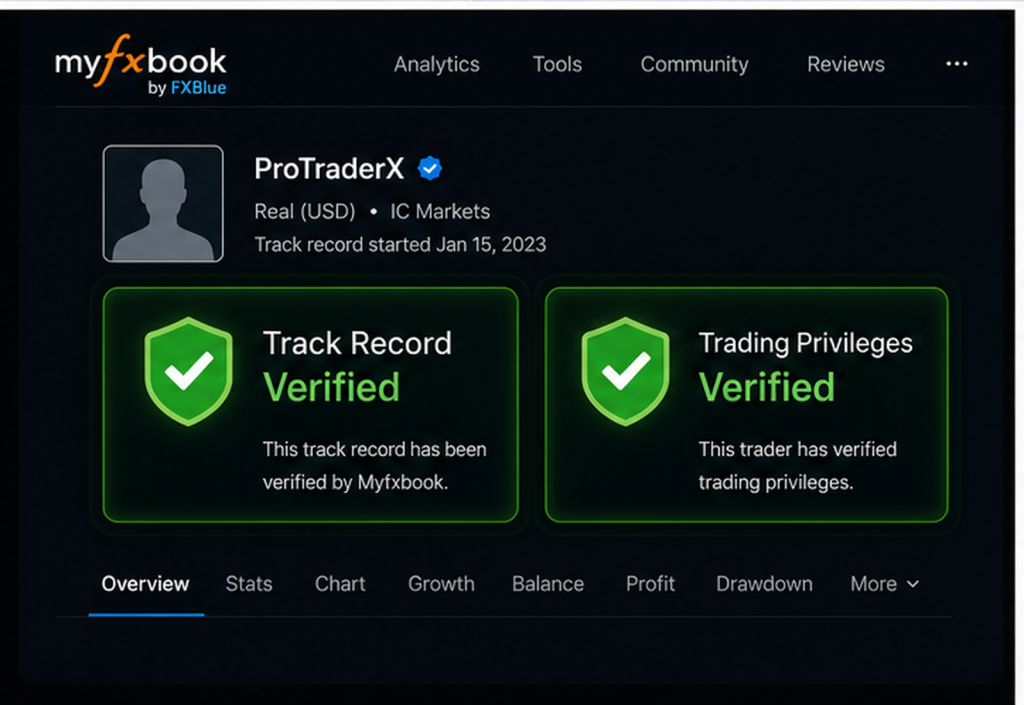
1. Confirm the trader has a verified live track record. Ask for a link to a verified account on Myfxbook or FX Blue. Myfxbook’s verification system confirms that the account is real (not demo), that the track record data matches the broker’s records, and that the person showing the results actually holds trading privileges on the account. If the account lacks these verification badges, or the trader refuses to share a link, that alone is reason to stop.
2. Check account age across different market conditions. A two-week winning streak proves nothing. You want to see how the trader performed during volatile periods, major news events, and extended losing cycles. A minimum of several months, ideally a year or more, gives you a far better picture of how the strategy behaves when conditions change.
3. Compare profit with drawdown. Ask the question: “How much risk was taken to make this return?” A 100% annual return with 60% max drawdown tells a very different story than a 40% annual return with 12% drawdown. The second trader is managing risk far more effectively, even though the headline return is lower.
4. Review open trades, not just closed trades. If a trader’s Myfxbook page shows private open trades, hidden equity, or restricted history, be cautious. Balance and equity should both be visible. Hidden floating drawdown is one of the most common ways results are made to look safer than they actually are.
5. Look for signs of martingale, grid, or recovery trading. Check the trade history for patterns: does lot size double or increase sharply after losing trades? Are multiple positions stacked on the same pair in the same direction? Does the strategy hold losing trades open for days or weeks, waiting for a reversal? Research from the National Centre for Biotechnology Information (NCBI) has shown that followers on social trading platforms tend to take more risk when signal providers increase their risk, creating a compounding effect that most beginners don’t account for.
6. Check whether trade size is consistent. Stable, proportional position sizing is a sign of disciplined risk management. If trade sizes jump erratically, especially after losses, the trader may be chasing recovery rather than following a structured plan.
7. Read the fee structure before depositing. Understand performance fees, subscription costs, minimum deposits, platform fees, broker commissions, and withdrawal restrictions before you start. If the fee structure is hidden, unclear, or requires you to deposit before the details are revealed, walk away.
8. Test with a demo or minimum capital first. Start by observing the trader’s live behaviour with the smallest possible allocation. Watch how they handle losing periods, news events, and drawdowns. If the trader’s real-time behaviour doesn’t match what their historical data suggested, you’ll find out before meaningful capital is at risk.
9. Set your own risk limits before copying. Decide in advance the maximum you’re willing to lose, your acceptable drawdown percentage, and the point at which you will stop copying the trader entirely. This stop-copy rule should be set before you begin, not after losses have already started. Emotional decisions made during a drawdown are almost always worse than pre-planned ones.
10. Walk away if answers are vague. Ask the trader directly about their strategy, their risk approach, their worst drawdown, and their losing periods. A legitimate trader can answer these questions without becoming defensive or evasive. If the response is vague, dismissive, or redirects to lifestyle marketing, you have your answer.
If you want to see how we approach copy trading at JTU with transparency, published results, and risk-aware expectations, visit our Telegram community to review everything for yourself before making any decision.
What to Do If You’ve Already Been Scammed
If you’ve already sent money to a fraudulent trader or platform, act quickly. The steps below won’t guarantee recovery, but they improve your chances and help protect others from the same scam.
Document everything immediately. Save screenshots of all conversations, transaction receipts, deposit confirmations, trade history (if any exists), emails, social media messages, and any marketing materials or promises the trader made. Store these in a separate folder. This evidence is essential for every step that follows.
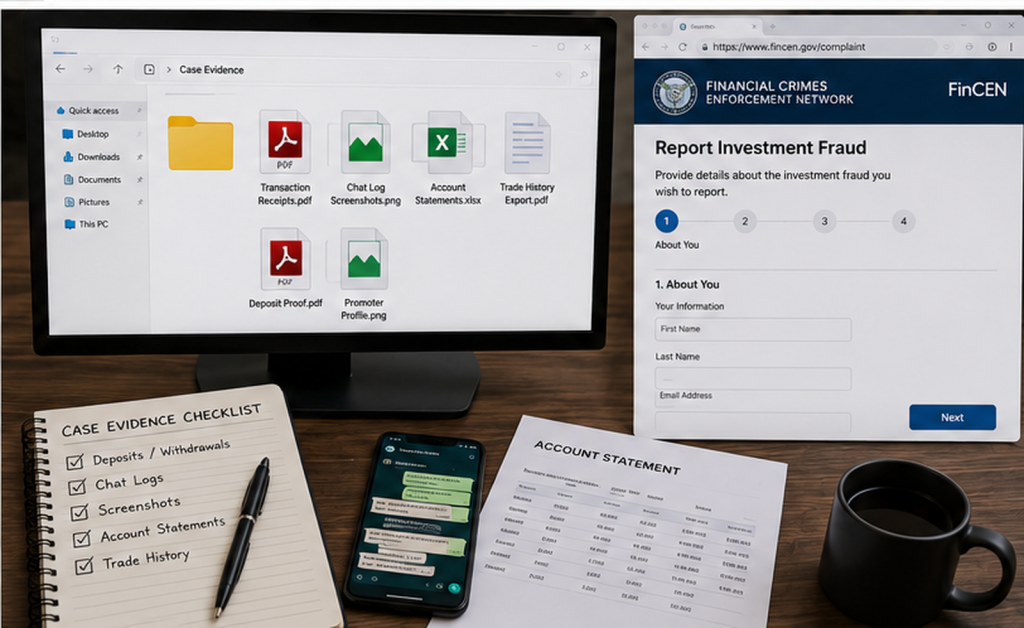
Report to the relevant financial authority. Which body you report to depends on your location and the trader or broker involved:
If the broker or trader operates from or targets the UK, you can report to the FCA through their ScamSmart portal or search the FCA Warning List to check whether the firm is already flagged.
If the broker is a member of the Financial Commission, you can file a dispute directly for free. Their Compensation Fund can pay up to €20,000 per complaint if the broker refuses to comply with a ruling.
In the US, forex-related complaints can be reported to the CFTC. For broader investment fraud, the FTC accepts reports through ReportFraud.ftc.gov.
Contact your bank or payment provider. If you deposited via bank transfer, credit card, or payment app, contact them as soon as possible. Some banks can initiate chargebacks or flag the receiving account. The sooner you act, the better your chances.
Do not pay anyone who offers to recover your money. Recovery scams are one of the most common follow-up frauds after an initial loss. Scammers target people who’ve already been burned, offering to trace funds or file claims for an upfront fee. The FTC has flagged this as a growing pattern, where victims experience a second loss from someone claiming to help recover the first. Legitimate regulatory bodies do not charge fees for filing complaints.
Risk Disclosure: Trading forex, gold, and cryptocurrency involves a significant risk of loss and is not suitable for all investors. The use of automated trading systems, copy trading, and Expert Advisors does not eliminate risk. Past performance is not indicative of future results. Market conditions, broker spreads, slippage, and system settings all affect outcomes. Only allocate capital you can afford to lose. James Trading University provides educational content only and does not constitute personalised financial or investment advice. Always consult a qualified financial adviser before making trading decisions.
Copy Trading Scams FAQ
How do I know if a copy trader is fake?
Warning signs include unverifiable results shared only as screenshots, pressure to deposit quickly, hidden drawdown data, unrealistic return claims, and refusal to share a full trade history through a verified platform like Myfxbook or FX Blue. If a trader cannot answer direct questions about risk and losses without becoming defensive, treat that as a signal to stop.
Are copy trading screenshots reliable?
On their own, no. Screenshots can be edited, cropped, cherry-picked from winning dates, or pulled from demo accounts. A verified live account history that shows balance, equity, drawdown, open trades, closed trades, and account age is substantially stronger evidence.
Can a trader with a high win rate still be risky?
Yes. A trader can close 95% of trades in profit and still be dangerous if the losing 5% carry losses many times larger than the average win. Martingale and grid systems are especially prone to this pattern. Always check the average loss size, the maximum drawdown, and the lot sizing pattern before focusing on win rate.
What drawdown level is too high for copy trading?
There is no universal safe number. Acceptable drawdown depends on the strategy type, account size, trading frequency, position sizing, and your own maximum loss tolerance. What matters most is that drawdown is disclosed transparently and proportional to the returns being generated.
Should I copy a trader who promises daily profit?
No. A daily profit promise is one of the strongest red flags in copy trading. Markets are uncertain, and losing trades are a normal part of any real strategy. Any trader claiming a fixed daily income is either misrepresenting their results or running a strategy that accumulates hidden risk until it fails.
Is copy trading safe for beginners?
Copy trading can help beginners observe how strategies are executed in live markets, but it is not automatically safe. You still need to verify the trader, understand the risks, test with small capital, and set your own stop-copy rules. Copying a trader without doing due diligence is no different from handing someone your money and hoping for the best.
Safer Copy Trading Starts with Verification, Not Trust
You don’t need to become paranoid about every trader you encounter. You need a process.
The pattern behind copy trading scams is predictable: show profit, hide risk, compress the decision window, discourage questions. Once you recognize this pattern, most scams become obvious before you ever open your wallet.
The checklist in this post is designed to be used every time, not just once. Verify the live account. Check the drawdown. Review lot sizing. Understand the fees. Test small. Set a stop-copy limit before you start, and walk away from anyone who can’t give you a direct answer about how they manage risk.
Trading involves real risk, and no amount of verification eliminates that. But verification separates the traders worth evaluating from the ones who should never get access to your capital.
If you want to keep learning about copy trading, risk management, and structured trading strategies, join the JTU Telegram community where we share education, results, and honest conversations about what works and what doesn’t.