
An arbitrage scanner is what turns funding rate arbitrage from a theory into something you can actually execute. It pulls live funding rates from dozens of exchanges into one screen, so you can see where a delta-neutral position pays before you commit real capital.
This guide breaks down how funding rate arbitrage works, what a proper arbitrage scanner should show you, and what it still won’t protect you from.
What Does an Arbitrage Scanner Show You?
| An arbitrage scanner is a monitoring tool that pulls live funding rates from multiple crypto exchanges into a single dashboard and lines up the different payment intervals so they’re comparable. The scanner doesn’t place a trade for you, and it doesn’t guarantee an outcome. It shows you where the opportunity currently sits so you can decide whether it’s worth acting on. |
Key Takeaways
- Funding rate arbitrage earns yield from perpetual futures funding payments, not from predicting price direction.
- A delta-neutral position, long spot plus an equal short perpetual, cancels out price exposure.
- Positive funding rates mean longs pay shorts, and the short perpetual leg is what collects those payments.
- Checking funding rates across exchanges by hand takes 20 to 30 minutes; an arbitrage scanner does the same job in seconds.
- A proper arbitrage scanner normalises payment intervals, works out spreads after fees, and alerts you before a window closes.
- The strategy generally needs $5,000 to $10,000 in capital before fees stop eating most of the yield.
- An arbitrage scanner reduces the effort required to find a trade. It does not remove funding reversal risk, liquidation risk, or exchange risk.
What Is Funding Rate Arbitrage, and Why Do You Need a Scanner for It?
Funding rate arbitrage is a delta-neutral strategy. You hold a long spot position and a short perpetual futures position of matching size in the same asset, at the same time. Because one leg gains what the other loses on any price move, your net exposure to that price is close to zero. What’s left is the funding payment.
Perpetual futures don’t expire, so exchanges use a funding rate to keep the contract price anchored to the spot price. As Kraken explains in its guide to perpetual futures contracts, when the contract trades above spot, longs pay shorts, and when it trades below spot, the payment reverses. You’re not betting on which way BTC moves. You’re positioned to collect whichever side of that payment is currently profitable.
Here’s what that looks like with real numbers. Say you put $10,000 into the trade, split between a spot BTC buy and a short BTC perpetual of equal size. If the funding rate is running at 0.03% per 8-hour settlement, that’s three payments a day, so roughly $9 a day before fees.
It sounds small until you see it compounding across months, and it sounds a lot less exciting once trading fees, withdrawal costs, and spread are subtracted from it.
The table below shows how that yield tends to play out at different capital levels and market conditions, based on data pulled from arbitrage scanner platforms and trading write-ups tracking the strategy through 2026.
| Capital | Market Scenario | Est. Net Annual Yield After Fees |
| $10,000 | Favourable — high positive funding rates | 10–20% APY |
| $10,000 | Neutral market conditions | 3–8% APY |
| $25,000+ | Full market cycle average | 8–15% APY |
| Under $5,000 | Below practical minimum | Fee drag consumes most or all yield |
This is a different kind of arbitrage from the triangular arbitrage strategy we’ve covered before, where the edge lives in a price mismatch across three trading pairs and closes in milliseconds. Funding rate arbitrage plays out over hours and days instead of seconds, but the same underlying problem applies: the rate you see right now is not the rate you’ll get if you take too long to act. That’s the entire reason an arbitrage scanner exists.
Without one, you’d be opening tabs for Binance, Bybit, OKX, and Hyperliquid, writing down each funding rate by hand, and comparing them manually. By the time you’ve done that across five exchanges, the best rate has usually moved. One open-source scanner builder described polling seven exchanges every five minutes and ranking every coin by the spread between its cheapest long leg and its most expensive short leg — which is exactly the kind of comparison a human can’t do reliably at speed.
What Does “Delta-Neutral” Mean in This Context?
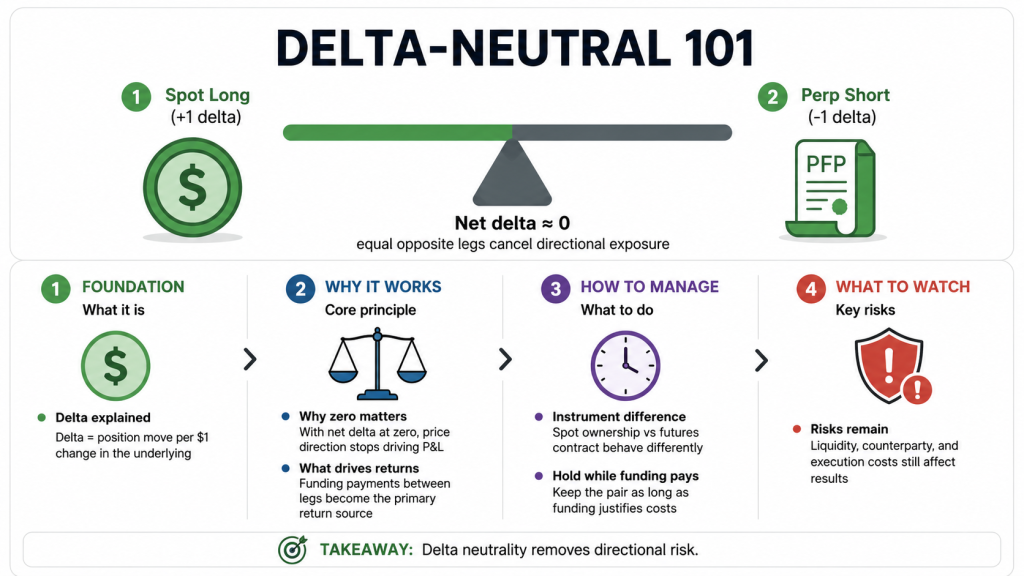
Delta measures how much a position moves for every $1 move in the underlying asset. A long spot position has a delta of +1: it gains a dollar for every dollar BTC rises. A short perpetual futures position of equal size has a delta of −1: it loses a dollar for that same move. Add the two together, and net delta comes out to zero, which is what “delta-neutral” refers to in the finance world more broadly.
That zero is the entire point of the strategy. Price direction stops mattering to your P&L. What’s left driving your return is the funding payment moving between the long and short side every settlement period, independent of whether BTC is up, down, or flat for the day.
It’s worth noting this isn’t the same setup as the two-way trading and hedging approach we’ve written about for forex and gold. That guide covers opening opposing positions on the same instrument to pause directional exposure temporarily.
Funding rate arbitrage uses two different instrument types, spot and perpetual, specifically to hold that zero exposure for as long as the funding payment stays worth collecting. If you’re not clear on how spot ownership differs from a futures contract in the first place, our spot vs futures trading guide covers that distinction before you build either leg.
Why Manual Rate-Checking Fails Traders
The core problem is speed. Checking funding rates across five or six exchanges by hand takes 20 to 30 minutes once you account for logging in, finding the right page, and writing the numbers down somewhere you can compare them.
Attractive funding spreads rarely last that long. By the time you’ve finished the round trip, the opportunity you were chasing has usually narrowed or disappeared.
The second problem is interval mismatch. Most centralised exchanges settle funding every 8 hours. Several decentralised platforms, including Hyperliquid and Drift, settle every hour. Comparing an 8-hour rate directly against a 1-hour rate without converting both to the same timeframe produces a number that looks meaningful but isn’t.
There’s a parallel here to the execution-speed problem we covered in the BTC scalping bot guide: a human reacting manually is competing against systems that never blink. An arbitrage scanner doesn’t remove the skill required to run the strategy. It removes the twenty-minute lag that makes acting on stale data the default outcome for anyone checking rates by hand.
But Can Small accounts survive? (Big accounts too)
With the right tool, yes, of course.
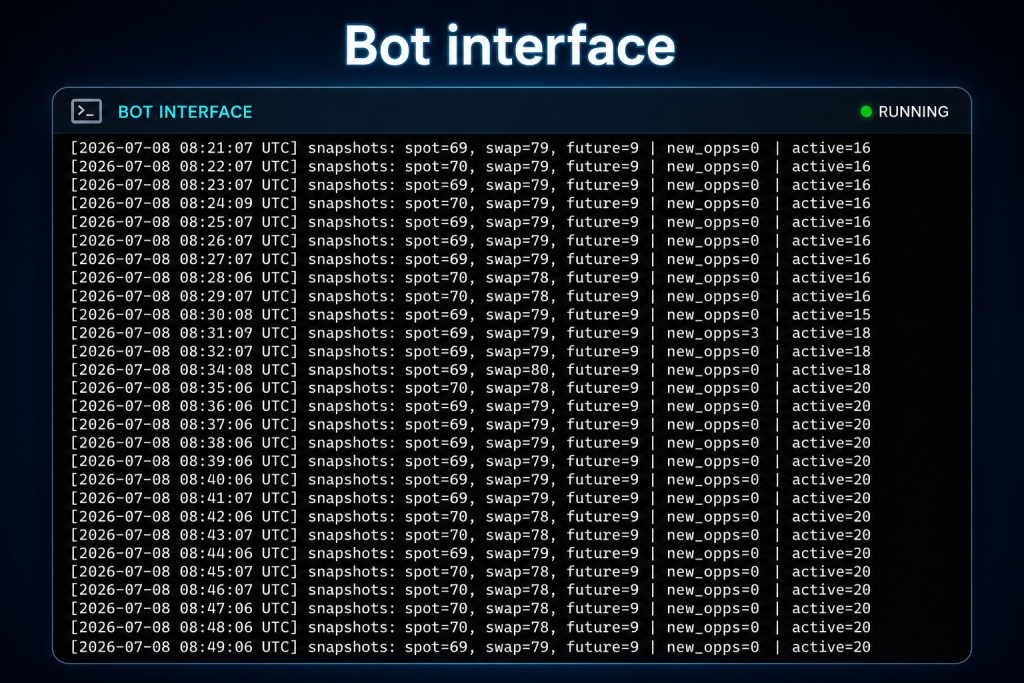
And if you’re wondering how, here’s the answer: James DELTA-NEUTRAL Arbitrage Bot.
This bot is designed to excel at 3 things:
- ⚡Speed → scans multiple exchanges in seconds
- 🎯Accuracy → calculates fees/slippage and net edge
- 📈Scale → evaluates opportunities across 10+ exchanges
Built to Make Arbitrage Analysis Faster and More Structured
- Scan Multiple Exchanges, and notifies you: This bot compares opportunities across 10+ (Gate, OKX, Binance, MEX-C, Bybit, and more) exchanges simultaneously, reducing the need to jump between platforms and manually compare data.
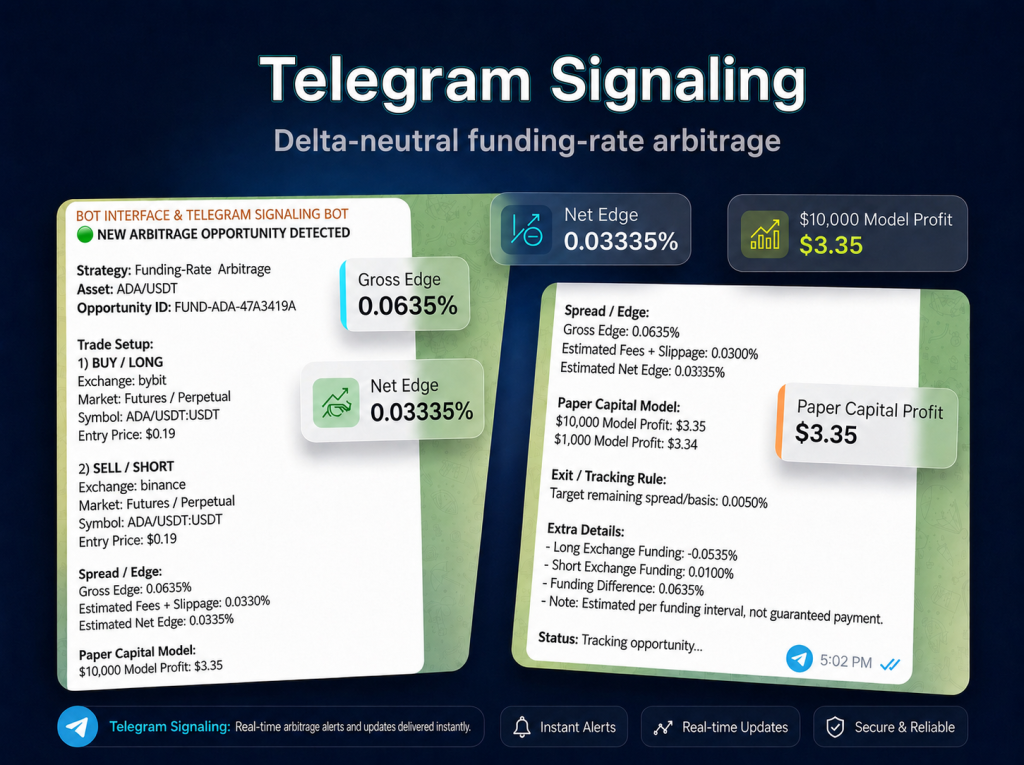
- See the Real Cost: Estimated fees and slippage are included in the analysis, helping you look beyond the headline spread and focus on the estimated net edge.
- Understand the Dollar Impact: The Paper Capital Model shows how the estimated edge translates to your selected capital size, making the opportunity easier to evaluate.
- Know Your Exit Condition: A defined tracking rule gives you a numerical spread target to monitor, helping you respond when market conditions change.
If you want to analyze arbitrage opportunities with greater speed, structure, and precision, this is the tool built for the job.
👉 Click here to contact us for James DELTA-NEUTRAL Arbitrage Bot.
What a Proper Arbitrage Scanner Actually Does
Not every scanner on the market does this job well, and the features below are what separate a genuinely useful arbitrage scanner from a page that just lists numbers.
| Feature | Why It Matters |
| Real-time updates (sub-60 second refresh) | Opportunities can close inside 30 minutes; stale data means you’re trading on a rate that no longer exists. |
| Multi-exchange aggregation in one view | Checking five-plus exchanges manually introduces errors and eats the time the trade needed. |
| Auto-normalised funding intervals | Comparing an 8-hour CEX rate against a 1-hour DEX rate without conversion gives you a meaningless number. |
| Historical rate charts (5+ day view) | Shows whether a rate is a stable trend or a one-period spike before you commit capital. |
| Alert and notification system | You can’t watch a dashboard around the clock; a push alert is what makes this workable around a normal schedule. |
| Spread calculator including fees | Shows the net result after entry fees, exit fees, and spread — the number that actually matters. |
| Combined DEX and CEX coverage | Hyperliquid and Drift often post higher rates than Binance or Bybit on the same asset. |
| Liquidation risk warnings | A sharp 10–20% move can trigger a margin call before your next funding payment lands. |
CoinGlass, one of the more established platforms in this space, runs a dedicated funding rate arbitrage tool that ranks the spread between exchanges across major perpetual pairs, which gives you a sense of what a working arbitrage scanner is meant to output.
Independent builders have taken the same idea further: one developer’s write-up on building a free cross-exchange scanner describes polling around 3,700 perpetual contracts across seven exchanges every five minutes and annualising the yield per symbol correctly, rather than assuming every exchange settles on the same 8-hour clock.
How to Read an Arbitrage Scanner Before You Open a Position
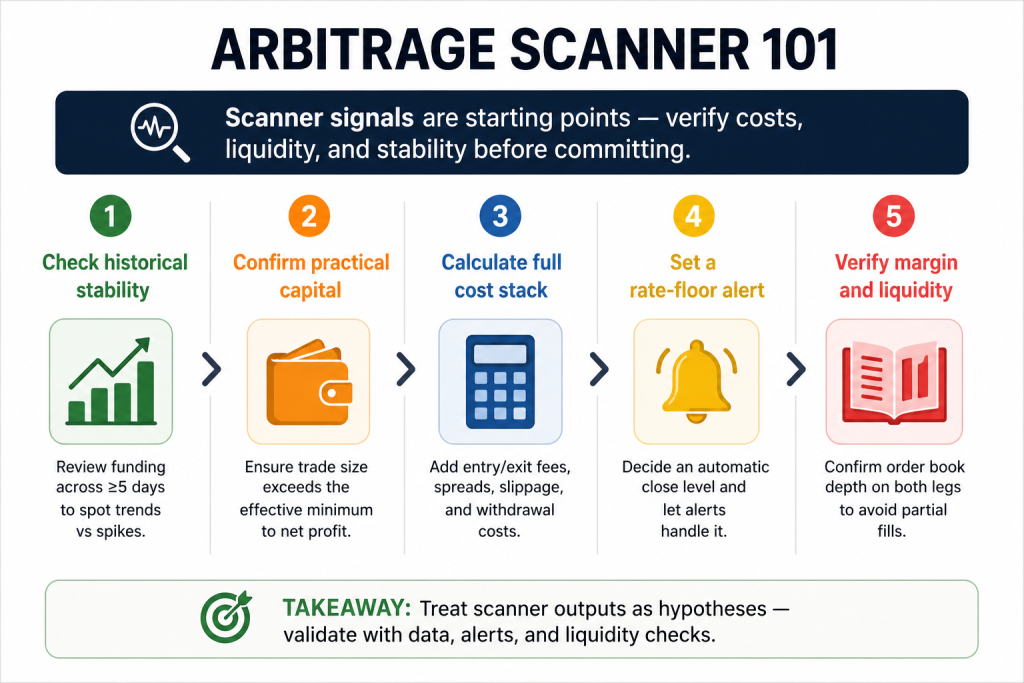
Seeing a big number on a scanner is not the same as having a trade worth taking. Work through these five checks before you commit capital.
- Check historical rate stability across at least five days. A single high reading can be a spike about to reverse, not a trend you can build a position around.
- Confirm your capital is above the practical minimum. Positions under roughly $5,000 tend to have most or all of their funding yield consumed by entry, exit, and withdrawal fees.
- Calculate the full cost stack before entering. Add entry fee, exit fee, spread, expected slippage on both legs, and withdrawal costs, then compare that total against the funding you’d actually collect.
- Set a rate-floor alert. Decide the funding level at which you’ll close the position, and let the arbitrage scanner notify you automatically instead of relying on you remembering to check.
- Verify margin and liquidity on both legs before funding either wallet. A scanner showing an attractive rate doesn’t confirm the exchange has the order book depth to fill your size cleanly.
What an Arbitrage Scanner Can’t Protect You From
A scanner is a monitoring tool. It tells you where the opportunity is right now. It doesn’t remove the risks that come with running the strategy, and treating it as a safety net is where traders get hurt.
Funding rates reverse without warning. A rate paying a healthy 30% annualised can flip negative overnight if sentiment shifts, and a position that was earning yesterday can start costing you money today if you’re not watching the alert you set.
Liquidation risk sits on the perpetual leg specifically, even though the position is supposed to be delta-neutral overall. The CFTC’s advisory on virtual currency trading is direct about this: leverage amplifies the underlying risk, and a sudden adverse move can force a margin call before your funding payment ever arrives. A scanner shows you the rate. It does not manage your margin for you.
Exchange counterparty risk is the risk that sits underneath the whole trade. Both legs of the position live on centralised or decentralised platforms, and your capital is exposed to whatever operational or security risk that specific exchange carries, separate from anything the funding rate itself is telling you.
Basis risk shows up at the close. Spot and perpetual prices rarely converge to the exact same number the moment you decide to exit both legs. That small gap, multiplied across a large position, can shave a meaningful amount off the return an arbitrage scanner appeared to be showing you at entry.
Is Funding Rate Arbitrage Right for You?
| Trader Profile | Fit | Why |
| Under $5,000 capital | Not practical yet | Fee drag from entry, exit, and withdrawal costs tends to consume most or all of the funding earned |
| $5,000–$10,000 | Workable with tight cost control | Enough room to absorb fees if you’re monitoring the position and using an arbitrage scanner to catch reversals |
| $25,000 and above | More comfortable operating range | Better cushion to absorb fee drag and short-term rate swings across a full market cycle |
| Can’t monitor daily | Higher risk without automation | Funding reversals and margin issues need to be caught quickly; alerts help, but they don’t replace attention. |
This isn’t a strategy you set and forget. It rewards traders who can check in regularly, understand margin mechanics on the futures leg, and are comfortable holding capital across two separate wallets or exchanges at once.
Frequently Asked Questions
What is funding rate arbitrage in crypto?
Funding rate arbitrage is a delta-neutral strategy where a trader holds a long spot position and a matching short perpetual futures position in the same asset, collecting the periodic funding payment while price exposure between the two legs cancels out.
What tools do you need for funding rate arbitrage?
You need access to both a spot exchange and a futures or perpetual exchange (often the same platform), enough capital to absorb fees on both legs, and an arbitrage scanner to compare live funding rates across venues instead of checking each one manually.
Is funding rate arbitrage risk-free?
No. It removes directional price risk between the two legs, but it still carries funding reversal risk, liquidation risk on the futures leg, exchange counterparty risk, and basis risk when the position is closed.
How much capital do I need to start funding rate arbitrage?
Most traders find $5,000 to $10,000 is the practical minimum before fees start consuming most of the funding earned. Positions built with less capital tend to see yield eaten by entry, exit, and withdrawal costs.
Can an arbitrage scanner guarantee a profitable trade?
No. An arbitrage scanner shows you where funding rates are currently favourable across exchanges. It does not guarantee the rate will hold, that liquidity will be sufficient to fill your size, or that the position will remain profitable after fees.
Is funding rate arbitrage legal?
Funding rate arbitrage itself is a standard trading strategy available on regulated and unregulated exchanges alike. Rules vary by jurisdiction and by exchange, so confirm your local regulations and the specific platform’s terms before trading perpetual futures.
What it all means.
An arbitrage scanner doesn’t replace understanding the strategy behind funding rate arbitrage. It replaces the twenty-minute manual check that made the strategy impractical for most traders in the first place.
Once you know how a delta-neutral position works, what a normalised funding rate actually means, and what a scanner still can’t protect you from, you’re equipped to judge whether a specific opportunity is worth your capital.
Start with the fundamentals covered here before you touch a live position: understand the delta-neutral mechanics, calculate your full fee stack, and use an arbitrage scanner to see the market instead of guessing at it.
Trading cryptocurrency involves significant risk of loss. Funding rate arbitrage, delta-neutral strategies, and any automated tool, including an arbitrage scanner, do not eliminate risk and do not guarantee profit.