

What Is Gold Scalping?
Gold scalping is a short-term trading approach where positions on XAUUSD are opened and closed within minutes, targeting small price movements repeatedly across a session. A scalper aims to capture 10–30 pips per trade by entering at structurally supported levels, using tight stop-losses, and exiting before the move reverses or stalls. Because each trade targets a small range, execution quality, spread conditions, and risk control matter more in scalping than in almost any other trading style.
Key Takeaways
- A gold scalping strategy works when the 15–30 minute chart confirms structural direction and the 1–5 minute chart refines the entry point. The lower timeframe should never invent the trade idea.
- Spread, slippage, and commission are not afterthoughts. On small-target gold scalps, execution costs can consume the entire edge of a technically valid setup.
- Prop firm accounts add a second layer of risk beyond the market itself. Daily drawdown limits, news restrictions, and minimum holding times can end an account even when the trade logic was sound.
- Knowing when not to scalp gold is part of the strategy. Wide spreads, upcoming news, unclear structure, and emotional re-entry after a loss all disqualify a setup from execution.
- If you’re new to gold trading and not ready to manage execution manually, copy trading from a verified source lets you learn by watching real trades play out in live conditions before taking on full responsibility.
Why the 1-Minute Chart Alone Won’t Work for Gold Scalping
This is the habit that takes the most accounts. You zoom into the 1-minute chart, spot a clean-looking candle pattern, and enter. No zoom-out. No structure check. No context about where the price is sitting relative to the levels that actually matter. Just a pattern and a trigger.
The problem isn’t the pattern itself. It’s the absence of context. The 1-minute chart shows you how the price is behaving at a micro level right now. What it can’t tell you is whether that behaviour has room to continue, or whether price is one candle away from running directly into a 30-minute resistance zone that will end the move immediately.
Think about it this way. Institutions and central banks, the entities that actually move gold prices, don’t make decisions based on a 5-minute candlestick. They operate on daily, weekly, and 4-hour levels. The higher timeframe establishes the true market direction. Trading against that direction on the 1-minute chart is like trying to run an F1 car into a heavy-duty tractor. It’s a complete disaster.
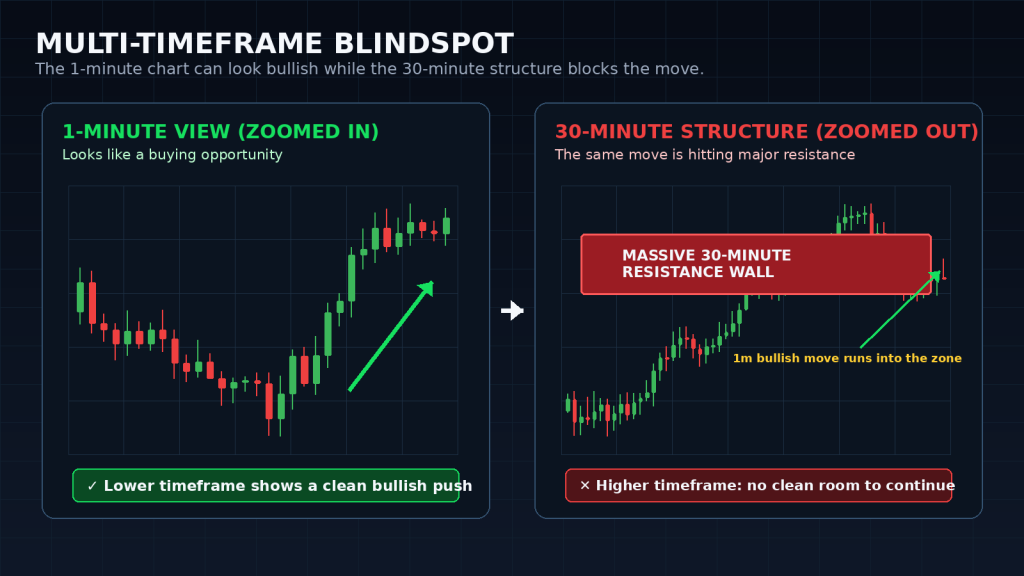
Here’s a scenario that plays out constantly. Price on the 1-minute chart forms a clear bullish structure shift. You enter long. The move extends for 8 pips. Then it stalls and reverses hard. You exit at break-even if you’re fast, or at a loss if you hesitate. On the 30-minute chart, price was pushing directly into an untested sell-side zone that had been holding for two sessions. That zone was invisible on the 1-minute chart. The pattern looked perfect. The structural permission was never there.
Fast candles on the lower timeframe also create emotional urgency. When price is moving quickly, your brain feels pressure to act. That pressure causes chasing: entering after the move has already started, accepting a worse risk-to-reward ratio because fear of missing out is louder than technical analysis. The 1-minute chart creates a strong emotional response. The 15–30 minute chart acts as a brake on that response.
What Makes a Gold Scalping Strategy Work on XAUUSD
The best gold scalping strategy uses the 15–30 minute chart to confirm structure, then uses the 1–5 minute chart for precise entries. Before entering, you need to identify trend bias, liquidity zones, rejection areas, and execution costs because XAUUSD scalps are highly sensitive to spread, slippage, and latency.
Gold moves fast. On a typical London or New York session, XAUUSD can move 150 to 300 pips before lunch. For someone watching the lower timeframes, that looks like an opportunity everywhere. But the same volatility that creates those moves also creates false breaks, erratic fills, and wide spreads, especially around news releases.
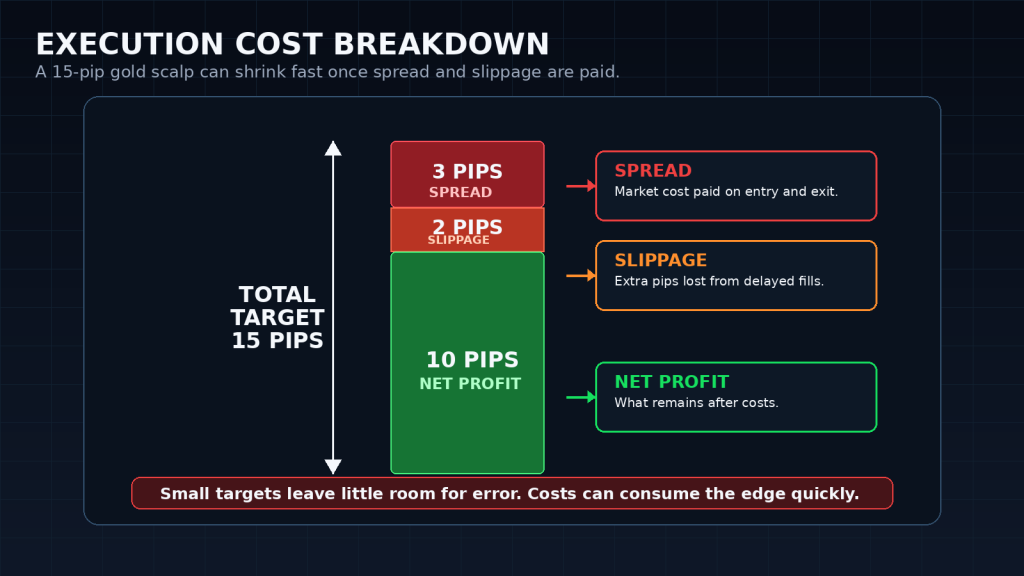
Scalping is built around capturing small price movements repeatedly. That means your transaction costs (spread plus commission plus slippage) eat a disproportionate share of each trade’s potential. The smaller the target, the more those costs matter. A gold scalp targeting 15 pips looks very different after a 3-pip spread and a 2-pip slippage event.
The strategy in this post addresses that directly. You only enter scalps that have genuine structural backing, realistic cost-adjusted targets, and logical stop placement. Not every setup qualifies. The filter is strict on purpose.
The Core Framework: 15–30 Minute Structure, 1–5 Minute Execution
Using the 15–30 Minute Chart to Confirm Structure
Before you touch the 1 or 5-minute chart, the intermediate timeframe must answer a set of specific questions. Not roughly. Specifically. If you can’t answer them clearly, the trade doesn’t qualify for execution yet.
The 15–30 minute chart needs to tell you whether gold is trending, ranging, or in an expansion phase. You need to identify where the nearest liquidity highs and lows sit, and whether the price has swept a liquidity level recently. You should be able to see whether the price is rejecting a major structural zone, and whether there’s enough clear distance to a logical target before the opposing structure appears. The trade also needs to be aligned with the current session impulse (London, New York, or overlap), and you need to confirm that no high-impact news is scheduled in the next 30 to 60 minutes.
15–30 Minute Structural Checklist
Before moving to the lower timeframe, confirm each of these:
- Clear directional bias confirmed
- Visible liquidity target identified above or below the current price
- Recent sweep, rejection, or displacement visible on the chart
- No immediate opposing structure blocking the path to the target
- Enough range for target expansion (at minimum 2:1 after costs)
- Spread is normal for current session conditions
- No high-impact news directly ahead in the trade window
If you can’t tick every item on that list, the trade isn’t ready. That’s not hesitation. That’s discipline. The market will give you another setup. A violated prop firm account or a blown retail account doesn’t recover as easily.
Using the 1–5 Minute Chart for Entry Precision
Once the 15–30 minute structure confirms that a trade idea is valid, the lower timeframe becomes useful. Its only job is to refine the entry, giving you a tighter stop placement and a better risk-to-reward ratio than you’d get by entering on the higher timeframe candle close.
The lower timeframe refines the risk. It should not invent the trade idea.
After structural permission is confirmed, look for a micro break of structure in the direction of the ITF bias, or a pullback into a retest zone after an initial displacement move. A failed continuation candle (where price attempts to continue in the wrong direction and fails) is another valid trigger, as is a rejection wick forming at an ITF structural level. For bullish setups, watch for a higher low forming after a sell-side liquidity sweep. For bearish setups, watch for a lower high forming after a buy-side liquidity sweep.
The Step-by-Step Gold Scalping Entry Plan
Step 1: Mark the 15–30 Minute Bias
Open the 30-minute chart before you do anything else. Mark the previous session high and low (Asian, London, or New York, depending on when you’re trading), the current 30-minute swing high and swing low, and any major rejection candles from the last two to four sessions. Identify visible liquidity pools where equal highs, equal lows, or clusters of stops have formed. Note any displacement zones where the price moved with unusual speed and left a clear imbalance.
Keep the chart readable. Two or three clear levels are worth more than ten overlapping zones that create analysis paralysis. The point is to know where structure is, where liquidity sits, and which direction has the clearest path.
Step 2: Wait for Liquidity to Be Taken
This is the step most people skip, and it’s the one that separates disciplined gold scalping from emotional clicking.
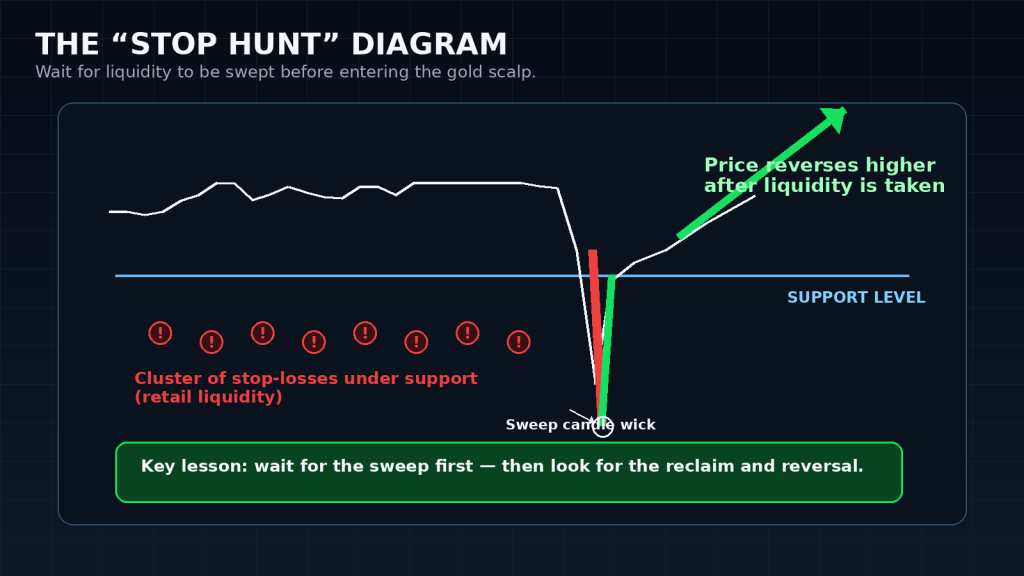
A strong gold scalp most often begins after liquidity has been swept, not before. Chasing a breakout of a high or low (entering as the price pushes through a level) means you’re buying after the institutional order flow has already been filled, often right before the reversal begins.
A bullish scalp is significantly stronger when price sweeps a short-term low, takes out the stops sitting below that level, and then reclaims above it. The liquidity has been collected. The move can now expand upward with less resistance. A bearish scalp follows the same logic in reverse: price sweeps a short-term high, takes buy-side stops, and rejects back below the level.
Waiting for the sweep before entering is patience. Entering before the sweep is speculation about which direction the hunt will go. On gold, that speculation is expensive.
Step 3: Drop to the 1–5 Minute Chart
Now, and only now, does the lower timeframe become your working chart. You’re not looking for a new trade idea here. You’re looking for confirmation that the intermediate-timeframe thesis is playing out and a precise entry with a logical stop.
On the 1 or 5-minute chart, look for a microstructure shift (a break of a short-term swing that aligns with the ITF direction), a pullback after the initial displacement move that gives you a tighter entry, or a retest of the broken level that holds. Rejection forming near the invalidation zone is also a valid signal. The entry point needs to allow a stop placement that makes logical sense, not just a tight number, but behind a real structural level.
Step 4: Place the Stop Where the Idea Is Contradicted
This is the most consistently misunderstood part of scalp risk management. The instinct is to focus on making the stop tight. The correct focus is on making the stop logical.
A tight stop placed randomly in open space gets hit constantly. A slightly wider stop placed behind a swept low, or above a rejected high, only gets hit when the trade idea is genuinely wrong. That distinction changes your win rate and your composure under pressure.
Setup Reference: Entry, Stop, and Target Logic
| Setup Type | Entry Logic | Stop Logic | Target Logic |
|---|---|---|---|
| Bullish sweep reversal | Low is swept, price reclaims above the level, pullback holds | Below the swept low | Prior high or next ITF liquidity pool |
| Bearish sweep reversal | High is swept, price rejects back below, retest fails to reclaim | Above the swept high | Prior low or next ITF liquidity pool |
| Trend continuation scalp | ITF trend intact, LTF pullback holds above last higher low | Behind pullback structure (prior swing) | Next liquidity zone in the trend direction |
Execution Costs That Break Gold Scalping Strategies
This section doesn’t get enough coverage in most gold scalping content, and that’s a problem. Execution costs are one of the primary reasons technically valid setups lose money in live trading.
Gold scalping targets smaller moves. The smaller the target, the larger the percentage of that target consumed by transaction costs. If you’re targeting 20 pips and your combined spread plus commission is 5 pips, you need the price to move 25 pips just to break even. A setup that looks clean on a chart can be structurally unprofitable at the execution level if cost assumptions are ignored.
Does Spread Matter on XAUUSD?
Spread is the cost of entering the trade: the difference between the bid and ask price at the moment your order is filled. On XAUUSD, the spread isn’t fixed. It varies based on session, news proximity, liquidity conditions, and broker pricing model.
During the London and New York sessions in normal conditions, XAUUSD spread on a competitive ECN broker is typically 2 to 4 pips. During news events, rollovers, or low-liquidity periods, that spread can widen to 15, 20, or even 50+ pips in extreme cases. A scalp targeting 15 pips entered at a 15-pip spread is a zero-edge trade before price moves at all.
You should check the spread before entry, not after. If the spread is visibly wider than normal for the session, the setup doesn’t qualify, regardless of how clean the structure looks.
Why Slippage Happens on Gold
Slippage isn’t always broker manipulation, though bad actors exist. In most cases, slippage is a natural consequence of the gap between when your order is sent and when it’s filled. On fast-moving instruments like gold, that gap (even measured in milliseconds) can mean a significantly different fill price.
Slippage is most common during fast momentum moves, news releases, thin liquidity windows like the early Asian session, and periods of server latency. It can be positive or negative. You can get filled better than your order price, but in practice, negative slippage is far more common for retail accounts because brokers benefit from the spread, not from improving your fill.
Track your actual fills. If there’s a consistent gap between where you intended to enter and where you actually got filled, that gap is a real cost that needs to go into your strategy’s edge calculation.
Broker Execution Checklist
Before scalping gold live, especially with real capital or a prop firm account, verify the following about your broker:
- Average XAUUSD spread during your primary trading session
- How spreads behave during news events (ask support or review your trade history)
- Commission per standard lot (100 oz of gold)
- Execution model: market execution or instant execution, and what that means for requotes
- Stop-loss fill behaviour: does the broker fill stops at the requested level or at market?
- Whether scalping strategies are explicitly permitted under their terms
- Whether EAs, trade copiers, or latency arbitrage tools are restricted
- VPS or server location if you’re running automation (distance to broker server affects fill quality)
- Order history logs: review fill prices against intended prices across at least 50 trades before sizing up
Prop Firm Rules You Must Check Before Scalping Gold
A retail account can survive a bad scalp. A prop firm account can lose everything from a single rule violation.
The prop firm environment changes the risk calculus entirely. You’re not just managing market risk. You’re managing rule risk at the same time. A trade that’s technically correct can still end the account if it violates daily drawdown limits, news trading restrictions, or minimum holding time requirements.
Before scalping gold on any prop firm account, get explicit answers to these questions. Don’t assume. Read the terms document. If something is unclear, contact the firm’s support before trading.
- Is XAUUSD explicitly permitted on the account type you hold?
- Are scalping strategies (trades held under 5 minutes) permitted?
- Is there a minimum holding time, and if so, how is it measured?
- Is news trading restricted? How close to a news event is trading prohibited?
- Are EAs, trade copiers, or third-party signal services permitted?
- Are stop losses required on all positions?
- Does floating (unrealised) drawdown count toward the daily limit?
- Is the daily drawdown limit calculated from the starting balance or from the highest equity point reached that day?
- Are there maximum lot-size limits per trade or per instrument?
- Are there consistency rules requiring a minimum number of trading days or capping the maximum percentage of profit from a single day?
The Daily Drawdown Trap
This is where technically clean scalping meets real-world prop firm failure. You execute a valid setup. Structure confirms. Entry is precise. Then the spread widens at the moment of entry, slippage hits the stop at a worse level, and the loss is slightly larger than modelled. A second trade to “recover” adds more pressure. By the time the session ends, the daily drawdown limit has been breached, not through reckless trading, but through the compounding effect of execution costs, emotional re-entry, and a limit that was never clearly defined before the session started.
Define your daily loss limit before you open a chart. Write it down. When you hit it, close the platform. The account’s survival matters more than any single session’s outcome.
Best Market Conditions for Gold Scalping
Not all sessions are equal for XAUUSD scalping. The best conditions combine clean liquidity, defined structure, active price movement, normal spread, and clear distance to the target. Those conditions don’t exist at all hours.
| Market Condition | Scalping Quality | Reason |
|---|---|---|
| London open expansion (7:00–9:00 AM GMT) | High, but volatile | Strong directional movement and institutional liquidity. Best structural setups of the day. |
| New York open (1:30–3:30 PM GMT) | High, but news risk increases | Momentum is often clean and structured, but major US economic data releases can create unpredictable fills. |
| London–New York overlap (1:00–4:00 PM GMT) | Good with caution | Highest volume period of the day. Strong moves, but news sensitivity is elevated. |
| Pre-news compression | Risky, avoid | Price often traps both buyers and sellers before the release. No structural clarity. |
| Post-news spike (first 3–5 minutes) | Dangerous | Spread and slippage risk are at their highest. Fills are unreliable. |
| Late New York / Asian session | Lower quality | More false breaks, weaker continuation, wider spread on many brokers. |
Risk Management for 1–5 Minute Gold Scalps
Risk management in scalping isn’t motivational. It’s mechanical. What you feel about a trade is irrelevant. Rules aren’t suggestions. The following principles are non-negotiable for anyone using this strategy with real or prop firm capital.
| Risk Control | Application |
|---|---|
| Risk per trade | Keep position sizing conservative. Scalp setups carry higher execution variance than swing trades. Don’t oversize because the timeframe is short. |
| Maximum trades per session | Set a hard limit and respect it. Overtrading and emotional re-entry after a loss are the two most common session-destroyers. |
| Daily loss limit | Define this number before you open the platform. When you hit it, you’re done for the day. No exceptions. |
| News filter | Avoid the 30-minute window before and after any high-impact XAUUSD news event. Fills become unreliable, and stops can be hit at levels far from intended. |
| Spread filter | Skip any setup where the current spread is above your session average. The cost-adjusted edge disappears. |
| Execution review | Track actual fills, not just chart outcomes. Your real trading performance is measured in fills, not in what the chart showed was possible. |
These rules connect back to a core principle: capital protection comes before opportunity. Someone who is still in the game after 100 sessions of disciplined small losses will outperform someone who hits two big wins and one account-destroying session.
A Gold Scalping Setup in Practice: ITF-to-LTF Execution
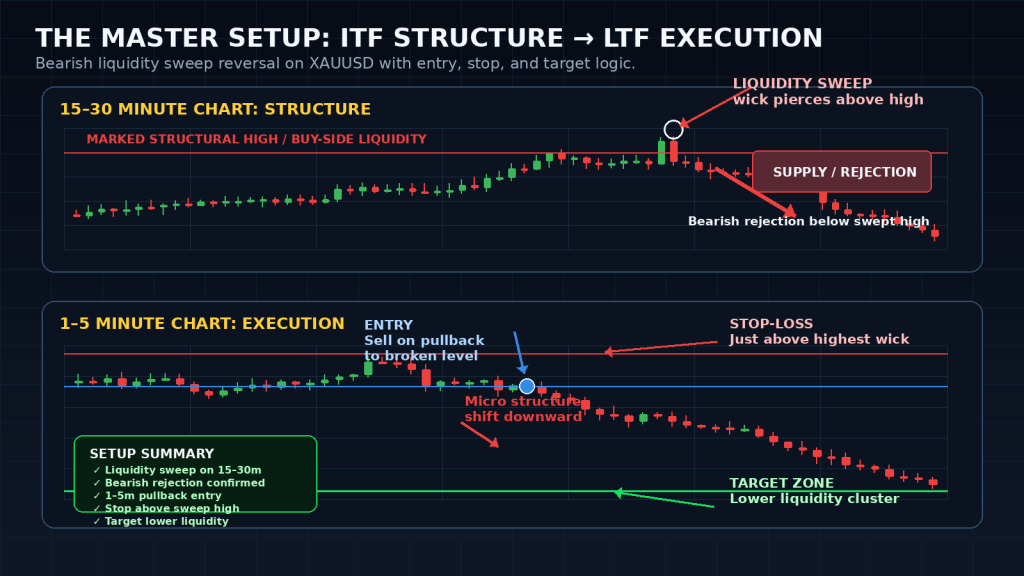
Here’s a practical walkthrough of how the full framework applies to a real trade scenario. This is a bearish liquidity sweep reversal, one of the highest-probability setups in this gold scalping strategy.
15–30 Minute Context. Price trades into a previous session high where a cluster of buy-stop orders is sitting above equal highs. Price wicks above the high, sweeping the buy-side liquidity so that orders above the high are triggered and filled. A strong bearish rejection candle closes below the swept high on the 30-minute chart. The structural integrity check confirms that sell-side liquidity remains open below with no immediate support structure in the target path. Spread is normal. No major news within the next 90 minutes.
1–5 Minute Execution. Price attempts to reclaim the swept high on the 5-minute chart. The attempt fails, and a lower high forms. Minor bullish structure on the 1-minute chart is broken to the downside, creating a micro structure shift. A brief pullback to the broken level holds, and price rejects the retest. Entry is placed on the close of the rejection candle. Stop goes above the sweep high, beyond the point where the bearish thesis is invalidated. The target is set at the nearest identified sell-side liquidity zone confirmed on the 30-minute chart.
This setup works because every element is aligned. The ITF sweep creates the structural permission. The LTF confirms the directional rejection. The stop is logical rather than arbitrary. The target has a clear structural rationale. The risk-to-reward ratio is quantifiable before the trade is entered, not estimated after.
When You Should Not Scalp Gold
Knowing when not to trade is part of the strategy, not a disclaimer attached to it. These are the specific conditions that disqualify a gold scalp from execution, regardless of how good the chart looks.
You should skip the trade when the spread is wider than your session average because the cost-adjusted edge is gone. Avoid entering when a major news event is within the next 30 minutes, since execution conditions become unpredictable. If the 15–30 minute chart is unclear, choppy, or stuck in a tight range with no defined bias, there’s no structural permission to scalp. When the potential target is too close to the opposing structure to justify the spread and commission, the math doesn’t work. If you’re trying to recover a previous loss, your emotional state is compromising execution quality. If your daily drawdown is already near your prop firm or personal account limit, the remaining risk budget doesn’t support another entry. If your broker’s platform is lagging or execution times are visibly slower than usual, fill quality is unreliable. And if the price is moving so fast that you can’t clearly define an invalidation level, that’s not an entry opportunity. That’s chasing.
Manual Gold Scalping vs Automated Execution
The Manual Scalper’s Challenge
Manual scalping on XAUUSD is cognitively expensive. In a single-entry decision, you have to process 30-minute structural context, lower-timeframe trigger conditions, current spread, news schedule, position sizing, stop placement, target validation, and your own emotional state, all in under 30 seconds while the price is moving.
That cognitive load is where execution breaks down. The structural analysis was correct. The entry logic was sound. But hesitation caused a late entry at a worse price. Or urgency caused an entry before the pullback completed. Or the stop was placed too tightly because the intended level felt too far away in the moment.
Where Automation Fits
Automation can solve specific parts of this problem. Not all of it, but specific parts.
A well-built execution system can apply the same entry criteria every time without hesitation, respect spread filters before entering, set stops and targets at exactly the right structural levels without second-guessing, and track fills with precision so performance data is accurate and usable. What it can’t do is create an edge where none exists, protect against a structurally flawed strategy, or guarantee fills in fast market conditions.
Automation removes some emotional mistakes from execution. It does not remove market risk, broker risk, slippage, or drawdown. The edge still has to exist in the strategy itself.
If you want to see how systematic execution compares to manual gold scalping in live conditions, including real drawdown behaviour and fill quality, the JTS Telegram community tracks live Gold EA performance with full transparency. Review the data before you make any decision.
Pre-Entry Checklist: 1–5 Minute XAUUSD Scalp
Use this before every entry. If any item can’t be confirmed, the trade doesn’t qualify.
- 15–30 minute directional bias is clear
- Liquidity zones above and below the current price have been identified
- The trade is not executing directly into the opposing 15/30 minute structure
- Spread is at or below the normal session average
- News schedule has been checked with no high-impact event within 30 minutes
- Entry is formed close to the structural invalidation level (stop is logical, not arbitrary)
- Stop placement is behind a clear swept level or structural reference point
- Target is large enough to remain positive after spread and commission
- Position size fits account risk parameters with no oversizing
- Prop firm rules have been reviewed, with no rule violations possible from this trade
- Daily loss limit has been defined before the session and has not been hit yet
- This is not a revenge entry after a previous loss
Start With Structure, Not Speed
If you’re new to gold trading and not yet confident managing entries, stops, and execution costs on your own, the fastest way to learn is by watching real trades play out in live conditions. Copy trading lets you follow a verified strategy in real time, so you can observe how structure-based decisions are made, how drawdowns are handled, and how entries align with higher-timeframe direction, all while your account participates in the same positions.
This is the learn-and-earn approach: you build understanding through observation before taking on full execution responsibility yourself.
James Trading University offers copy trading access at zero registration cost. Review the strategy, the risk disclosures, and the live performance data before making any decision. Copy trading carries the same market risks as any live trading activity. Past performance does not guarantee future results.
Frequently Asked Questions
Is gold good for scalping?
Gold can suit scalping because XAUUSD moves with a significant range during major sessions, often 150–300 pips during London and New York hours alone. But that same speed increases execution risk. Spread, slippage, stop placement, and broker conditions all need to be verified before any 1–5 minute entry. Volatility is only an advantage if execution is controlled.
What timeframe is best for gold scalping?
Use the 15–30 minute chart for structural confirmation and the 1–5 minute chart for entry execution. The lower timeframe should refine the entry, not create the trade idea. A lower-timeframe pattern without intermediate-timeframe backing isn’t a scalp setup. It’s a gamble with a tighter stop.
How do beginners start with gold trading?
The safest starting point is a demo account where you can apply this framework without risking capital. For every session, track your entry price, intended entry price, actual fill price, spread at entry, stop placement, and fill outcome. Measure the gap between what the chart showed and what execution delivered. Don’t increase position size until the strategy has demonstrated consistent cost-adjusted performance across at minimum 30 to 50 sessions. If you want to learn by observing live gold trades before managing entries yourself, JTS copy trading lets you do that with zero registration cost. Review the full details and risk disclosures before registering.
Can I scalp gold on a prop firm account?
Yes, but only if the firm explicitly permits XAUUSD scalping, and only if every trade respects the firm’s rules around drawdown limits, news trading, minimum holding times, lot-size restrictions, and automation policy. Read the rules document before trading, not after a violation. A single rule breach can end the account regardless of how profitable the strategy is.
Why do gold scalping strategies fail in live trading?
Most fail because execution costs are ignored during the strategy design phase. Spread, commission, slippage, latency, and emotional re-entry can turn a setup that looks clean on a chart into a losing trade in live conditions. The chart doesn’t account for any of those factors. Your risk model must.
Should I trade gold during the news?
Most beginner and intermediate traders should avoid entering positions in the 30-minute window directly surrounding major news events. News causes fast price movement, spread widening, and unpredictable fills. A valid structural setup that forms immediately before a news spike is not worth the execution risk.
What is the safest way to start gold scalping?
Begin on a demo account or with a minimum live size. Track every session’s fills, spreads, and outcomes against what the chart showed. Don’t treat the demo as casual practice. Trade it with the same rules, the same checklist, and the same daily loss limit you’d use on a funded account. The habits you build in demo are the habits that show up under pressure.
Structure First. Entry Second. Execution Costs Always.
Gold scalping is one of the most technically demanding forms of active trading. The opportunity is real. So is the risk. The difference between people who build consistent results on XAUUSD and those who cycle through losses isn’t the candle pattern. It’s whether the 1-minute chart is treated as the full picture or as a precision tool in service of a properly validated trade idea.
This gold scalping strategy comes down to three layers. The 15–30 minute chart gives you permission. The 1–5 minute chart gives you precision. Spread, slippage, broker conditions, and prop firm rules determine whether that precision translates into real profitability. Ignore any one of those layers, and the strategy breaks down.
Use the checklist. Audit your fills. Define your daily limit before the session opens. And when conditions don’t meet the standard, don’t trade. The next session will come.
Risk Disclaimer: Trading forex, gold (XAUUSD), and cryptocurrency carries a significant risk of loss and is not suitable for all investors. Past performance is not indicative of future results. Leveraged CFD products can result in the loss of your entire invested capital. Only allocate capital you can afford to lose. The strategies, tools, and educational content provided by James Trading University are for informational and educational purposes only and do not constitute personalised financial advice. Always conduct your own research and consult a qualified financial professional before making trading decisions.