| DEFINITION: Automated trading is a system where programmed software opens, manages, and closes trades based on predefined rules — without requiring manual input. Manual trading means you personally analyze the market, decide on entries and exits, and execute each trade by hand. Neither approach is all-around better than the other. What matters is whether it fits your strategy, your discipline, and the live conditions your trades will face. |
Key Takeaways
• Automated trading can reduce emotional execution mistakes — but it cannot remove market risk.
• Manual trading allows more discretion, but discretion without a clear plan becomes inconsistent.
• A profitable backtest does not prove live performance. Spreads, slippage, strategy decay, and volatile conditions all change results once real money is involved.
• No trading bot can guarantee daily profits. Markets do not produce gains on a fixed daily schedule.
• The CFTC has explicitly stated that AI and automated trading systems cannot predict the future or sudden market changes.
• Many experienced traders combine both approaches — using automation for structured execution and human oversight for market context, strategy review, and risk monitoring.
Should You Switch from Manual to Automated Trading?
To determine if switching from manual to automated trading is for you, answer these 3 questions honestly:
1. Do you constantly give up sleep after a trading session of losses or wins?
2. Do you second-guess yourself regularly even after a perfect technical analysis and risk management set-up?
3. Is constant strategy changing (scalping, swing, arbitrage, etc) your experience in the forex and crypto markets?
If you said yes to these 3 questions, switching to an automated trading system can be more suitable for your trading journey because:
• Automated trading is great at executing fixed rules quickly and without emotional interference.
• While manual trading has better odds when the market requires unique judgment that a fixed-rule system was not designed to provide.
For most traders, the real question is not which method wins. It is the approach that fits what you actually have right now: a tested strategy, a broker setup that supports it, and the discipline to monitor it properly.
What Automated Trading Actually Does (and Doesn’t Do)
An automated trading system — also called a trading bot, Expert Advisor (EA), or algorithm — is software that monitors the market and executes trades when predefined conditions are met. It opens, manages, and closes positions automatically, without manual input on any individual trade.
The core advantage of automated trading is disciplined execution — no hesitation, no emotional interference at the point of entry.
On MT4 and MT5, these systems run as Expert Advisors. On crypto exchanges like Binance, they connect through an API. On copy trading platforms, the automation works differently — a follower account mirrors a master trader’s positions in real time, scaled proportionally to account size.
At JTU, we cover all three environments, including the Gold EA for XAUUSD and a BTC bot for crypto markets. Both are discussed in the context of risk management throughout this guide.
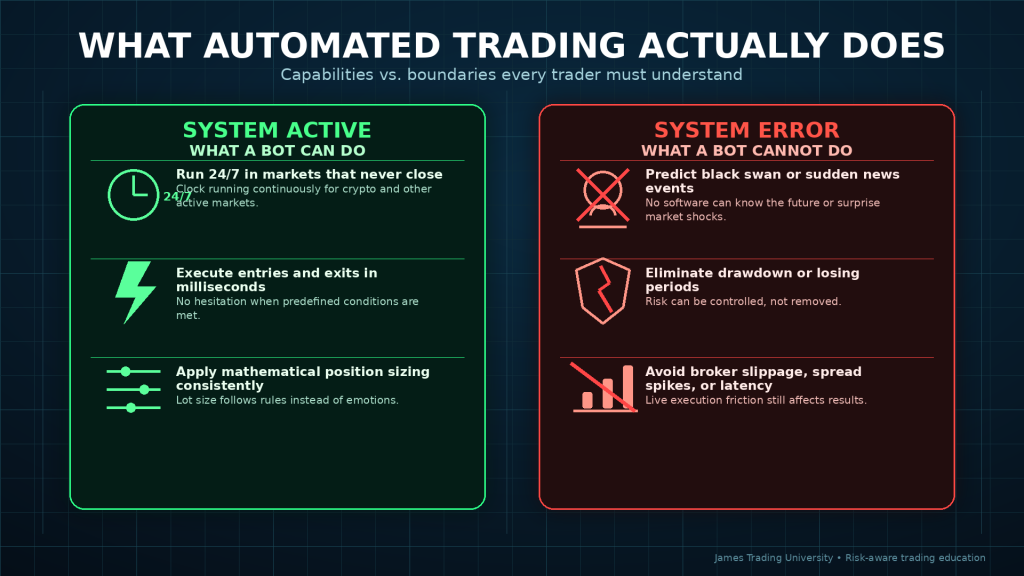
What a bot can do:
• Follow rules without hesitation or second-guessing between sessions
• Execute entries and exits faster than any human reaction time can match
• Monitor multiple instruments simultaneously without losing focus
• Apply position sizing rules consistently to every single trade
• Run 24/7 in markets that never close — like crypto
What a bot cannot do:
• Think beyond the programmed rules
• Predict market moves that fall outside what its rules were designed to handle
• Remove the possibility of drawdown or losing periods entirely
• Adapt to a market regime whose logic does not account for
• Avoid all slippage, spread spikes, or execution delays from the broker side
• Guarantee daily income, fixed returns, or a positive result on any specific trade
The CFTC makes this explicit in its customer advisory: AI technology cannot predict the future or sudden market changes. Anyone promoting an automated system that claims otherwise is either mistaken or deliberately misleading you.
Manual Trading: Strength, Flexibility, and the Psychology Problem
Manual trading gives you something automation cannot: the ability to look at current conditions and decide whether the setup you see is actually valid right now.
A bot follows its rules regardless of whether a central bank just made an unexpected announcement or whether the market is printing a price structure that falls outside its parameters. You can read that context. A bot cannot.
Manual execution includes reading charts, identifying setups, choosing entry and exit levels, managing open trades in real time, and deciding when conditions simply do not meet your criteria.
For a newer trader, this process builds the foundational market understanding that automation alone can never give you. You cannot monitor or improve a system you do not understand — and the fastest way to develop that understanding is time spent in the market yourself, making and reviewing decisions.
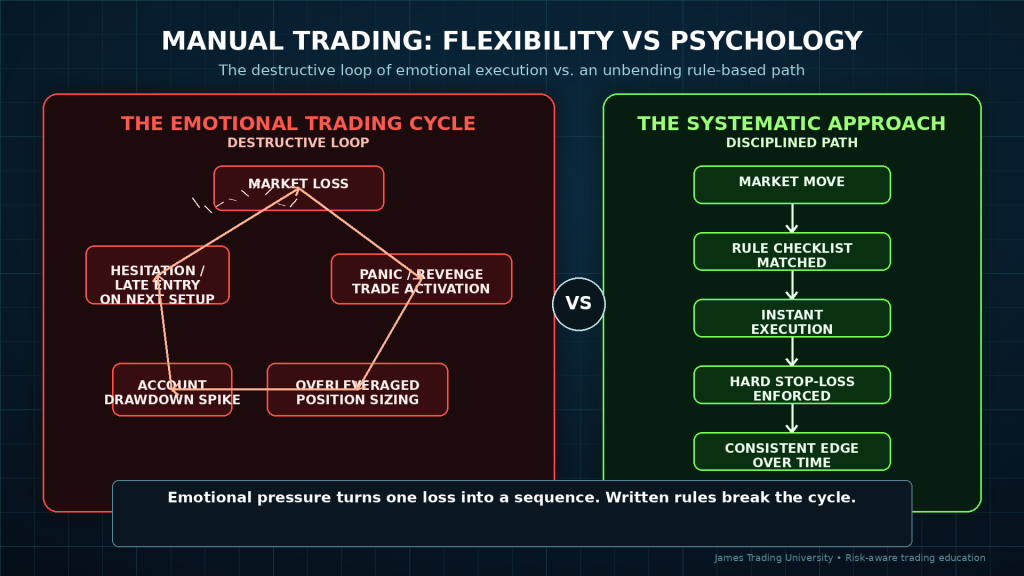
But manual trading carries a significant structural problem: you bring your emotions into every single decision.
Academic research consistently shows that traders making decisions under emotional pressure perform measurably worse than those following systematic rules. Fear leads to late entries and premature exits. Greed pushes position sizes beyond what the edge can support. After a loss, the urge to recover immediately — revenge trading — often produces the second loss faster than the first.
Saxo’s trading psychology guide notes that overconfidence following a string of wins is equally dangerous, pushing traders to take on exposure that their actual edge cannot sustain.
This is not a character flaw — it is how human brains respond to financial uncertainty and loss under pressure. The market punishes emotional decision-making directly and consistently.
The manual trader who survives long-term is typically the one who has written their rules, follows them regardless of their emotional state in the moment, and reviews trades honestly after each session — which is essentially the same discipline that automation enforces mechanically.
Automated vs Manual: The Real Comparison
No single factor determines whether automated trading or manual trading will deliver better results for you. What matters is the combination of factors across your specific strategy, market conditions, broker environment, and risk tolerance. The table below gives you an honest side-by-side across the factors that determine outcomes.
| Factor | Automated Trading | Manual Trading | JTU Risk-Aware View |
| Execution Speed | Fast and rule-based; enters the instant conditions are met | Dependent on human reaction time and state of mind | Bots are stronger for time-sensitive entries when rules are clearly defined |
| Emotional Control | Removes hesitation and bias from the moment of execution | Vulnerable to fear, greed, and revenge trading | Automation improves execution discipline — it does not eliminate market risk |
| Flexibility | Limited to the logic programmed into the strategy | Can adapt when conditions shift unexpectedly | Manual judgment is valuable when market behaviour falls outside bot parameters |
| Backtesting | Can be tested systematically on historical data | Harder to evaluate with consistent assumptions | A profitable backtest is not proof of live performance |
| Drawdown Control | Can include stop-loss, equity stop, and kill switch logic | Depends entirely on the trader’s discipline at the moment | Risk controls must be built in before any live deployment |
| Strategy Decay | Must be monitored and updated as conditions shift | Trader may notice and adapt — or may not | Neither approach is truly set-and-forget |
| Learning Value | Shows how structured rules perform over time | Builds foundational market understanding directly | Education comes before automation at every stage |
| Live Execution Risk | Slippage, spread spikes, API failure, VPS downtime | Late entries, emotional exits, inconsistent sizing | Both approaches carry real execution risk — neither is safe by default |
| Market Coverage | Can monitor and trade 24/7 | Limited to active screen time and mental focus | 24/7 markets like crypto favour automation — with active human oversight |
Every advantage in the automated column comes with a condition, and every weakness in the manual column can be addressed through structured rules and genuine discipline. The table is a navigation tool — not a final verdict.
Why Backtests Look Better Than the Live Market
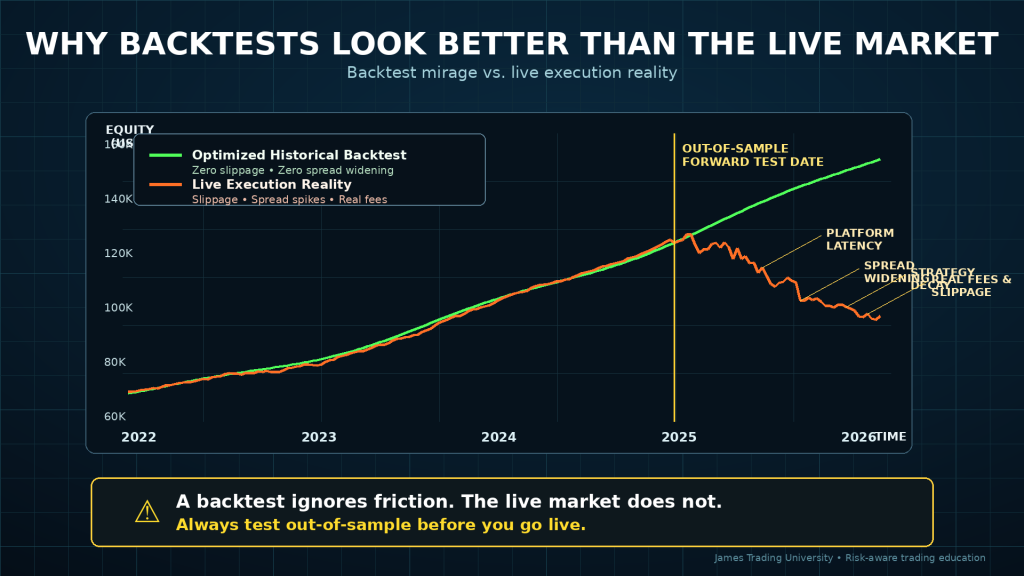
A backtest shows how a strategy would have performed on historical data. That sounds useful — and it can be — but the results are almost always more optimistic than what live trading produces. The gap between what the backtest shows and what live execution delivers is one of the most consistently underestimated concepts in automated trading, and it is the reason why profit screenshots mean very little without context.
Most backtests ignore conditions that are present in real execution: spread widening during news events, slippage on fast-moving entries and exits, commission and swap fees compounding across hundreds of trades, latency between your bot’s signal and the broker’s actual fill, and requotes or partial fills that change your real entry price.
Beyond these execution gaps, many strategies are over-optimized — adjusted until they produce an appealing curve on historical data. Research by Bailey and Lopez de Prado, published on SSRN, shows how backtested Sharpe ratios are systematically inflated when multiple parameter combinations are tested, and only the best-performing result is selected.
A QuantPedia analysis of 355 strategies found that Sharpe ratios degrade on average by 33% when moving from in-sample backtests to out-of-sample conditions.
Strategy Decay Makes the Problem Ongoing
Even a strategy with a genuine edge can lose it over time. Market volatility changes. Liquidity conditions shift. When a particular pattern becomes widely traded, the edge it has offered narrows. Broker conditions evolve.
A strategy that worked consistently in 2022 conditions may behave very differently in 2026 without adjustment. This is strategy decay — and it does not announce itself. You notice it in the results, usually after the losses have already accumulated.
FINRA’s guidance on algorithmic trading makes clear that supervisory obligations continue after any strategy goes live. The same principle applies to retail traders: a bot deployed and then left unreviewed is not a trading tool — it is an unchecked system running on your capital.
What Forward Testing Actually Proves
Walk-forward testing is the gold standard for strategy validation. You optimize the strategy on one segment of historical data, test it on the next untested segment without adjusting anything, record the results, then shift forward and repeat.
This produces out-of-sample results — performance on data the strategy was never fitted to — which is a far more honest picture than any standard backtest. Research on strategy robustness consistently shows that strategies which survive out-of-sample testing with stable performance metrics are significantly more likely to hold up in live conditions.
The four-layer validation framework that holds up in practice:
1. Historical backtest with realistic spread, commission, and slippage assumptions included
2. Out-of-sample test on data the strategy was never optimized against
3. Demo or small-capital forward test under live market conditions after the backtest period
4. Live monitoring with defined drawdown limits and a kill switch in place before scaling up
If a bot you are considering has only a backtest curve and no forward-tested history, that is not a performance claim. It is a marketing image.
The Real Risks on Both Sides
The table below covers the risk categories across both automated trading and manual execution. What follows is what it looks like when one of them lands in real conditions.
| Risk | Automated Trading | Manual Trading |
| Overfitting | Strategy adjusted to historical data — looks strong in backtest, fails in live conditions | Traders can also fit their thinking to recent patterns and mistake recency for a real edge |
| Emotional Exposure | Low during execution — but false confidence in automation can prevent necessary human intervention | High — fear, greed, FOMO, and revenge trading are consistently the leading causes of account losses |
| Strategy Decay | Bot continues following outdated rules as market behaviour shifts, unless reviewed | Trader may adapt — but may also adapt based on emotion rather than logic |
| Execution Quality | Slippage, spread spikes, broker latency, API disconnects, VPS downtime | Late entries, second-guessing, inconsistent position sizing across similar setups |
| Technical Failure | VPS crash, platform freeze, duplicate bot install, incorrect lot size or settings | Human order errors — wrong direction, wrong lot size, wrong pair |
| Monitoring Obligation | Bots require periodic review — especially after market events, news periods, or broker changes | A trader must be present and mentally focused — decision quality declines under fatigue |
A Real Example: The Cost of One Missed Update
My BTC scalping bot runs 24/7. One evening before I went to bed, there was market speculation that prices would turn bearish. I had low energy that night and did not update the bot’s rules or make the adjustments the situation required. By morning, stop losses had been hit across multiple accounts.
The bot did exactly what it was programmed to do. The problem was that what it was programmed to do was no longer appropriate for the conditions that developed overnight. That is not a bot failure. That is a monitoring failure.
Automation removes emotion from execution. It does not remove your responsibility as the person who owns and operates the system.
Are ‘Daily Profits’ a Realistic Goal?
No — and any system marketed on a daily profit promise should be treated with serious skepticism. The CFTC has warned directly that claims of guaranteed daily returns, 100% win rates, and risk-free automated systems are among the most common markers of retail trading fraud.
The language to avoid includes: “make money every day,” “guaranteed daily income,” “no-loss bot,” “100% win rate,” and “passive income without risk.”
Markets do not produce gains every single day. Some sessions are quiet. Some are volatile. Some should be skipped entirely because the spread, liquidity, or news conditions do not suit the strategy. A daily income expectation from a trading bot is not a feature — it is a sales message. The market has no obligation to cooperate with anyone’s income schedule.
| The Better Question to AskInstead of asking: “Can this bot make daily profits?”Ask: “Can this system survive regular market conditions — drawdown, spread spikes, strategy decay, and volatility — without breaking its own risk rules?” |
The metrics that actually answer that question honestly:
| Metric | What It Actually Tells You |
| Maximum Drawdown | The worst peak-to-trough equity drop the system has experienced in any tested period |
| Average Recovery Time | How long does it take to return to the previous equity peak after a drawdown |
| Average Loss Size | Whether individual losses are controlled and within the expected parameters for the strategy |
| Equity Curve Stability | Whether results trend upward consistently or show sharp, irregular drops that signal fragility |
| Spread & Slippage Tolerance | Whether the strategy’s edge survives realistic execution conditions, not just clean historical fills |
| Forward-Tested Performance | How the system behaved on data it was never optimized against — the most honest indicator available |
| Kill Switch or Daily Stop | Whether a mechanism exists to pause trading automatically when defined risk thresholds are breached |
These are the questions to apply to any system — including JTU’s Gold EA. The Gold EA is built on structured rules for XAUUSD with stop-loss logic and drawdown controls. That does not exempt it from the live execution risks covered throughout this guide. Any system you choose to run — including ours — should be evaluated on these metrics before real capital is committed.
The Hybrid Approach: Human Strategy, Automated Execution
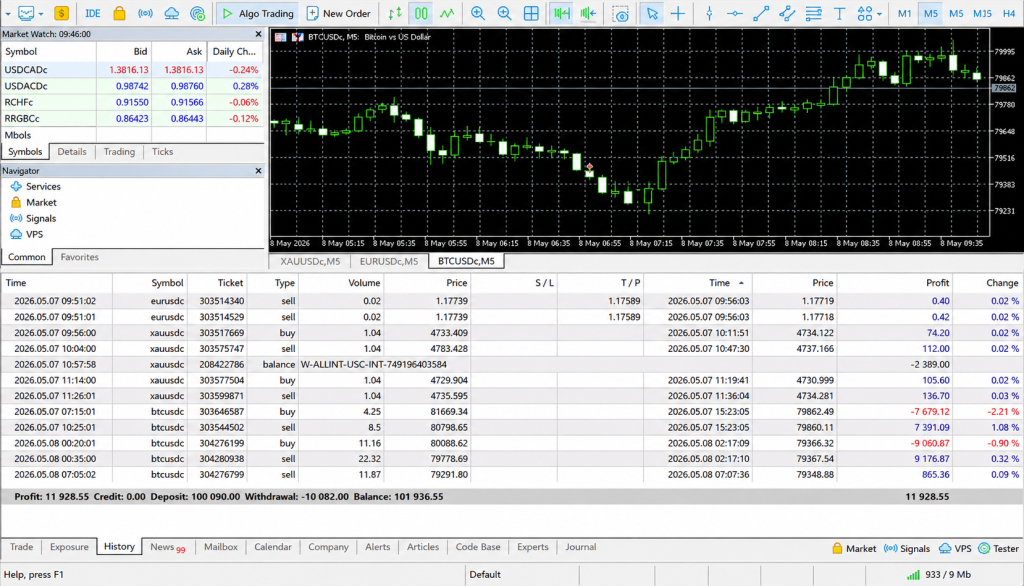
The position most serious traders arrive at over time is not automated trading or manual trading — it is a structured combination of both, where each method covers what the other cannot handle alone.
The principle at JTU is straightforward: automation should reduce emotional interference in your trading, not remove your responsibility as the trader who owns the system.
A hybrid model works best when you have a forward-tested strategy, and the problem is execution — hesitation, emotional sizing, late entries. Automation handles those while you retain oversight of strategy performance, market context, and risk levels.
What the trader still monitors in a hybrid system:
• Broker spread conditions during high-volatility sessions and news windows
• Drawdown levels — and whether they are approaching limits that require pausing the bot
• News events that fall outside the strategy’s designed market parameters
• Bot settings, including lot size, risk per trade, and overnight hold rules
• Total equity exposure across all open positions at any given moment
My philosophy at JTU is to learn and earn. If you are not ready to monitor and understand the system you are running, you are not ready to deploy it at risk.
That is why copy trading from a verified, risk-managed source is a practical bridge — you stay engaged with the market, observe how structured execution works, and do not miss opportunities while you are still building the manual foundation to run your own systems. You participate, you learn, and you develop the understanding to eventually command the market yourself.
Automation should improve your discipline. It should never become blind trust in a process you cannot explain or review when conditions change.
Join the James The Trader Telegram community to see how automated trading, Gold bots, BTC bots, and copy trading work in a risk-managed, educational environment before choosing a bot or broker setup. Explore James The Trader Community.
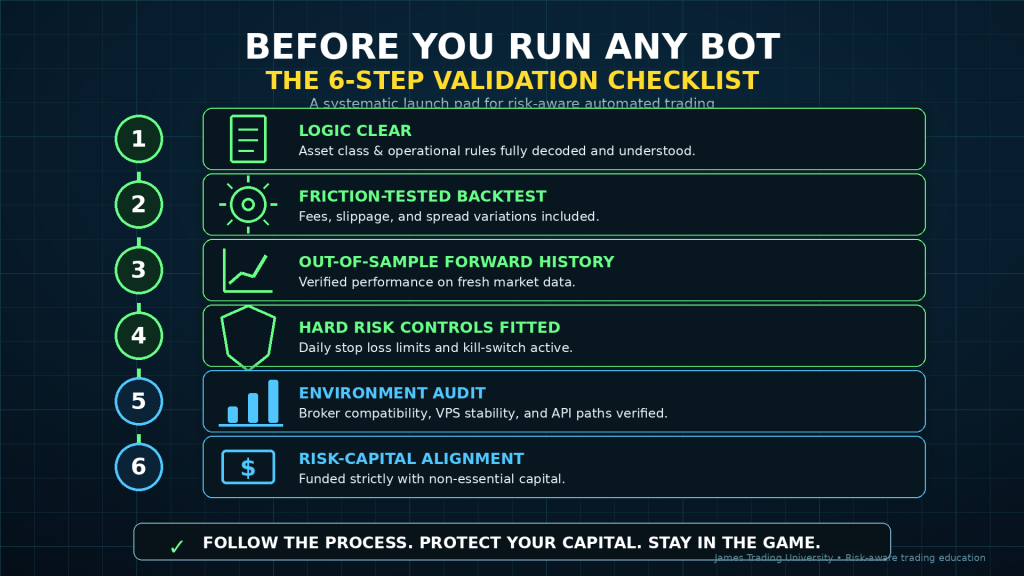
Before You Run Any Bot: The 6-Step Validation Checklist
Use this checklist before deploying any automated trading system on a live account — whether you built it, bought it, or received it through an education provider. Each step surfaces information that a backtest curve alone will never give you.
Step 1 — Understand What the Strategy Actually Does
Ask: What market does it trade in? Is it trend-following, mean-reversion, breakout, scalping, or recovery-based? Does it use stop losses, or does it hold positions indefinitely? Does it trade in both directions, or only one? Does it close within the session or hold overnight?
If you cannot answer these questions clearly after reviewing the available documentation, you do not have enough information to put real capital behind the system.
Step 2 — Review the Backtest With Realistic Assumptions
Check: How long is the test period, and does it cover different market conditions — trending, ranging, and high-volatility periods? What spread and commission assumptions were used? What is the maximum historical drawdown, and what was the worst consecutive losing streak? Was the strategy tested on news periods or only on clean market data?
Research on strategy robustness consistently shows that strategies stable across a range of parameter settings and historical periods degrade far less when they move to live execution. Strong backtests that only hold up in a narrow parameter range are a warning sign, not a selling point.
Step 3 — Verify Forward-Tested Results Separately
Backtesting and forward testing are fundamentally different exercises. Backtesting uses historical data that the strategy was already fitted against. Forward testing runs the system in live or demo conditions after the backtest period ends — on data the strategy was never optimized on.
Ask: How long was it forward-tested? Was that testing in demo or live conditions? Did results include realistic spread and execution behaviour, or only clean historical fills?
Step 4 — Check Drawdown Rules and Kill Switch Logic
Ask: What is the maximum percentage of account equity at risk at any time? Is there an equity stop that halts trading when drawdown reaches a defined threshold? Is there a daily loss limit? Does lot size reduce after a sequence of losses? Does a kill switch exist to pause the entire system when conditions require it?
A bot without these controls running on a live account is not a trading tool you control — it is an unmanaged system running on your capital.
Step 5 — Confirm Broker and Platform Compatibility
Ask: Does the bot run on MT4, MT5, or a specific exchange API? Does it require a VPS for stable uptime? Does your broker permit the strategy type? — Grid strategies, for example, are restricted by some regulated brokers and most prop firms. Are spreads at your broker consistently tight enough for the strategy’s logic to function as designed?
FINRA’s guidance on algorithmic trading notes that inadequate risk controls and environment mismatches are primary sources of problematic algorithm behaviour. That principle applies at the retail level just as much as it does institutionally.
Step 6 — Start With Capital You Can Afford to Lose
Trading carries risk. Automated trading systems experience drawdown, technical failure, slippage, spread spikes, and strategy decay in live conditions. Live execution will differ from backtested assumptions in ways that are difficult to fully predict in advance.
Never deploy a bot with capital whose loss would affect your financial stability. This is not a formality — it is the most important risk control available to you.
Which Approach Fits Your Trading Stage?
| Trader Type | Better Starting Fit | Why |
| Complete beginner | Manual learning first | Needs to understand risk, market structure, and trade management before introducing automation |
| Emotionally inconsistent trader | Structured automation or hybrid | Removes impulsive execution decisions — but monitoring obligations remain the trader’s responsibility |
| Strategy developer | Automated trading | Rules can be systematically backtested, forward-tested, refined, and iterated over time |
| News or event-driven trader | Manual or semi-automated | Human judgment is critical when fast-moving events distort normal market behaviour |
| Gold / XAUUSD trader | Hybrid with a tested Gold EA | Gold’s volatility and spread spikes during news require strict controls and active human oversight |
| Crypto trader | Automated with active monitoring | 24/7 markets favour bots — but API risk, exchange outages, and overnight shifts need human attention |
| Copy trading user | Education-led copy trading | Understand the risk profile of who you are copying before committing any capital to the system |
The table gives you a starting direction — not a guarantee. Every entry carries the same underlying requirement: a real trading edge, honest risk controls, and ongoing attention to how the approach performs in actual market conditions.
Final Thoughts
Automated trading is not a shortcut to consistent profits. Manual trading is not a safer default for traders who lack the discipline to follow their own rules. Both carry real risk, and both require structured systems, proper risk management, and honest ongoing review to produce sustainable results over time.
What automation genuinely offers is relief from the emotional interference that breaks manual traders. A bot does not hesitate.
It does not revenge-trade after a loss. It does not hold a losing position beyond its rules because the trader “feels like it might come back.” It follows the rules — which is the single thing most manual traders struggle to do consistently when the market is moving against them.
What manual trading genuinely offers is the ability to read context. When the market is printing unusual behaviour ahead of a major announcement, when the spread has widened beyond the bot’s operating parameters, or when conditions have shifted in ways the strategy was not designed for — a human can see that and step aside.
Building that capacity takes time and deliberate practice. But it makes you a far more capable overseer of any automated trading system you eventually run.
The traders who navigate both approaches well are the ones who learn market structure manually first, build systems they understand fully, automate what repetition and discipline can improve, and stay actively engaged with what live market conditions can change.
At JTU, the philosophy is learn and earn. We do not teach traders to hand their capital to a system they do not understand. We teach you to understand the system behind the move — why it enters, how it manages risk, when to pause it, and what conditions can break its logic.
That understanding is what separates a disciplined trader from someone who lost money to a promise they never fully read. Educate. Automate. Elevate.
| Risk DisclaimerTrading forex, gold, and cryptocurrency involves significant risk of loss and is not suitable for all investors. Past performance — including backtested performance — is not indicative of future results. This content is provided for educational purposes only and does not constitute financial or investment advice. |
| Ready to See How This Works in Practice?Join the free JTU Telegram community to explore how automated trading, Gold bots, BTC bots, and copy trading work in a risk-managed, educational environment — before choosing a bot or broker setup.Explore James The Trader Community → |
Frequently Asked Questions
1. Is automated trading better than manual trading?
Neither is universally better. A disciplined manual trader can outperform a poorly monitored bot. A well-monitored bot can outperform an emotional manual trader.
2. Can trading bots make consistent profits?
Trading bots can produce positive results in market conditions for which they are properly designed and tested. However, slippage, spread spikes, strategy decay, and changing market regimes affect live performance in ways that backtests cannot fully capture.
3. Why isn’t everyone using trading bots if they work?
Profitable automation is genuinely difficult to build, test, and maintain. A viable bot requires a real trading edge, realistic backtesting with proper cost assumptions, out-of-sample and forward-tested performance, sound risk controls, and active ongoing monitoring.
4. Can a bot lose money even if the backtest was profitable?
Yes — backtests do not account for real broker execution, live spreads, slippage, and execution delays. Research by Bailey and Lopez de Prado on SSRN demonstrates how backtested performance metrics are systematically inflated relative to what strategies produce on new, out-of-sample data.
5. What is the biggest risk in automated trading?
The most consistently underestimated is false confidence. A bot executing cleanly feels safe. That sense of safety can cause traders to stop monitoring drawdown, ignore changing market conditions, or skip broker compatibility checks when conditions shift.
6. Is manual trading safer than automated trading?
The question is not which is inherently safer. A disciplined manual trader can outperform a poorly monitored bot. A well-monitored bot can outperform an emotional manual trader.
7. How do I know if a trading bot is overfitted?
Walk-forward testing is the most reliable method for identifying whether a strategy or bot has genuine out-of-sample validity.
8. Should beginners use automated trading bots?
The most effective path for beginners is to understand the market manually before deploying any automation. Copy trading from a verified, risk-managed source is a practical way to stay engaged with the market while developing that understanding.