
Are Trading Bots Allowed on Prop Firms?
Yes. Most prop firms permit automated trading, Expert Advisors, and algorithmic systems in 2026. What they do not permit is uncontrolled automated behavior, and the difference between those two things is where most traders run into problems.
A bot does not get flagged because it is automated. It gets flagged because of how it trades. The prop firm evaluates behavior: drawdown patterns, order frequency, position consistency, and whether the logic that passed the challenge matches the logic running on the funded account.
Prop firm bot compliance is a risk-control problem, not a software problem. A bot that performs cleanly in backtests can still fail a funded account if its behavior breaches a rule the backtest never modelled.
Key Takeaways• Most prop firms allow trading bots, EAs, and algorithmic strategies — but each firm has a current EA policy you need to check before deploying • A bot gets flagged for how it trades, not simply for being automated • Prop firms track drawdown on floating equity in real time — a bot that only monitors closed P/L can breach a daily limit while still holding an open position • Copy trading, latency arbitrage, HFT, grid strategies, and hidden stop-losses are the most widely restricted behaviors across major prop firms • Switching strategies after passing the challenge is one of the most common reasons funded accounts get flagged after the fact • A prop firm-compliant bot needs a daily loss kill switch, floating drawdown monitor, spread filter, and slippage control — not just a profitable backtest |
What “Trading Bot” Actually Means on a Prop Firm
Prop firms do not evaluate bots as one category. The word gets used loosely, and the distinction matters because each type of automated system faces different scrutiny on a funded account.
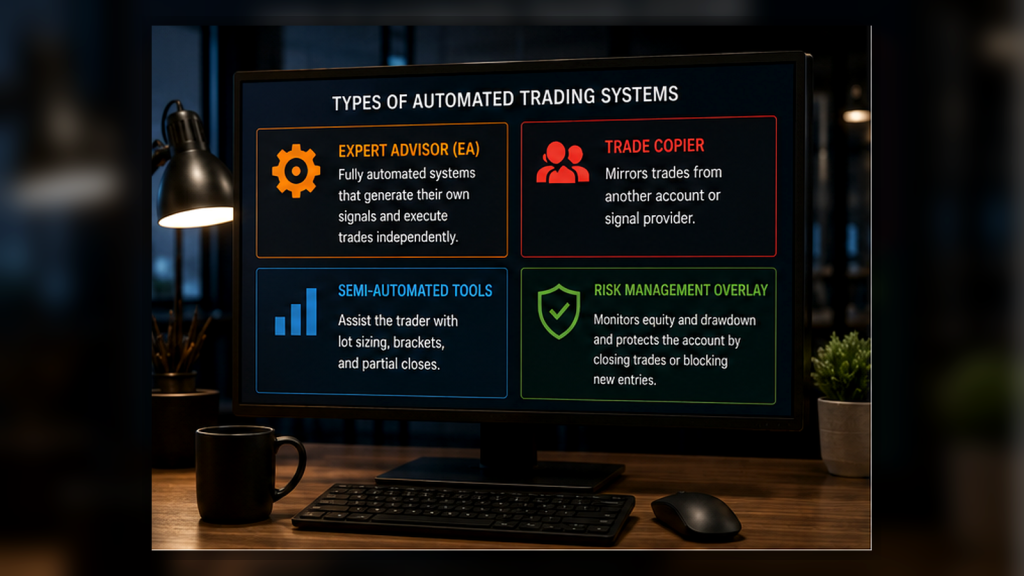
Expert Advisor (EA)
An EA is a fully automated script — usually built for MetaTrader — that opens, manages, and closes trades based on coded logic without any manual input. When most traders talk about a forex bot or gold bot, this is what they mean. It generates its own signals and executes independently.
Trade Copier
A trade copier mirrors positions from one account or signal provider onto another. It does not generate its own strategy. Most prop firms treat copy trading as outsourced risk, which places it in a different compliance category from a self-contained EA — even when the on-screen execution looks identical.
Semi-Automated Execution Tool
This is a script that assists a human trader without making entry or exit decisions independently: auto lot-sizing, bracket placement, and partial close tools fall here. Prop firms generally view these more favourably because the human remains in control of the trading decision.
Risk Manager or Drawdown Protector
A monitoring layer that watches equity and floating loss, then closes trades or blocks new entries when limits are approached. This type of tool is often specifically encouraged by prop firms because it directly addresses their primary concern: drawdown control on the funded account.
What Prop Firms Are Actually Evaluating in 2026
Prop firms do not grade bots on profit alone. A funded account is the firm’s capital, and the firm needs confidence that the trading behavior behind the results is realistic, repeatable, and not exploiting the platform itself.
That is why a bot can be net profitable and still fail prop firm compliance. Overleveraging on a winning streak, using a shared copy trading source, sending an abnormal number of order modifications per minute — these can all violate prop firm terms even while the equity curve looks positive.
EA policies across different prop firms converge on a similar set of concerns, even when the exact wording varies.
Drawdown Is Tracked on Floating Loss, Not Just Closed Trades
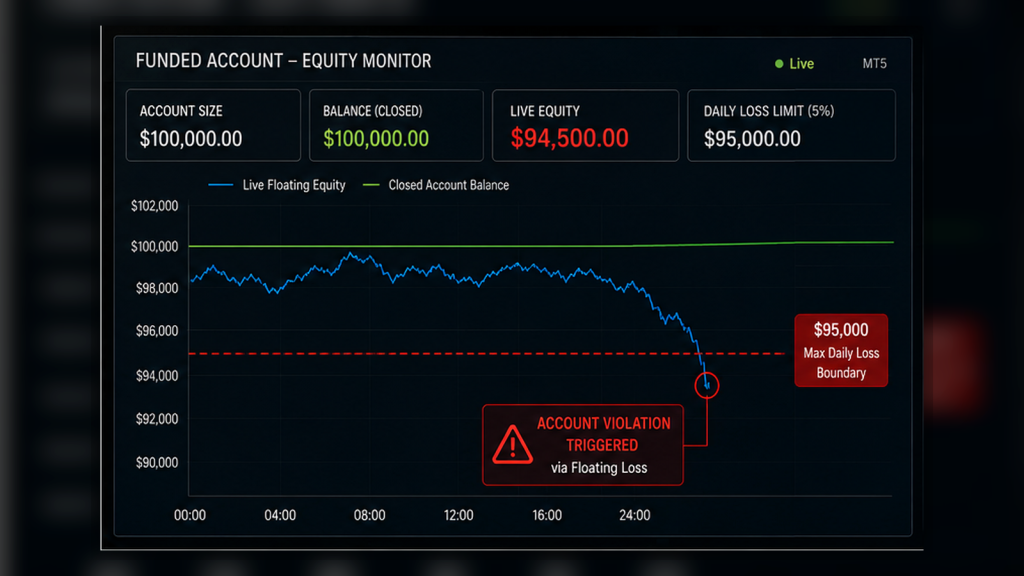
Most prop firm systems calculate drawdown on unrealized equity in real time. A bot that only monitors closed P/L can blow through a daily drawdown limit while a position is still open. If the EA is not reading floating equity, it has no early warning before the prop firm flags the funded account.
Copy Trading Is Treated as Outsourced Risk
Mirroring trades from another trader, a public signal channel, or a shared EA setup is one of the most widely restricted behaviors on prop firms. If you are copying someone else’s trades, the prop firm can no longer verify that you are the one making the risk decisions — which is the basis of the entire funded arrangement.
Third-Party EAs Create Duplication Concerns
If hundreds of funded traders are running the same publicly available bot, prop firms worry about correlated drawdowns across their books. Some firms require written approval before a third-party EA can be used on a funded account. Others track usage patterns and flag accounts running identical logic simultaneously.
Server Hyperactivity Looks Exploitative
Excessive order modifications, rapid-fire scalping loops, and unusually high request volumes can look less like trading and more like an attempt to game platform execution. Prop firms monitor this behavior separately from whether individual trades on the funded account were profitable.
The rule that catches the most traders is strategy consistency. Passing a prop firm challenge with conservative manual trades on EUR/USD, then switching to an aggressive XAUUSD gold bot once the account is funded, is one of the most common ways prop firm accounts get flagged after the evaluation phase.
Changing that pattern reads as rule evasion even if no single trade breaks a stated limit.
For a detailed breakdown of how consistency affects funded trading, BabyPips’ guide to prop trading accounts covers what firms actually look for beyond simple profitability.
Strategies Most Likely to Get a Bot Flagged
Some strategies appear on restricted lists frequently enough across prop firms that they are worth treating as high-risk categories, regardless of how profitable they have been in testing.
HFT and tick scalping. Ultra-fast, high-volume execution that most prop firms classify as unrealistic or exploitative. Even when profitable, this style draws scrutiny on funded accounts because it does not reflect genuine market participation at scale.
The distinction between standard algorithmic trading and HFT is important here. Investopedia’s explanation of high-frequency trading clarifies why institutions and regulators treat it as its own category, separate from routine automated forex or commodity trading.
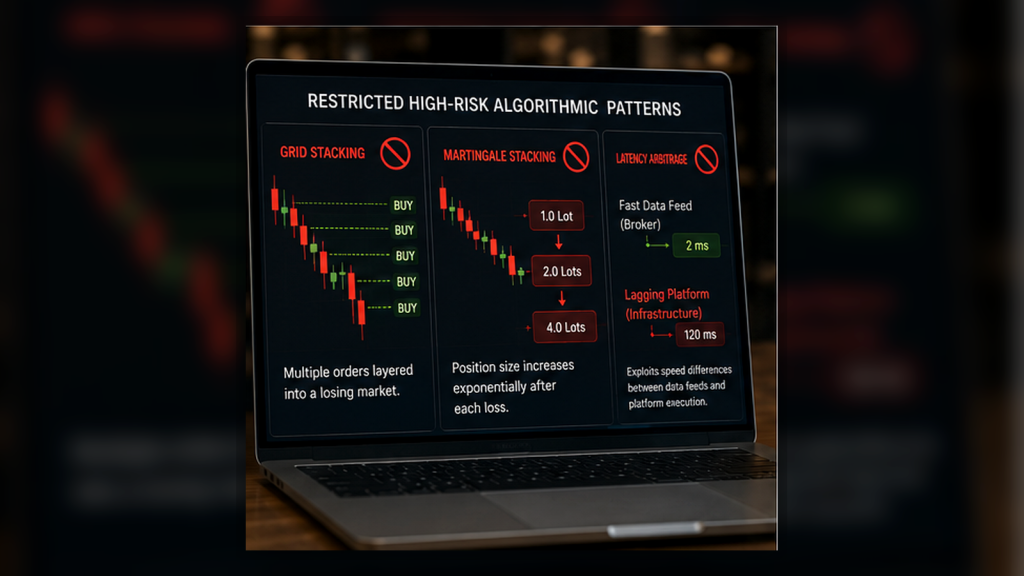
Latency arbitrage. Exploiting the delay between a price feed and execution targets the prop firm’s infrastructure rather than the market. Firms detect this from order timestamps alone, and it is one of the fastest ways to lose a funded account.
Grid trading. Opening a ladder of orders at set price intervals. Some prop firms prohibit it outright because it can stack exposure quickly and produce order patterns in risk monitoring systems that look unusual even when each trade is small.
Martingale and recovery systems. Not explicitly banned everywhere, but doubling down after losses builds floating drawdown fast enough that it frequently breaches the prop firm’s daily or maximum drawdown limits before any recovery takes place.
Group or multi-account hedging. Taking opposing positions across linked accounts. Each account may look compliant individually, but prop firms can see cross-account patterns and treat coordinated setups as abuse — even when not a single account has broken a stated rule.
Hidden stop-loss methods. Managing risk through code rather than a visible, platform-level stop. If the prop firm requires risk controls to appear in the trading platform, a programmatic stop that exists only in the EA’s code does not satisfy that requirement — even if it functions correctly.
The James Trading Prop Firm Option
Most prop firm-ready bots on the market are either too aggressive for daily drawdown limits or too passive to hit the profit targets required to pass a challenge. The gap is usually in the settings, not the strategy itself.
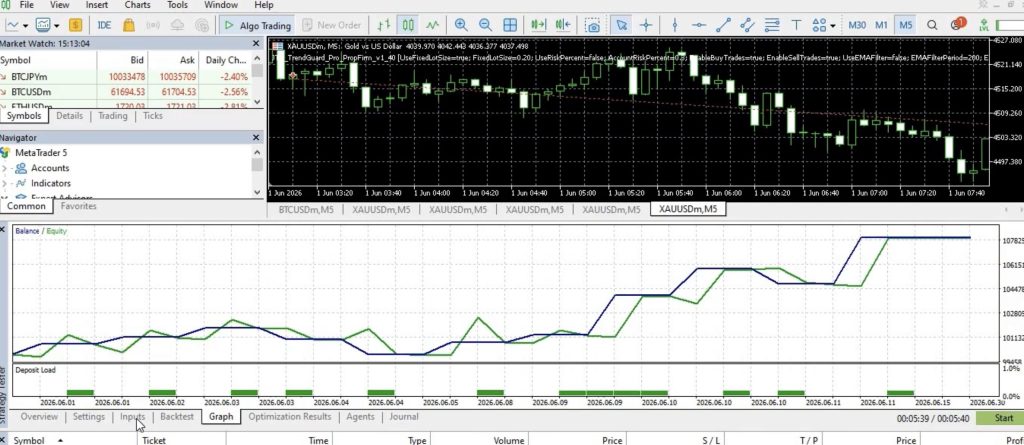
Here at James Trading Strategies, we have built a new automated system designed specifically to operate inside the standard parameters most prop firms use. The standard prop firm challenge requires a trader to hit a minimum of 3% profit while staying within a 3% daily drawdown limit.
That is a narrow band — and most manual traders either overtrade to chase the target or hold back so much that they cannot generate enough return within the challenge window.
Our system was tracked on a live account from June 1st to June 30th, 2026. Over those 30 days, it achieved the 3% profit target while staying within the 3% daily drawdown limit throughout the entire period.
What this live result demonstrates is that the logic can operate within the constraints most prop firms set, consistently, without requiring you to manually monitor every position.
The system is new, prop-firm-enabled, and built for traders who want automated execution that respects the rules — not one that bends them until the funded account gets flagged.
Click here to learn more about the James Trading Prop Firm system.
Prop Firm Rules in Practice: FTMO, The5ers, and FundedNext
Prop firm EA policies change periodically, so always check the current rules page before deploying anything. The table below shows how three widely used prop firms currently approach automated trading compliance on funded accounts.
| Prop Firm | EA Policy Summary |
| FTMO | Allows discretionary, algorithmic, and EA trading. Flags third-party EA duplication, capital allocation violations, server hyperactivity, and strategies that are not replicable under real market conditions. |
| The5ers | Permits EAs but prohibits copied signals, tick scalping, latency, reverse arbitrage, HFT, and stealth stop-losses. Third-party software may require prior written approval before use on a funded account. |
| FundedNext | Does not generally restrict strategy types, including EAs and martingale. Prohibits strategy switching after the challenge, copy trading from external sources, cross-account hedging, arbitrage, tick scalping, grid trading, HFT, and excessive risk behavior. |
The common thread across all three: the prop firm evaluates whether your behavior in the challenge predicts your behavior when it is their money. Anything that obscures, changes, or externalizes that behavior creates a compliance problem — whether or not any individual trade broke a stated rule.
What to Confirm Before Deploying a Bot on a Prop Firm
Three things need to be confirmed before placing any automated system on a prop firm challenge or funded account. Miss any one of them, and you are assuming compliance rather than verifying it.
Account and broker structure. Check whether the account runs in hedging or netting mode. On a netting prop firm account, a sell placed against an open buy closes the buy automatically rather than creating a separate hedge.
Confirm whether FIFO rules apply to your broker and jurisdiction. If you run an EA, verify it was built for your account’s position accounting mode — an EA designed for hedging accounts can close trades it was not programmed to close on a netting-mode prop firm account.
MetaTrader 5’s platform documentation covers account modes clearly. US traders should also review NFA Compliance Rule 2-43b, which restricts same-account hedging on regulated forex accounts.
Calculate the full cost before opening. Every recovery or directional reversal position doubles the cost structure. Add spread on both entries, estimated swap for the expected hold duration, slippage range, and margin impact before placing any order. A bot that costs more to maintain than the risk it controls is not risk management — it is expensive indecision with open positions attached.
Define the exit condition before the position opens. Write down the specific trigger that closes the bot’s positions: a price level, the passing of a news event, an equity threshold, or a time limit. If that exit condition is not defined before the trade opens, there is no structure — just a floating loss waiting for a decision.
Risk Controls Every Prop Firm Bot Should Have
A bot that looks compliant on paper still needs built-in guardrails to stay compliant in live conditions. These are not optional extras — they are what separates a prop firm-ready system from one that looks fine until market conditions shift.
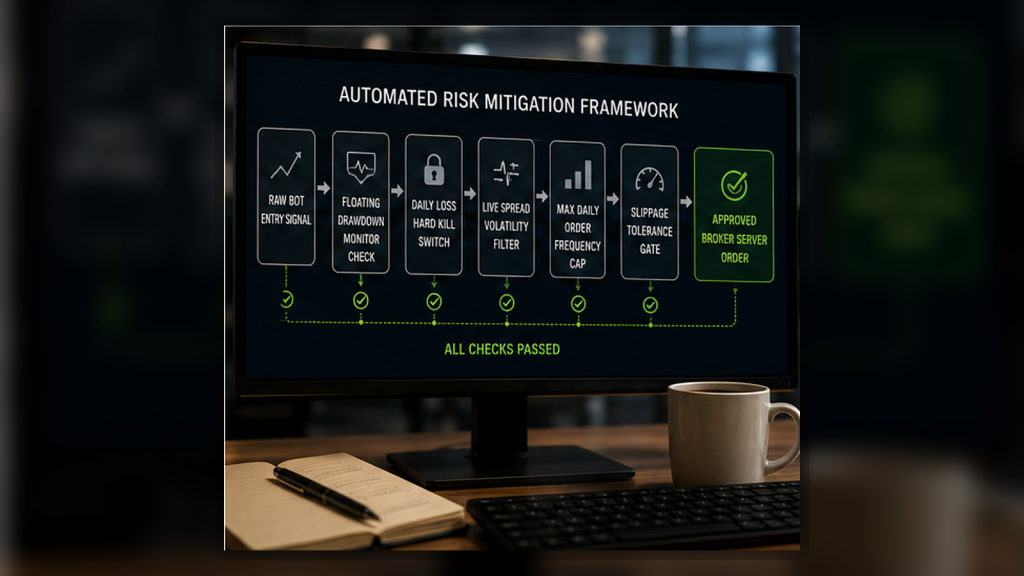
Daily loss kill switch. Stops all trading automatically once the day’s loss limit is approached, without relying on you to notice in time. Most prop firm violations happen because a bot kept running after a daily drawdown limit was already close to being breached.
Floating drawdown monitor. Tracks open-position exposure in real time. Prop firms evaluate unrealized loss, not just closed P/L. If the bot is not reading floating equity, it is measuring compliance against the wrong number.
Spread filter. Pauses trading during spread spikes around news releases, rollover periods, or thin liquidity windows. For prop firm accounts running gold (XAUUSD), this is especially important — gold spreads can widen significantly around major economic releases.
Slippage filter. Blocks entries when the filled price deviates too far from the expected price. A single severe slippage event on a large position can push floating drawdown past the daily limit on a prop-firm-funded account without the bot flagging it.
Max trades per day cap. Limits order frequency to avoid both overtrading and the appearance of server hyperactivity in the prop firm’s monitoring system.
News and volatility filter. Reduces exposure around high-impact economic releases. The risk during news is not only to position profit — it is to the consistency of execution that prop firms use to evaluate whether the trading behavior on the funded account is genuine.
Common Mistakes That Get Prop Firm Accounts Flagged
Assuming “EAs allowed” covers every EA. Most prop firms permit algorithmic trading in principle but restrict specific behaviors within it. “Allowed” applies to the approach. It does not automatically apply to whatever logic the EA uses.
Running a public third-party bot without checking for duplication. If a bot is widely available and many funded traders are running identical setups, the prop firm may flag the pattern without any single account having broken a stated rule.
Tracking closed P/L instead of floating equity. The prop firm’s system is watching unrealized loss. If the bot is not, there is no early warning before a drawdown limit is breached.
Passing the challenge with one approach and switching after funding. The challenge phase is designed to predict funded behavior. Any significant shift in how the bot trades after the funded account goes live — different pair, different lot sizing, different hold time — creates a consistency gap the prop firm can treat as evasion.
Running a gold bot through news events with no volatility filter. Gold is one of the most volatile instruments around major releases. Prop firm accounts using gold bots without news protection fail drawdown limits at a higher rate than most other setups.
Treating a clean backtest as proof of compliance. A backtest shows profitability under historical conditions. It does not show how the bot behaves during a spread spike, a slippage event, or an unexpectedly volatile session — the exact moments that determine whether a prop firm account stays within its limits.
Frequently Asked Questions
Are trading bots allowed on prop firms in 2026?
Yes, most prop firms allow trading bots, EAs, and algorithmic trading systems. The bot has to operate within that firm’s current rules on drawdown, order frequency, strategy type, and consistency — not a general assumption about what is permitted.
Can I use a gold bot on a prop firm account?
Most prop firms allow it, but gold (XAUUSD) bots need tighter risk controls than most currency pairs. Gold spreads widen quickly during high-impact releases; slippage is less predictable, and floating drawdown can build fast. A gold bot without a spread filter and a floating drawdown monitor carries significant risk on any prop firm-funded account.
What happens if a prop firm catches a banned EA on my account?
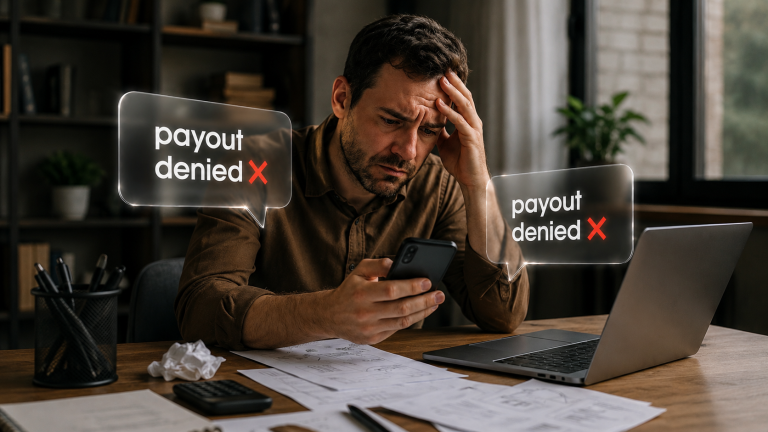
The outcome depends on the firm and the severity. Most prop firms will deny a payout, close the funded account, or ban the account holder from future challenges. Some firms issue a warning first. Others do not.
Can I use a trade copier on a prop firm?
Only if the firm explicitly permits it and the accounts involved are entirely your own. Copying trades from another person, a signal channel, or a group setup is one of the most commonly restricted behaviors across funded programs.
Are martingale bots allowed on prop firms?
It depends on the firm. Even where martingale is not explicitly prohibited, the strategy tends to fail prop firm accounts anyway — the floating drawdown during a loss sequence frequently breaches daily or maximum drawdown limits before any recovery can happen.
What is the most common reason a bot fails a prop firm challenge?
Floating drawdown. Most bots track closed P/L, but most prop firms measure drawdown on unrealized equity in real time. The bot holds a position open; the market moves against it; a floating loss builds past the daily limit — and the funded account is flagged before the losing trade even closes.
What This Means for You
Prop firm trading is not about finding a profitable bot. It is about finding a bot that can stay profitable inside specific rules, consistently, over a sustained period.
The challenge phase exists to show the prop firm how the account behaves under risk. The funded stage is where that behavior has to hold. Any bot that relies on restricted strategies, ignores floating drawdown, or shifts approach after funding is going to run into problems eventually — regardless of how the backtest looks.
Get clear on the rules of the specific prop firm you are targeting before deploying anything. Verify whether the bot’s logic touches any restricted category. Source or build a system with proper risk controls built in from the start, not added after the first violation.
And if you are running a gold bot on a prop firm account, make sure it has spread and volatility protection for actual market conditions.
Automation can remove emotion from execution. It cannot remove risk from the market. That responsibility stays with you.
To learn more about structured automated trading systems, join the James Trading University Telegram community: James The Trader Channel
| Risk Disclaimer Trading forex, gold, and crypto — including on prop firm or funded program accounts — carries a significant risk of loss and is not suitable for all participants. Live tracking results mentioned in this post reflect one month of live performance and are not indicative of future results. Prop firm rules, drawdown limits, and EA policies change frequently; always verify current requirements directly with the firm before deploying any automated system. Only allocate capital you can afford to lose. James Trading University does not provide personalized financial advice. |