

Simple definition:
No-code trading is the use of visual blocks, menus or plain-language rules to create trading alerts, backtests or automated order instructions without writing software code. It can also execute predefined conditions.
Can a No-code builder automate a Forex strategy?
Yes, no-code trading can automate a Forex or Gold strategy without writing a single line of code. The condition is that your setup must be expressible as objective rules before automation is even on the table.
For example, the moment you type ‘buy when momentum is strong’ into a visual strategy builder and press Run, you find the real obstacle in no-code trading: the phrase has no executable meaning.
The builder cannot decide what strong looks like. It cannot measure momentum unless you tell it which indicator, which value, and which comparison to use. Until those questions are answered in numbers and conditions, the setup stays in your head, not in the system.
Strategy first, automation second. That sequence applies regardless of which platform you choose or which market you trade.
Key Takeaways
- The difference between a tradable idea and an objective rule that software can actually execute
- Which parts of a Forex or XAUUSD strategy can be automated, and which decisions stay under human control
- A step-by-step process for building a no-code trading bot from rule definition to a limited live rollout
- How to model spread, slippage, commissions and execution delays in backtesting
- The acceptance checks to complete during paper trading and forward testing
- The hard risk limits, kill switches and monitoring rules required before real capital is exposed
What No-code trading can Automate.
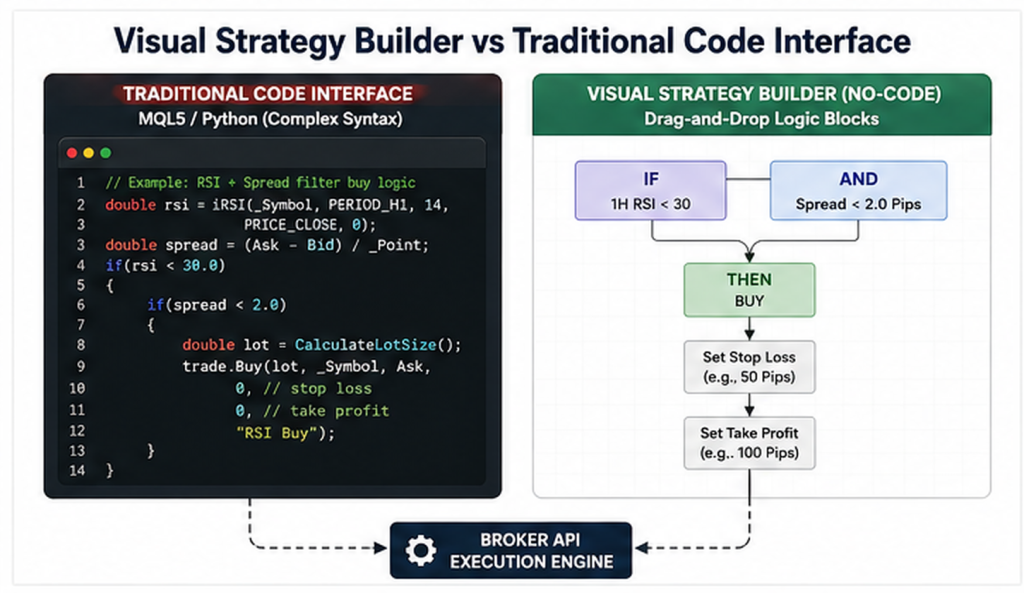
Visual strategy builders, plain-language platforms like Capitalise.ai (acquired by Kraken in August 2025 and being integrated into Kraken Pro), and TradingView’s strategy tester all work by converting your conditions into executable code on the backend. You interact with menus, dropdowns, and visual blocks. The underlying logic is still algorithmic.
The practical difference from traditional algorithmic trading is where the translation happens. In a coded system, you write the logic yourself in Python, MQL5, or Pine Script. In a no-code trading system, the platform handles that translation based on your inputs. The strategy logic is identical in both cases — only the interface differs.
No-code removes the programming requirement, not the need for precise rules, reliable data, realistic testing and active monitoring.
How no-code trading differs from traditional algorithmic trading
In traditional algo trading, you write, debug, and maintain code. A logic error can produce behaviour that is difficult to trace. With a no-code trading system, the platform handles the translation, so your time goes into strategy definition and testing rather than syntax. The tradeoff: the platform’s interpretation may not match your intent, especially for complex or multi-leg setups.
Alerts, backtests, semi-automation and full automation
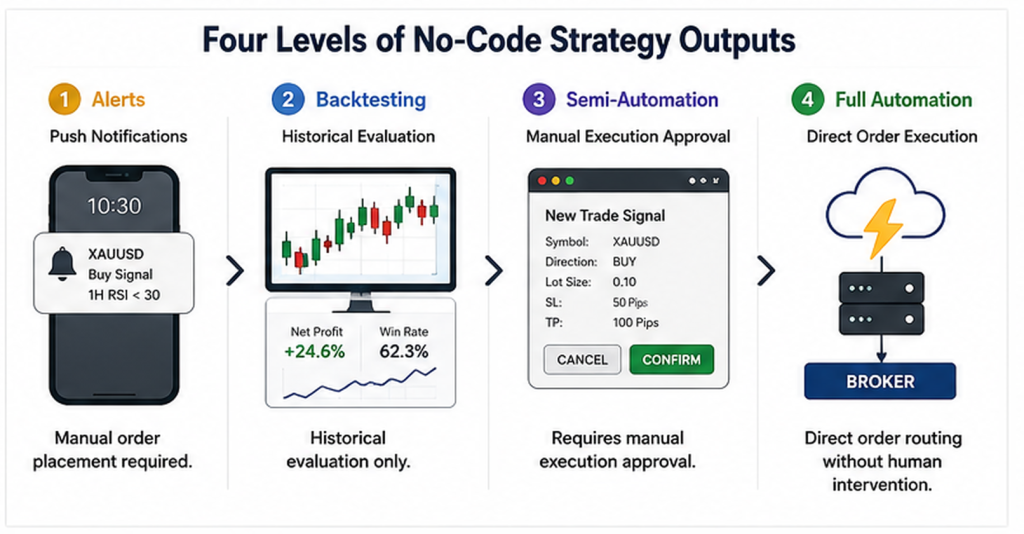
Most no-code trading platforms support more than one output level, but not necessarily all four. Alerts notify you when a condition is met but leave order placement to you. Backtests simulate how your rules would have behaved on historical data. Semi-automation routes a signal to an order screen for manual confirmation. Full automation places orders without any human input when conditions are met. A no-code trading tool may support backtesting without supporting live execution. Confirm which output levels apply to your broker and market before building.
Key terms you need before building
- Backtesting applies your rules to historical price data to estimate past performance.
- Forward testing runs the same logic in real-time demo conditions to check whether actual execution, costs, and signals match what the backtest showed.
- Slippage is the difference between the expected fill price and the actual one.
- Max drawdown is the largest equity drop from a peak to a subsequent low.
- A kill switch stops all trading immediately — manually triggered or automatically activated when a defined loss limit is breached.
Which Parts of a Trading Strategy Must Become Objective Rules?
This is where no-code trading breaks down for most people. The tool is not the obstacle. The setup is. Before opening any builder, every input in your strategy needs an answer that can be evaluated as true or false at any specific point in time.
Think about what that means for XAUUSD. ‘Buy when the market looks strong on the 4H chart’ contains four undefined terms: strong, looks, 4H, and chart. A no-code trading system requires you to replace that with something measurable: ‘Close crosses above the 20-period EMA on the 4H XAUUSD chart during the 07:00–10:00 UTC window, with ATR above its 14-period average, and spread below 2.0 pips at entry.’ The first version is a thought. The second is a rule.
For a higher-timeframe approach, the false breakout strategy rules show how a chart observation translates into explicit, testable entry conditions — the exact type of conversion this section covers.
| Discretionary phrase | Objective rule (example) | Required data | Failure or edge case |
|---|---|---|---|
| ‘Buy a strong breakout’ | Close above the prior 20-bar high by 1x ATR on the 4H chart | OHLC data, ATR, timeframe | Gap open, spread spike, or signal after session close |
| ‘Avoid bad market conditions’ | No entry when the spread exceeds 2.5 pips, or the ATR is above 150% of the average | Bid/ask spread, ATR, session time | Missing or delayed data feed |
| ‘Risk small’ | 1% of equity with a hard maximum of 2.0 lots regardless of formula | Account equity, stop distance, symbol contract | Incorrect contract size at execution |
| ‘Trade only good sessions’ | Entry allowed only between 07:00–10:00 UTC and 13:00–16:00 UTC | Server time, session schedule | Holiday hours or DST shifts |
Start with one setup and one market
Limit the first build to a single instrument, timeframe, and setup. One market, one session window, one chart timeframe. Adding complexity before a tested foundation exists creates hidden exceptions that only surface when real capital is at stake.
Define the market and timeframe context
Specify the symbol, the session window (London open: 07:00–10:00 UTC), the chart timeframe, any higher-timeframe filter used for directional bias, and the conditions that suspend trading: major news, rollover, thin liquidity before or after market close.
Turn the entry into Boolean conditions
Every filter must be answerable as true or false at any bar. ‘RSI below 32 on the 1H chart AND price above the 4H 50 EMA AND spread below 2 pips AND entry only between 07:00–10:00 UTC’ is executable. ‘Momentum looks bullish’ is not. Write each condition as a specific comparison with a defined value and time window. If you cannot write it that way, it is not ready to automate.
Write exits and invalidation rules before profit targets
Define the initial stop placement, take-profit logic, time-based exit rules, and conditions that cancel an unfilled order — before setting a single profit target. Exit rules are underdefined more often than entries, and they produce more live losses because of it.
Make position sizing and exposure explicit
State risk per trade as a percentage or fixed cash value, add a hard lot-size ceiling regardless of formula output, and define the maximum number of simultaneous open positions. If two correlated setups can run at the same time, that combined exposure must be capped explicitly.
Identify the discretionary rules that cannot yet be automated
Every setup has filters that live in your visual judgment: chart formations, context reads, session behaviour. List these separately rather than hiding them inside vague wording. These are either refined into objective conditions in a future build or kept as manual oversight requirements.
A rule that cannot be measured consistently cannot be tested consistently. Do not automate subjective exceptions by guessing.
How Do Visual Strategy Builders Turn Rules Into Automated Actions?
A no-code trading platform converts your inputs into a decision chain: if these conditions are true, take this action. The chain reads market data — price bars, indicator values, session time, account equity, spread — evaluates your conditions, and produces an output: a logged test result, an alert, or a live order instruction to the broker.
Inputs, conditions and actions
Inputs are the data the system reads. Conditions are the combinations that must simultaneously be true. Actions are what the platform does when conditions are met: records a backtest trade, sends a notification, or routes an order. A signal that looks correct on the chart may not trigger the expected action if one input was missing or delayed at that specific bar — a gap the no-code trading interface does not always surface clearly.
The data-to-broker execution chain
Between a condition becoming true and an order reaching your broker, several things can fail: data latency, platform processing time, API connectivity, broker-side routing, and order rejection. Each adds potential slippage, delay, or a missed entry. A no-code trading system that works cleanly in a backtest may miss fills in live execution because the backtest assumed instantaneous, zero-cost order routing.
What to compare before choosing a builder
The question is not which platform looks most polished. It is whether the tool supports your broker, your instruments, your required output level, and your testing standards — specifically bid/ask data, spread modelling, and exportable decision logs. A backtest built on close-price data without spread is not a meaningful test.
| Capability | Why it matters | Question to ask | Red flag |
|---|---|---|---|
| Forex/XAUUSD data support | Rules need correct prices and session specs | Does the tool use bid/ask data matching the broker’s symbol? | Backtests use only generic close prices |
| Backtesting cost controls | Spread and slippage assumptions change all results | Can you set spread, commission, slippage and order timing? | No visibility into test assumptions |
| Paper trading/demo routing | Forward testing exposes live execution gaps | Can the same rule set run unchanged in demo mode? | Separate logic for test and live |
| Risk controls | Hard limits reduce damage from logic errors | Can you cap size, daily loss, exposure and frequency? | Only stop-loss settings are available |
| Logs and monitoring | You need a record of decisions and errors | Are rule triggers and order responses timestamped? | No exportable decision log |
| Kill switch | Unsafe conditions require an immediate stop | Can trading be disabled automatically and manually? | No emergency stop available |
| Broker/API connectivity | Live execution reliability depends on this | How are disconnects and rejected orders handled? | Orders retry without a limit |
How Do You Build a No-Code Trading Bot Step by Step?
Eight steps form the production workflow. Each step produces a document, a calculation, or a confirmed result that feeds the next one. Compressing this by skipping steps introduces failures that do not surface until real capital is involved.
For how session context and timeframe filtering work in practice on XAUUSD, the XAUUSD structure and timeframe rules in the Gold scalping guide show how a chart-based approach becomes a structured rule set.
The James Trading University Gold EA follows this same build sequence — precise entry conditions, tested risk parameters, defined session filters, and forward-tested execution behavior before any live capital is used. No-code trading built this way is automation as execution discipline, not a shortcut around preparation.

Step 1: Choose one setup, instrument and timeframe
Document the setup hypothesis: the market condition you expect to exploit, on which instrument, during which session, on which chart timeframe. One setup only. Not a collection of ideas that happen to share the same timeframe.
Step 2: Write the entry as testable conditions
Convert every entry filter into measurable inputs, comparisons, lookback periods, and timing rules. Write them in plain language first, then verify each can be answered true or false at any specific bar in historical data. If a filter cannot be answered that way, it is not a rule yet.
Step 3: Define stop, target and trade invalidation
Set the initial stop distance, take-profit logic, time-based exit rules, and what happens when data is missing at the time of a signal. Define what closes the trade before the trade ever opens. Exit logic written in advance prevents the ad-hoc decisions that create the largest live losses.
Step 4: Calculate position size from risk
Use account equity, stop distance, and instrument value to produce a lot size. Then add a hard-size ceiling — a fixed maximum that applies regardless of what the formula outputs. This ceiling is not optional. It is the actual risk control that protects against data errors and extreme spread conditions.
Step 5: Add session, spread and volatility filters
Block entries during rollover windows, spread spikes above your defined threshold, abnormal ATR expansion, and high-impact news events that the original setup was not designed to trade through. These filters define when the strategy applies. Without them, the system will attempt entries in conditions it was never tested against.
Step 6: Configure the backtest assumptions
Set the data period, bid/ask handling method, commission per trade, slippage range, and order timing method. Run a short initial test first to verify the platform is logging conditions and fills as expected. Bad assumptions in the configuration invalidate every result the full test produces.
Step 7: Run paper trading with identical rules
Run the unchanged rule set in real-time demo conditions and log every difference between expected and actual behavior: delayed fills, missed signals, incorrect costs, platform errors. Do not modify the rules during this stage — record proposed changes for a future version. The purpose is to see what the system does, not what you intended it to do.
Step 8: Use a limited live rollout with a kill switch
Only after prewritten acceptance criteria are met, begin with the smallest practical lot exposure. Monitor every session actively. Have the kill switch ready, tested, and accessible before the first live trade opens. A no-code trading system that has not been monitored in live conditions is not ready for real capital, regardless of backtest performance.
Trading involves risk of loss. Past performance does not guarantee future results. Only risk capital you can afford to lose.
How Should You Backtest a No-Code Trading Strategy?
Backtesting is a filter, not proof that a no-code trading system will survive live markets. If the data period covers one market regime, the parameter values are fitted to that regime and nowhere else. If spread and slippage are excluded, the profit figures in the equity curve are not real.
Published research on backtest overfitting — including Harvey and Liu’s work on data-snooping bias and multiple testing available through SSRN — consistently shows that strategies optimized repeatedly on the same historical period perform significantly worse on unseen data. The more parameters adjusted in search of a better-looking equity curve, the less the result tells you about what the strategy will actually do in live conditions.
Use data that matches the market and timeframe
Check the timezone applied to the bars, whether session boundaries match your actual trading window, whether the bid/ask spread is captured or only the close prices, and whether the XAUUSD or Forex symbol matches your broker’s contract specification. A symbol mismatch can produce results that look accurate in the backtest but cannot be replicated with your actual broker.
Model spread, commission, slippage and delay
A strategy with a 2.0 pip average win that carries a 1.0 pip spread and 0.5 pip slippage per round trip has a net average of 1.0 pip before swap — fundamentally different from the equity curve that modelled zero costs. Model every cost from the first test. Do not run a clean version first to see if the strategy looks promising.
For a practical breakdown of how execution costs compound over time in automated trading, the execution costs in automated trading section in the BTC scalping bot guide applies this math to a real automated setup with specific numbers.
Separate development data from validation data
Use the first portion of your data period to develop and test rules (in-sample), then validate the rules on a later period that the rules never saw (out-of-sample). If results collapse on the unseen period, the strategy was fitted to the past rather than to actual market behavior. An in-sample pass with an out-of-sample fail is a rejection signal, not an optimization problem.
Measure risk, not just net profit
The numbers that matter are max drawdown, the longest losing sequence, total trade count, average trade after all costs, and sensitivity to small parameter changes. A strategy that produces strong results only with exact settings is almost certainly overfit. Use Investopedia’s drawdown definition as a baseline, then apply the firm’s specific calculation method for live funded accounts.
Write rejection criteria before reviewing results
Before running any test, write down the drawdown level, losing run length, or behavioral signal that would stop the project. If rejection criteria are not defined in advance, results get rationalized after the fact. This is how well-intentioned strategy testing turns into an expensive backtest loop.
Historical results are a filter, not proof that a bot will survive live markets.
| Test | Question answered | Useful evidence | Failure signal |
|---|---|---|---|
| Historical backtest | Did the stated rules behave as expected on past data? | Trade list, costs, drawdown, rule logs | Results depend on one short period or one parameter |
| Out-of-sample test | Does the logic retain similar behavior on unseen data? | Stable risk metrics and trade characteristics | Performance collapses outside the development data |
| Monte Carlo test | How sensitive is the system to trade order or execution variation? | Distribution of drawdown and outcome range | Small changes produce unacceptable loss |
| Sensitivity test | Is the setup stable around nearby parameter values? | Comparable results across a reasonable value range | One exact setting creates nearly all performance |
What Should You Verify During Paper Trading and Forward Testing?
A historical backtest cannot show what happens when data is delayed, when an order is rejected, or when the platform disconnects during an active trade. Paper trading surfaces these issues in live market conditions without real capital at risk. It also verifies whether the no-code trading system’s decision logic matches your written rules under real-time conditions — not just historical ones.
Forward testing definition: Testing in live or demo market conditions reveals real-time spread, slippage and execution delays that historical testing may miss.
Run the same rules without manual improvement
Don’t add filters during paper trading because a specific signal looks wrong. Log the proposed change for a future version and let the current rule set run as written. This is the only way to know what the system actually does. A rule set modified mid-test is a different system, not an improved one.
Compare expected and actual execution
For every signal, record the expected entry price, the actual fill, the expected spread, and any order errors. Differences between expected and actual behavior are the most valuable output that paper trading produces. A consistent 0.3 pip slippage that you did not model may feel minor until you account for it across hundreds of trades. BabyPips covers the basics of paper trading and what to record during a forward test.
Test failure and recovery scenarios
Simulate a platform disconnect, a data gap, and a manual kill-switch activation during the paper trading window. These events are guaranteed to occur in live trading at some point. Knowing how the system responds before real capital is involved changes how you configure the monitoring rules.
Set acceptance criteria and a minimum evidence window
Define what passing looks like before the paper trading period starts: a minimum number of trades across varied conditions, signal accuracy above a defined threshold, costs within the tested range, and all risk controls triggering correctly. If success is defined after the results are seen, the criteria describe the results, not the test.
| Check | Evidence to save | Pass condition | Action if failed |
|---|---|---|---|
| Signal accuracy | Timestamped rule log and chart snapshot at entry | Signals match written conditions exactly | Fix the logic and restart test from beginning |
| Order handling | Broker confirmations and platform error logs | No unexplained duplicates or missed orders | Disable live route and investigate the chain |
| Cost assumptions | Expected vs. actual spread and slippage per trade | Observed costs fall within the tested range | Retest with corrected cost inputs |
| Risk controls | Limit and kill-switch trigger events with timestamps | Controls trigger exactly as designed in all cases | Do not proceed to live use under any condition |
What Risk Controls Should Every No-Code Trading Bot Have Before Live Use?
Risk controls in a no-code trading setup are not features you add after the strategy is built. They are structural requirements that belong in the design from the first step. Every no-code trading system that runs with real capital needs all six of the following in place and tested before the first live order.
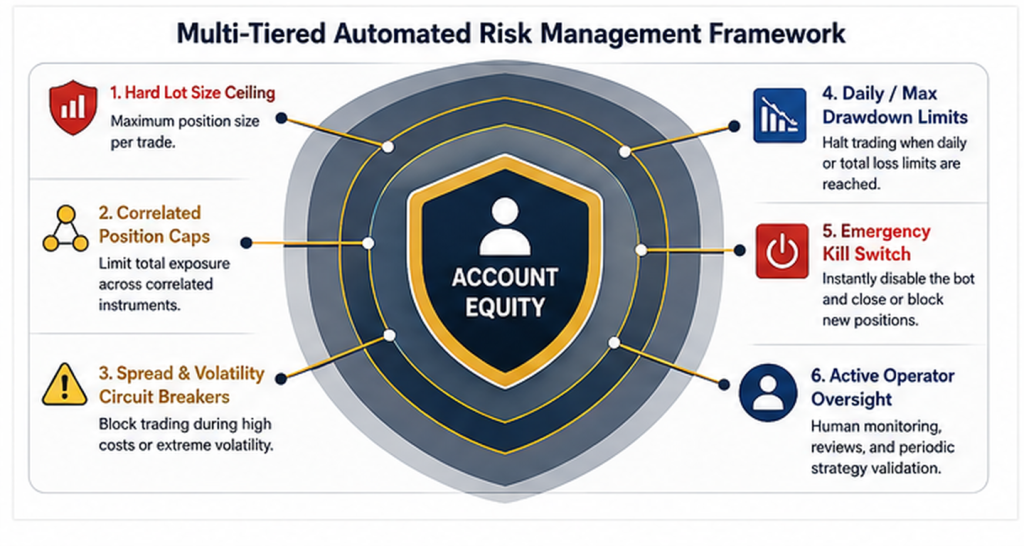
A hard maximum risk per trade
Cap both the percentage of equity at risk and the absolute lot or contract size. This ensures that a data error, incorrect equity calculation, or extreme spread cannot create a position the account cannot absorb. The ceiling applies regardless of what the formula outputs — that is the entire point of a hard limit.
Daily, weekly and maximum drawdown limits
Define the drawdown thresholds at which new entries stop, whether open positions are reduced, and what the restart condition requires after a pause. Drawdown limits do not prevent losses. They limit how much can accumulate before the system requires human review.
For position sizing and drawdown limits applied to small Forex accounts specifically, the Forex risk management for small accounts guide covers the 1% rule and how it scales as account equity grows.
Limits on simultaneous and correlated positions
A no-code trading system running three setups across XAUUSD, EURUSD, and GBPUSD during a strong dollar move is not running three independent strategies. It holds concentrated directional exposure across three positions simultaneously. Cap the number of open positions and the total correlated directional exposure as two separate limits.
Spread, volatility and session circuit breakers
Pause new entries when the spread exceeds a defined threshold, when the ATR expansion moves outside the tested range, during rollover windows, or when the session filter is closed. These controls protect against conditions the strategy was not designed or tested to handle — and reduce damage from unexpected news events that widen spreads sharply.
A manual and automatic kill switch
Define the conditions for a complete system stop: API failure, repeated order rejection, stale data feed, abnormal position size, or equity breach. Both manual and automatic triggers must be tested before live use, not just described in a document. A kill switch that has never been triggered in demo conditions is not a real kill switch.
Monitoring, alerts and restart rules
Assign responsibility for checking the system on a defined schedule. Specify which alerts require immediate action and which are informational. Define the conditions under which the system can restart after a controlled shutdown. A no-code trading bot with no monitoring plan is a running process with no operator.
Approved claims language: risk-managed system, structured trading framework, forward-tested approach, designed with drawdown control. None of these descriptions makes a system risk-free or unable to produce losses.
What Can No-Code Trading Not Solve for You?
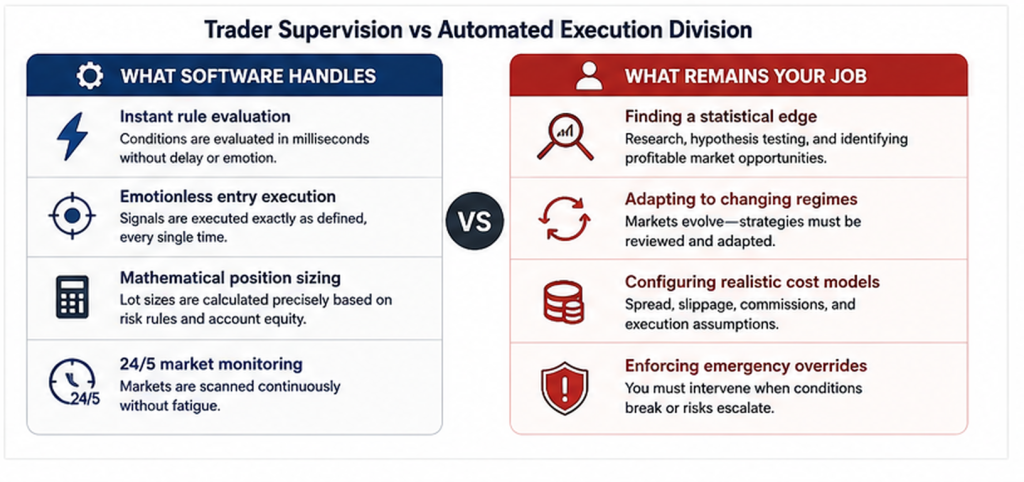
No-code trading removes the programming barrier. What it leaves entirely in your hands is every decision that determines whether the strategy deserves to run — and every condition that determines whether it should continue running.
Automation cannot create a trading edge
Execution consistency and positive expectancy are separate questions. A precisely defined rule can still be unprofitable. If the setup has no statistical edge in historical data, automating it produces consistent losses rather than inconsistent ones. The no-code trading builder does not improve the strategy. It just executes it with less hesitation.
Backtests can be overfit or based on weak data
Repeated optimization on the same historical period produces a strategy tuned to the past. This limitation applies to a visual drag-and-drop builder exactly as it applies to hand-coded Python — the interface does not change the math behind the overfitting problem.
Market regimes change
A system built and tested in a low-volatility ranging environment may behave differently when volatility expands, or a persistent trend develops. The rules have not changed. The conditions the rules were designed for have. A passing backtest in one regime does not guarantee relevance in the next.
Broker and API execution can change outcomes
Spread widening, latency changes, symbol mapping differences, API downtime, partial fills, and order rejection all affect live results in ways a no-code trading backtest cannot predict. Investopedia explains slippage clearly — and the mechanism applies equally whether the strategy was coded by hand or built in a visual builder.
Human oversight is still required
You need to monitor the system, maintain version records, review every incident, and retain authority to stop it. Automation removes some emotional execution mistakes from the process. It does not remove operator responsibility. A no-code trading system running unmonitored is not a managed strategy.
Trading forex, gold, and cryptocurrency involves significant risk of loss and is not suitable for all investors. The use of automated trading systems, copy trading, and Expert Advisors does not eliminate risk. Past performance is not indicative of future results. Market conditions, broker spreads, slippage, and system settings all affect outcomes. Only allocate capital you can afford to lose. James Trading University provides educational content only and does not constitute personalised financial or investment advice. Always consult a qualified financial adviser before making trading decisions.
Frequently Asked Questions About No-Code Trading
Can you automate trading without coding?
Yes. A no-code trading platform can convert objective entry, exit and risk rules into alerts, backtests or automated orders without any programming.
How do no-code trading platforms work?
They work by combining market data inputs with your defined conditions and produce an action when conditions are met.
Can you backtest a strategy without programming?
Yes, provided the no-code trading platform supports historical testing with correct data assumptions. The test is only useful when the data matches your broker’s specifications, and when spread, commission, slippage, and order timing are realistically modelled.
Is a no-code trading bot safe for beginners?
Easier to build does not mean safer to run. A beginner using no-code trading tools still needs to define clear monitoring rules and have a tested kill switch before going live.
Can no-code trading remove emotional decisions?
No-code trading automation can reduce inconsistent execution by following predefined rules without hesitation. The mechanical execution step is handled. Every decision that surrounds it still belongs to you.
When should you move from paper trading to live trading?
Try migrating after the system meets critical prewritten acceptance rules: signal accuracy, execution costs, risk controls triggering correctly, and a meaningful minimum number of paper trades completed across varied conditions.
Use Strategy First, Automation Second
The decision sequence is the same regardless of which no-code trading platform you choose or which market you target. Define entry, exit, and sizing rules as testable conditions. Test against historical data with realistic costs. Forward-test execution behavior in demo conditions. Install risk controls and a kill switch. Then — and only then — consider the smallest practical live exposure with active monitoring from the first session. No-code trading built this way is a system, not a shortcut.
☐ Are all entry, exit and sizing rules stated as objective, measurable conditions?
☐ Does the backtest model include spread, commission, slippage and out-of-sample validation?
☐ Did paper trading confirm signal accuracy, execution behavior and cost assumptions?
☐ Are risk controls, circuit breakers and the kill switch tested and confirmed?
☐ Is there a defined monitoring plan with clear restart conditions?
If any answer is no, that step is where the next session belongs — not in adding more features to the builder or switching to a new platform.
To see Automated trading on rule testing, execution verification, and risk controls, join the James Trading University Telegram community: James the Trader community.